
Table of Contents
At the Ohiradai hairpin, start your watch as Waseda’s Shinsaku Kudo goes by. Aoyama Gakuin’s Asahi Kuroda comes through 1 minute 57 seconds later. At Kowakien, 4.7 kilometres up the road, the gap is 1:02. Kudo has been climbing at about 3:41 per kilometre. Someone is gaining nearly a minute on him anyway. This happened on January 2, 2026. To understand why Japanese families keep watching this race through lunch, follow those two stopwatches.[1][2]
The 103rd Hakone Ekiden runs Saturday, January 2, 2027, from Tokyo to Hakone, and Sunday, January 3, back to Tokyo. Pick a runner, a bend or a single handover. Once you want to know how far apart two runners will be when they reach it, the next hour tends to take care of itself.[3]
Follow one sash from Tokyo to Lake Ashi
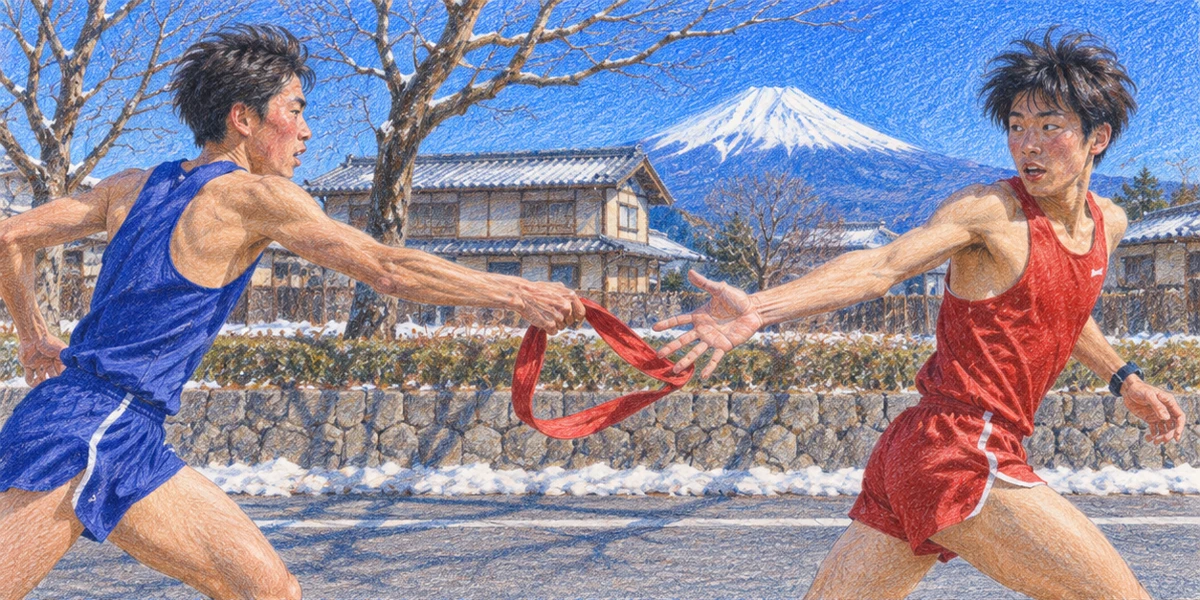
A marathoner covers 42.195km alone. An ekiden is a relay, and its organiser chooses the distance and number of legs. At Hakone each university assigns ten different men to carry a cloth sash called a tasuki. Five cover the outward 107.5km, five the return 109.6km. The lowest combined time over 217.1km wins. Imagine a relay in which your teammate takes roughly an hour to reach your outstretched hand.[4]
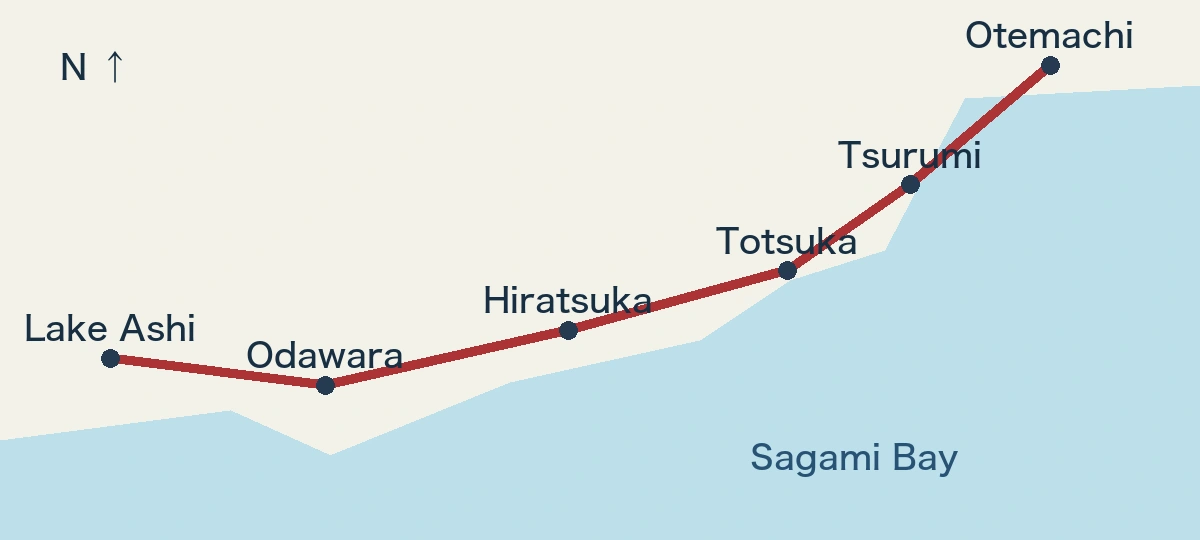
Outward from the upper right to the lake at left. The six places are in course order. Road shapes and distances are schematic.
| Between | January 2, towards Hakone | January 3, towards Tokyo |
|---|---|---|
| Otemachi and Tsurumi | Leg 1 · 21.3km | Leg 10 · 23.0km |
| Tsurumi and Totsuka | Leg 2 · 23.1km | Leg 9 · 23.1km |
| Totsuka and Hiratsuka | Leg 3 · 21.4km | Leg 8 · 21.4km |
| Hiratsuka and Odawara | Leg 4 · 20.9km | Leg 7 · 21.3km |
| Odawara and Lake Ashi | Leg 5 · 20.8km | Leg 6 · 20.8km |
In Otemachi watch the runners who would prefer someone else to lead. A pack offers shelter from the wind. Around Rokugo Bridge a move forces everyone to decide how much of that saved energy to spend. Tsurumi is where many teams put their ace on the road. Leg 2 takes them up Gontazaka and over another succession of rises in the closing kilometres. Count the people an ace passes, then check the price of those passes on the final approach to Totsuka.[4]
On leg 3 Sagami Bay opens up on the runners’ left. For the camera that means a seascape. For the athletes it means leaving the shelter of buildings. Look at the flags to see which way the wind blows. The fourth leg climbs gently late on. Twenty seconds saved there may let the climber keep the next runner in sight on the way into Hakone.[4]
What thirty minutes of climbing looks like on a hundred-metre clock
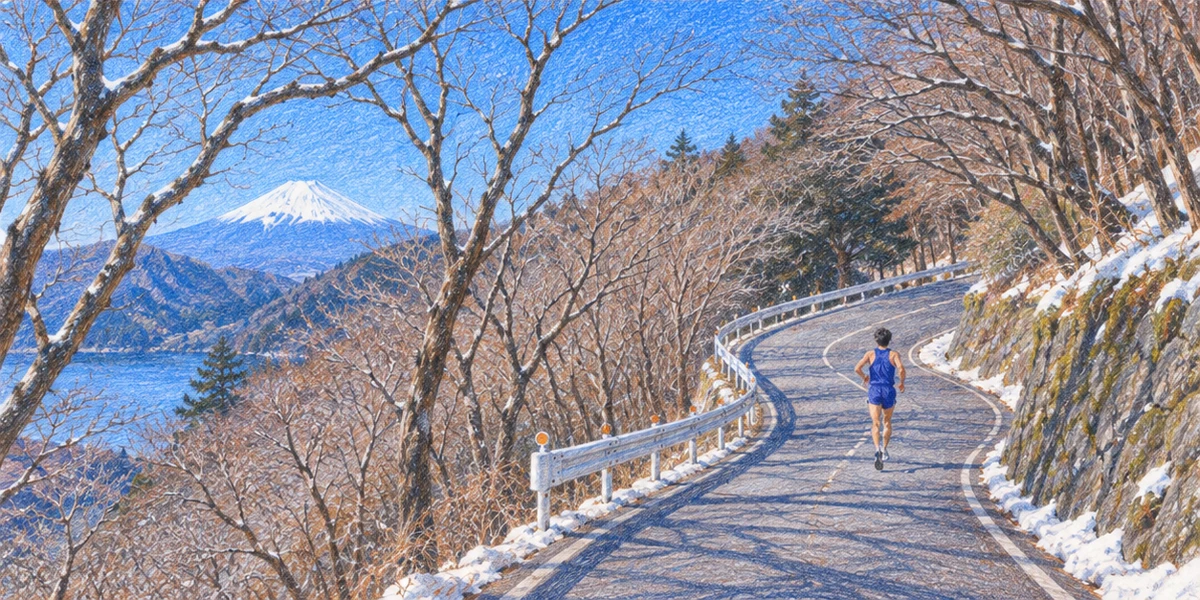
On leg 5 the athlete disappears around the bend. The climb continues for tens of minutes.
Kuroda covered the opening 3.5km from Odawara to Kanrei Domon in 10:34. That is 18.1 seconds per 100m, about 3:01/km. From Ohiradai to Kowakien he took 16:22 for 4.7km, 20.9 seconds per 100m, about 3:29/km. These are averages calculated from published checkpoints for the same man in the same race. A difference of about 2.8 seconds per hundred metres adds up to roughly 2:12 over 4.7km. Yet this was precisely where Kuroda took 55 seconds out of Kudo’s lead.[1]
Parts of the road around Ohiradai exceed an eight-percent gradient. Over 100 horizontal metres that means eight metres of ascent, nearly three floors of a building with three-metre storeys. The grade changes from bend to bend. From Ohiradai to Ashinoyu alone Kuroda climbed for 8.8km in 30 minutes 41 seconds. Leave the television to make lunch and come back half an hour later. He has been running uphill the whole time.[1]
Route 1 reaches roughly 874 metres above sea level at kilometre 16.2. There are 4.6km left. The runner who has learned to shorten his stride now has to descend to Lake Ashi. Kuroda finally caught Waseda beyond the summit, finishing with a leg record of 1:07:16. Stay for the descent.[4][2]
On the return, leg 6 starts with roughly four kilometres of climbing before the long, twisting downhill. Once out of the mountains the runner has to generate his own speed again for the last three kilometres. On January 2 watch what happens after the summit. On January 3 watch the feet when the downhill ends.[4]
In the first Hakone, the mountains were lit by torches
In 1917 two teams representing eastern and western Japan relayed from Kyoto’s Sanjo Bridge to Ueno in Tokyo. The roughly 516km course took 23 legs and three days of running through daylight and darkness. It demonstrated that a road race on this scale could actually be staged.[5]
Shiso Kanakuri had failed to finish the 1912 Olympic marathon in Stockholm. His ambition to develop runners who could compete abroad helped bring four schools to the line: Tokyo Higher Normal School (now the University of Tsukuba), Meiji, Waseda and Keio. Their first Hakone started at 1 p.m. on February 14, 1920. By the mountain stage it was dark. Local youths held torches, and runners accompanied the competitors through snow. Tokyo Higher Normal School won. Where we can now measure the gap between two athletes from a sofa, someone once had to stand with a flame just to show the way.[5]
War interrupted the race in 1941–42 and 1944–46. Roads used to transport military supplies could no longer be taken over by a relay. After racing resumed, Chuo put together six victories from 1959 through 1964. Nippon TV began live coverage in 1987. In the 2000s the climbs of Juntendo’s Masato Imai and Toyo’s Ryuji Kashiwabara helped make “mountain god” a familiar nickname. Compare their times with care: Kashiwabara ran a 23.4km fifth leg, today’s climbers 20.8km.[5][6][7][1]
At Tachikawa the tenth runner can decide January
Qualifying for 2027 took place on October 17, 2026. Everyone ran the same half marathon from the Ground Self-Defense Force base at Tachikawa, through town and into Showa Kinen Park. Nobody passed a sash. The ten fastest times at each university counted, and the ten fastest team totals qualified. The top ten finishers from the previous January already held automatic places.[8]
Toyo won qualifying in a combined 10:31:30. Its first finisher, Yu Miyazaki, ran 1:01:05 and its tenth, Yuta Seri, 1:04:06. At the cut Hosei posted 10:40:08 and Kokushikan 10:41:54. Spread over ten men, the gap was only 10.6 seconds per athlete. This is why teammates on the grass keep looking at their watches after their star crosses the line.[8]
The seeded universities are Aoyama Gakuin, Kokugakuin, Juntendo, Waseda, Chuo, Komazawa, Josai, Soka, Teikyo and Nihon. Joining them from Tachikawa are Toyo, Chuo Gakuin, Tokai, Senshu, Tokyo University of Agriculture, Yamanashi Gakuin, Daito Bunka, Kanagawa, Nippon Sport Science University and Hosei. Chuo and Chuo Gakuin wear different colours and got here by different routes.[8][6]
A 21st sash belongs to the Kanto Student Union team. For this edition each school placing 11th through 20th in qualifying gets a team slot. Six individual slots go to leading runners from schools placed 21st or lower, at most one per university. This composite team runs as an open entrant outside the official team standings and seeding contest. Jun Ikeido’s novel forms the basis of Nippon TV’s series that premiered October 10. Look for the individual university next to each composite runner’s name: these athletes normally train apart, and for this one race the sash matches.[9][10]
Waseda’s triple or Aoyama’s fourth straight Hakone?
Like the Arima Kinen horse race in late December, Hakone occupies a place on the family calendar. There are three major men’s university relays. Izumo rewards early speed over six legs. The eight-leg All Japan championship runs from Atsuta Shrine to Ise Shrine and decides the national university title. Hakone centres on Kanto schools and requires ten long-distance runners and two very different mountain specialists.[11][5]
Waseda won both autumn races in 2026 and can complete the season triple in January. Kudo, who raced Kuroda on the mountain, is now a senior. Aoyama has won three straight at Hakone and needs a new fifth-leg runner after Kuroda’s graduation. At Odawara, see which school gives its climber a head start and how large it is. Keep last year’s second and third teams, Kokugakuin and Juntendo, in sight too. This is a November 15 reading of the field. The leg assignments are still ahead.[11][6]
On the return follow tenth overall as closely as first. Leg 7 offers a chance to regroup, leg 8 has the Yugyoji climb, and leg 9 lasts 23.1km. A pass on leg 10 can send an entire university back to qualifying next autumn. Teams far behind after day one start together on day two. Two runners shoulder to shoulder can therefore be far apart on aggregate time. Look for the overall ranking on the broadcast.[4][6]
Where women race, and where the runners go after university
Hakone is a men’s university event. Entry does not involve women and men qualifying together for the same places. The women’s calendar includes the All Japan collegiate women’s championship and the Mount Fuji women’s invitational, with its longer road legs. Corporate teams have their own events, including the women’s Queens Ekiden and the men’s New Year Ekiden on January 1. In the Olympic marathon, Naoko Takahashi won gold in Sydney and Mizuki Noguchi in Athens. Their route to the international marathon was independent of eligibility for Hakone.[12][13]
Waseda first-leg runner Suguru Osako competed over 5,000m and 10,000m on the track and placed sixth in the Tokyo Olympic marathon. Juntendo’s Ryuji Miura specialises in the 3,000m steeplechase, a race over barriers and a water jump. He placed seventh in Tokyo and eighth in Paris. Look him up in summer and you will see a different use for the legs that carried a sash over a long Japanese road.[6][13]
Hiromi Taniguchi ran Hakone for Nippon Sport Science University, joined Asahi Kasei and won the men’s marathon at the 1991 World Championships in Tokyo. Corporate athletics lets an athlete race an ekiden under a company name while also competing individually for international selection. Remember the athlete’s name when the university singlet disappears.[6][14]
Can a television drama change the size of the audience?
During the year of the horse-racing drama The Royal Family, valid Arima Kinen fan votes rose from 5,021,272 in 2024 to 6,852,342 in 2025, about 36.5%. Those are votes cast for horses. One cannot convert the increase into 1.83 million new fans or assign individual votes to the programme, a popular horse or an event promotion. The comparison does establish that a measurable form of participation rose that winter.[15][16]
Hakone has no fan ballot. Video Research does have decades of Kanto household television ratings. In 1996 the outward and return broadcasts averaged 29.2% and 28.2%. In 2026 they averaged 28.5% and 30.2%. The outward figure fell 0.7 percentage points while the return rose 2.0. In 2021 the figures were 31.0% and 33.7%. Pick just two years and an intervening peak disappears.[17]
Household ratings do not distinguish a lone viewer from four family members watching the same set. From 2006 the historical table uses the second programme segment, excluding the pre-start broadcast. A phone stream or a clip watched afterwards cannot simply be added to the live household figure. Someone who discovers the drama through streaming and stands beside the road on race day may never appear in that number.[17]
After January compare each day with the same region and metric a year earlier. Read published individual ratings and streaming counts separately. Note how close the finish was and where the holiday fell in the week. To learn how many people first came through the drama would require asking viewers how they found the race.
Two nights in Hakone without trying to overtake the runners
January 1. Stay in Odawara and walk tomorrow’s route while it is light. The exchange is near Kazamatsuri, not outside Odawara Station. Check the walk from your accommodation and back. For a hot-spring holiday, two nights in Hakone-Yumoto offer the alternative of a walking-distance roadside spot. Either plan avoids trying to beat a runner on a bus during road closures.[4][18]
January 2. At Odawara look for the fourth runner taking off the sash and the fifth settling it over a shoulder. At Yumoto take your own time gap between two schools. When you hear the gap at Kowakien back at the hotel, it will be the continuation of the chase you saw. A Lake Ashi stay puts the outward finish and next morning’s start in the same area. Trying to reach the lake during the finish, on the other hand, means relying on transport during restrictions.[18]
January 3. The feet come from the opposite direction this morning. From Odawara you can then get warm and follow the exchanges at Tsurumi and the finish at Otemachi on television. Tsurumi is also a rail-accessible choice for a Tokyo-based spectator. A waiting runner can be sent off before a late teammate arrives so that roads can reopen on schedule. The distance between passing the team’s own sash and just missing the handover can be a few strides. Follow the organiser’s spectator notices, keep the carriageway clear and leave passages open around exchanges.[18]
Everyone sees the same clock when the anchor reaches Otemachi. If you started your own watch at Ohiradai, you will also remember the 55 seconds two runners wrote into that sash.
References
- [1]Sportiva / 5区定点別タイム・山上り取材 ↩
- [2]日本テレビ / 第102回往路ダイジェスト ↩
- [3]関東学生陸上競技連盟 / Competition calendar ↩
- [4]箱根駅伝公式 / Route and elevations ↩
- [5]箱根駅伝公式 / Origins and history ↩
- [6]箱根駅伝公式 / Historical results ↩
- [7]日本テレビ / Broadcasting history ↩
- [8]第103回予選会 / Official qualifying results ↩
- [9]関東学連 / Student Union selection ↩
- [10]文藝春秋 / Drama premiere and original novel ↩
- [11]早稲田大学 / All Japan win and season double ↩
- [12]富士山女子駅伝 / Entry and course ↩
- [13]日本陸連 / Olympic finalists since 2004 ↩
- [14]World Athletics / Tokyo 1991 men’s marathon ↩
- [15]JRA / Arima Kinen final ballot 2024 ↩
- [16]JRA / Arima Kinen final ballot 2025 ↩
- [17]ビデオリサーチ / Historical Kanto ratings ↩
- [18]箱根駅伝公式 / Spectator guide ↩
NOVEL SERIES VOL.1
The World Became Slightly Farther Away
The world may not change, but distance can.
A story about a man who cannot treat promises lightly, and the people he meets.The sequel, Clouded Glass, is out too. Start here.
View on Amazon
Jijoden.com
Your life is worth writing.
There is a truer self you can tell only to AI.Gather fragments of memory into a single story.
Take a LookRelated Articles
Catch Up on 2026 in Ten Minutes
From New Year's Day in Noto to November diplomacy, revisit the year month by month through our daily news archive.
Send Content-Certified Mail Online in Japan—A Practical Guide to e-Naiyo Shomei
Send content-certified postal mail from your computer in Japan. Learn the cost with delivery certification, how to prepare a letter, a rental-charge example, and when to use other Web Yubin services.
After I Quit Smoking, the Gum Aisle Got Bigger
From cigarettes to vaping to chewing gum. A tour of Japan’s gum shelf, the price of a break, and what a decades-long study can tell us about life five years after quitting.
Which Streaming Subscriptions Should You Keep? A Complete Japan Guide to Prices, Ads and Family Sharing
Compare 15 major streaming services in Japan: prices with and without ads, simultaneous streams, household sharing, Netflix profile emails, bundles, annual costs and when to cancel.
Vacant Home Rates by Prefecture in Japan: The Latest Ranking, With Tokushima Highest at 21.3%, Saitama Lowest at 9.3%, and Kagoshima First Once Rental and Second Homes Are Excluded
Using the 2023 Housing and Land Survey from Japan’s Statistics Bureau, this ranks all 47 prefectures by vacant home rate and number of vacant homes. Japan had 9,001,600 vacant homes, a record 13.8% of all dwellings. Tokushima is highest (21.3%) and Saitama lowest (9.3%). Excluding homes for rent, for sale and second homes, Kagoshima comes first and Tokyo last. It also covers how the survey defines a vacant home, trends since 1958, changing regional gaps and the limits of a sample survey.
From the Pocho Lab
