

Table of Contents
1. A trip to the post office becomes a task you can finish at home
You disagree with the charges for moving out of a rented apartment. Phone calls have not clarified the issue, and you want to put your position in writing. Content-certified mail sounds useful, but preparing paper copies, addressing an envelope and visiting a suitable post office adds another errand to an already busy week.
Japan Post's e-Naiyo Shomei, or electronic content-certified mail, removes much of that physical work. Upload a Word document prepared with the designated template, and Japan Post prints it, checks it, seals it in an envelope and dispatches it as content-certified mail. You do not need a home printer or an envelope. You apply online; the recipient receives a paper letter. It is a practical bridge between a document on your computer and the postal system.[1]
The starting point is Japan Post's Web Yubin / e-Naiyo Shomei portal. You may rarely need the service. Even so, it is worth knowing that you can use it yourself when you need a record of having formally sent a particular statement to a particular person.
That convenience is the main point of this article. The service does not write the letter for you, but once the wording is ready, the dispatch process becomes much easier. If you also need certification that the letter was delivered, add delivery certification. Remembering that combination is a useful first step.
There are a few prerequisites. Smartphones and tablets are outside the supported environment, and the uploaded file must be a Word document using the specified template. “Send it online” therefore means preparing and submitting it on a supported computer. Prices and specifications here were checked against official information on November 11, 2026. This is a guide to the service, rather than a report of a test mailing or measured delivery speed.[2]
2. Keep a record of both the document and its delivery
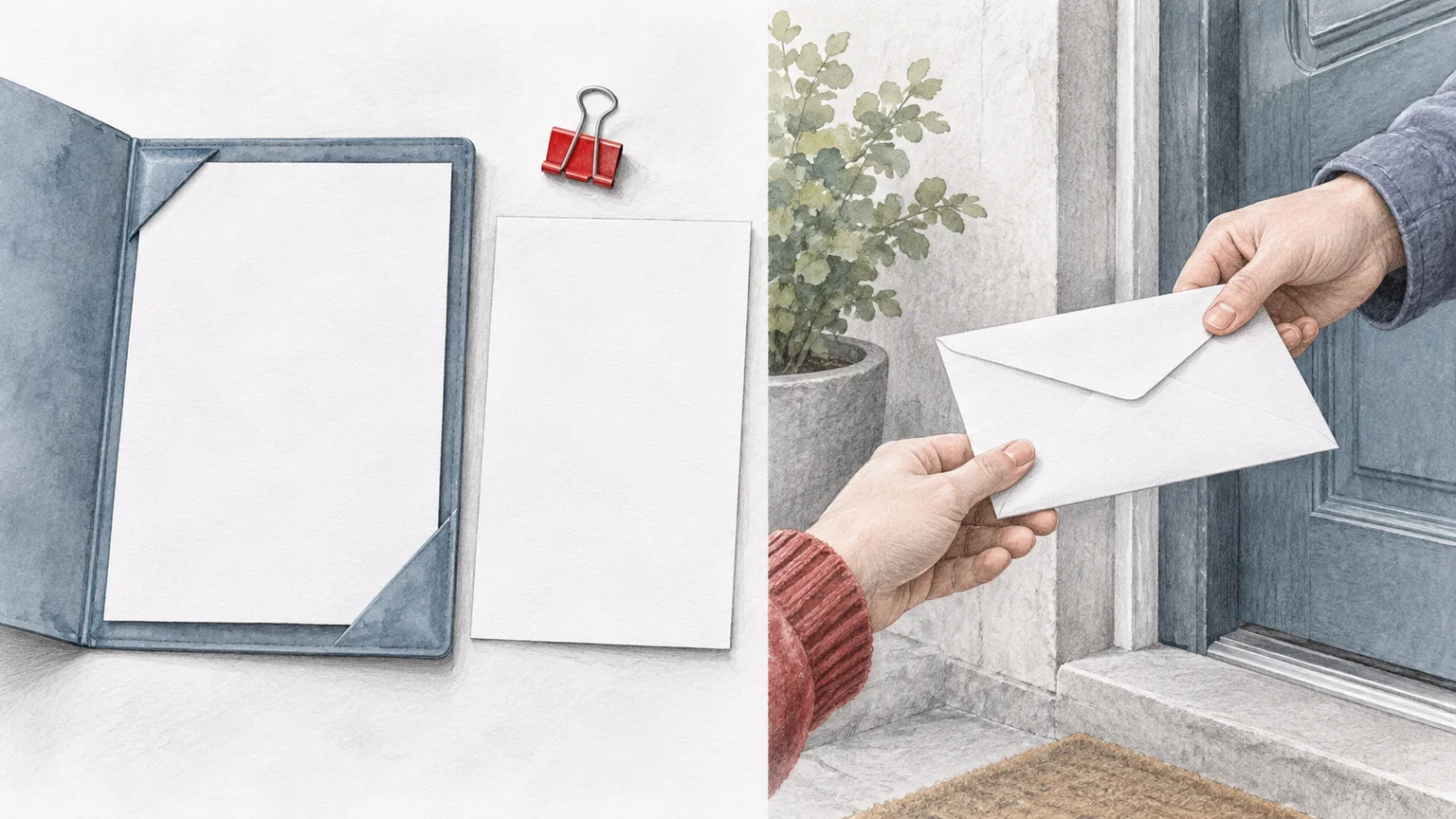
Recording a document's contents and recording delivery serve different purposes.
Content certification records when a document with particular contents was sent, by whom and to whom. Japan Post does not investigate whether the statements in it are true. A letter saying that you disagree with a charge records that statement. Whether the charge was justified remains a separate question involving the contract and the facts.[3]
Delivery certification records the fact that a registered postal item was delivered. It does not certify the identity of the person who actually received it. Avoid treating it as proof that the named individual personally read and understood the letter. Knowing that boundary makes it easier to select the record you actually need.[4]
- Content certification: a record of the document you sent.
- Delivery certification: a record that the postal item was delivered.
- Contracts, photographs and invoices: evidence supporting the statements in your letter.
These materials look at the same situation from different directions. A notice requesting an explanation of move-out charges and a photograph showing that a scratch existed before you moved in answer different questions. Having one does not remove the need for the other. Keep the material on which you based the letter as well as the letter itself.
This also helps before any court proceedings arise. If you seek advice, it is easier to explain events with an invoice, your written objection, a delivery record and the other party's response in chronological order. Think of it as making today's exchange understandable to your future self, rather than suddenly collecting evidence only after a dispute reaches court.
A formal letter may prompt the recipient to recognize that the matter needs careful attention. Even when the amount is small, recording a clear position can communicate seriousness. That is the author's assessment of a possible negotiating effect, not a promise that sending a letter will produce a refund. A document that clearly identifies the question and the response requested is usually a more useful basis for the next conversation than language designed to intimidate.
3. What does a letter with delivery certification cost?
For one letter to one recipient, with one chargeable document page and ordinary return of the certified copy to the sender, the basic total is ¥1,295. The components show that the price covers document processing and return of the copy as well as postage.[5]
| Component | Price |
|---|---|
| Postage | ¥110 |
| Electronic-mail processing, first document page | ¥19 |
| Content certification, first document page | ¥382 |
| Ordinary return of the certified copy | ¥304 |
| General registered-mail fee | ¥480 |
| Basic total | ¥1,295 |
| Delivery certification added at dispatch | ¥350 |
| Total with delivery certification | ¥1,645 |
The ¥1,645 figure is the total above plus the ¥350 delivery-certification fee. It excludes express delivery and other additions. Each subsequent document page adds ¥6 in electronic-mail processing and ¥360 in content certification, so two pages under the same conditions cost ¥2,011 with delivery certification. Check the final chargeable page count and total shown by the service before submitting.[5][4]
The useful comparison includes the journey to the post office and the time you would need to set aside for it. If you do not have a printer or cannot easily visit during opening hours, completing dispatch preparations at home has real value. If you lack a suitable computer setup and would prefer to take a paper document to the counter, the traditional route may fit better.
Do not assume that online dispatch must always be the cheapest option. Consider the length of the document and the equipment you already have. If you need to obtain access to Word just for this letter, that cost and effort are not included in the postage total. People who already have a suitable computer and Word can benefit most immediately from the convenience.
4. Start with the official template and the simple-dispatch option

Less time preparing an envelope leaves more attention for the wording and address.
Prepare an email address for registration, accurate sender and recipient names and addresses, your text, a suitable computer with Word, and a payment method. A credit card is a straightforward option for individual use. Registration is free. For one sender mailing one letter to one recipient, the simple-dispatch option is the natural starting point.[1]
First, download the official Word template. The manual and document-template page provides both portrait A4 with horizontal writing and landscape A4 with vertical writing. Starting with the supplied file is more reliable than trying to reproduce the layout in a blank document. The operating manual is available on the same page.[6]
Second, prepare the wording. The service allows up to five pages and does not accept figures or tables. Rather than uploading a photo-filled report, explain in text which invoice and item you are addressing and what you want the recipient to do. Keep supporting photographs separately so they can be provided when needed. Do not alter the designated margins or formatting simply to improve the appearance.[1]
Third, upload the file and check the sender, recipient and options. Select delivery certification if you need that additional record. Review the final document displayed by the service, not just the original Word file. Check the street address, apartment number, company name, monetary amounts and any dates or deadlines in the text individually.
Fourth, review the price and payment before dispatching. Pause a little longer here than you might when placing an ordinary online order. Japan Post's FAQ says that a completed submission cannot be canceled or edited. A separate request to retrieve an item before delivery may be possible, but it involves additional arrangements and fees, and the original submission charge is not refunded. A final check is the easiest precaution.[2]
Fifth, keep the records together. Save the final text, submission information, tracking number, the certified copy you subsequently receive and the delivery-certification record in one folder for the matter. A name such as “date–recipient–subject” is sufficient if it helps you find it later. If there are several drafts, identify which version was actually sent. Add the recipient's response when it arrives.
Round-the-clock acceptance and delivery time are separate things. Being able to submit tonight does not mean the letter will arrive tonight. If a legal or contractual deadline is approaching, establish which action must happen by which date before choosing the delivery method. Allow time for unfamiliar screens and payment authentication as well as transport.
5. What could you write about disputed move-out charges?
Imagine an invoice with a substantial wallpaper-replacement charge. You have asked about it by phone, but still do not know which surfaces were replaced, the area involved or the unit price. In this hypothetical example, the useful task is to check the charge item by item and put the disputed points into writing.
The Ministry of Land, Infrastructure, Transport and Tourism's restoration guidelines distinguish ordinary wear and aging from damage attributable to the tenant's intentional conduct or negligence. They do not treat every expense of restoring an apartment to new condition as the tenant's responsibility. The particular contract, special terms and condition of the room still need examination. Rather than reaching a conclusion because the total feels high, identify the basis for each charge.[7]
Gather the lease and special terms, photographs from move-in and move-out, inspection records, the invoice and previous emails. The ministry's Q&A also explains the importance of documenting the property's condition, including photographs. An image showing when damage existed and an itemized estimate showing the extent of replacement answer different questions.[8]
The following order can help you draft the letter. It is the author's suggested way to organize information, not a finished legal notice suitable for every individual dispute.
- Identify the matter. Give the property name, apartment number, tenancy end date and invoice date as appropriate.
- Specify the disputed items. Identify the charges and amounts you need explained instead of labeling the entire invoice improper.
- Separate established facts from questions. For example, a photograph may show the same mark at move-in, while the invoice may leave the replacement area unclear.
- Make the requested response concrete. Ask for the location, quantity, unit price and basis for assigning responsibility to the tenant, or ask that a calculation be reconsidered.
- Give a response destination and requested timeframe. Allow reasonable time to check documents and state where the reply should be sent.
A draft might say: “Please explain in writing the location, area, unit price and basis for charging me for the wallpaper replacement shown on the invoice. I do not presently agree to this item and would like to discuss it after reviewing the supporting material.” The recipient can see what needs an answer. The wording must be adapted to the contract and correspondence, but it illustrates how to separate frustration from the information required.
By contrast, do not assume that writing “If you do not reply, you will be deemed to accept all my claims” creates the other party's agreement by itself. What you demand and what you acknowledge may affect your own position. If the wording has uncertain consequences or the matter has already become a serious dispute, professional review before sending can be valuable.
The recipient also matters. The management company you usually call may be different from the landlord who is a party to the lease. Check the contract and the name on the invoice to establish whom you are notifying and why. A clearly addressed letter with a defined purpose is easier to follow up than sending the same accusation to every organization involved.
6. Useful before court, without replacing legal judgment
After receiving a letter, the other party might provide an itemized explanation that reveals a calculation error. Both sides might identify points on which they can agree and resolve the issue through discussion. Sending content-certified mail is a step toward formally communicating your position; it is not a promise that you will inevitably file a lawsuit.
The records may also be used as material in later court proceedings. Japan's courts explain that the small-claims procedure concerns claims for payment of money of ¥600,000 or less, generally aiming to resolve the matter in one hearing. A case can move to ordinary proceedings, including at the defendant's request. The procedure is not simply available for every dispute involving a small amount; the remedy sought matters.[9]
Objecting to an unpaid move-out invoice and seeking the return of a deposit already withheld are different situations. e-Naiyo Shomei does not assess the legal prospects of either. If the dispute concerns the cause of damage or responsibility for a charge, a notice and delivery record do not replace the contract or photographs supporting your position.
If you are unsure whether to use it, ask whether you have a statement you need formally recorded, whether you can identify the recipient and address, and whether you understand the meaning of your proposed wording. If you only need information, an email requesting an itemized explanation may be a lighter first step; save the reply. If a lawyer is already handling the case, coordinate before sending a separate notice yourself. Where an ongoing relationship matters, consider how a formal letter will be received as well.
Recording a notice and compelling someone to act are different stages. The letter alone does not force payment. The legal significance of refusal or return after non-delivery can depend on the circumstances. When timing or legal effect is central, distinguish the convenience of the postal service from the judgment required about the notice. That lets you use the tool without either undue fear or misplaced confidence.
7. For ordinary letters, there is Web Letter too

Preserve a record, send a notice or convey congratulations: choose according to the purpose.
The same Web Yubin portal offers other services that turn an online request into paper delivery. There is no need to make every routine communication into a formal content-certified notice. Use the convenient part of the system that fits the task.
Web Letter: for ordinary invitations, notices and invoices. This service handles printing, envelope preparation and dispatch. Japan Post lists a price of ¥129 for a one-page black-and-white letter. It can be useful when you want a paper notice sent to someone who does not use email. Distinguish that ordinary mailing function from certification of a document's contents.[10]
Web Letax: for congratulations and condolences. This service offers messages and presentation stationery for celebratory or condolence occasions. Its purpose is conveying a sentiment in a suitable physical form, rather than processing a business invoice. Check the venue, destination and timing when choosing it.[11]
Web Express: for urgent documents. Japan Post says same-day delivery is possible for applications generally received by 3:30 p.m., but some areas have an earlier cutoff such as 1:30 p.m. Check the destination postcode and applicable conditions. This is a separate service from the express option added to e-Naiyo Shomei; do not transfer its same-day-delivery guidance to content-certified mail.[12]
The basic choice is straightforward. Use Web Letter for ordinary paper correspondence, Web Letax for ceremonial messages and Web Express for suitable urgent documents. e-Naiyo Shomei is the option when you need a formal record of what you sent. Start with the function you need, rather than selecting solely by the lowest price.
It is easy to assume that posting a letter still means printing it yourself and finding an envelope. These services let you write at your computer and hand the remaining work to the postal system. Content-certified mail in particular has a more accessible starting point than its formal name might suggest. Even if you have nothing to send today, remembering the official page and template location saves you from starting the search from scratch later.
When the need arises, prepare the wording, confirm the address and add delivery certification if required. Removing one trip from a difficult errand can make it much easier to take the next step. That modest, practical convenience is what makes e-Naiyo Shomei worth knowing about.
This article introduces services using public information from Japan Post and other official sources. Individual claims, the legal effect and timing of a notice, and the choice of court procedure depend on the circumstances. Consult a lawyer when a legal judgment is needed, and check the current official conditions before applying.
References
- [1]Japan Post: Electronic content-certified mail. Service operation, dispatch methods and document requirements. ↩
- [2]Japan Post: Electronic content-certified mail FAQ. Supported devices and files, cancellation and editing. ↩
- [3]Japan Post: Content certification. Scope of certification. ↩
- [4]Japan Post: Delivery certification. Scope and fee when added at dispatch. ↩
- [5]Japan Post: Domestic rates for other mail. Electronic content-certified mail fee components. ↩
- [6]Japan Post: Operating manual and document templates. ↩
- [7]MLIT: Restoration guidelines for rental housing. Ordinary wear, aging and tenant responsibility. ↩
- [8]MLIT: Restoration-guideline Q&A. Inspections and records at move-in and move-out. ↩
- [9]Courts of Japan: Small claims. Eligible claims, hearings and transfer to ordinary proceedings. ↩
- [10]Japan Post: Web Letter. Uses and pricing. ↩
- [11]Japan Post: Web Letax. Congratulations and condolences. ↩
- [12]Japan Post: Web Express. Delivery conditions and cutoffs. ↩
NOVEL SERIES VOL.1
The World Became Slightly Farther Away
The world may not change, but distance can.
A story about a man who cannot treat promises lightly, and the people he meets.The sequel, Clouded Glass, is out too. Start here.
View on Amazon
Jijoden.com
Your life is worth writing.
There is a truer self you can tell only to AI.Gather fragments of memory into a single story.
Take a LookRelated Articles
After I Quit Smoking, the Gum Aisle Got Bigger
From cigarettes to vaping to chewing gum. A tour of Japan’s gum shelf, the price of a break, and what a decades-long study can tell us about life five years after quitting.
Moving Out of a Rental in Japan: A Practical Guide to a Fair Settlement
Separate renovation estimates from tenant liability. Check lease clauses, wallpaper depreciation, inspection signatures, AI-assisted review, certified mail, direct debits and Japan's updated small-claims procedure.
Which Streaming Subscriptions Should You Keep? A Complete Japan Guide to Prices, Ads and Family Sharing
Compare 15 major streaming services in Japan: prices with and without ads, simultaneous streams, household sharing, Netflix profile emails, bundles, annual costs and when to cancel.
Vacant Home Rates by Prefecture in Japan: The Latest Ranking, With Tokushima Highest at 21.3%, Saitama Lowest at 9.3%, and Kagoshima First Once Rental and Second Homes Are Excluded
Using the 2023 Housing and Land Survey from Japan’s Statistics Bureau, this ranks all 47 prefectures by vacant home rate and number of vacant homes. Japan had 9,001,600 vacant homes, a record 13.8% of all dwellings. Tokushima is highest (21.3%) and Saitama lowest (9.3%). Excluding homes for rent, for sale and second homes, Kagoshima comes first and Tokyo last. It also covers how the survey defines a vacant home, trends since 1958, changing regional gaps and the limits of a sample survey.
Total Fertility Rate by Prefecture in Japan: The Latest Ranking, With Okinawa Highest at 1.52, Tokyo Lowest at 0.96 and the Nation at a Record-Low 1.14
Using vital statistics from Japan’s health ministry, this ranks all 47 prefectures by total fertility rate. In 2025 the national rate was a record-low 1.14, with Okinawa highest (1.52) and Tokyo lowest (0.96). Prefectural 2025 figures are provisional, with final figures due in November 2026. It also covers changes from the previous year, trends since 1947, the number of births, how to read Tokyo’s figure and what the numbers cannot show.
From the Pocho Lab
