
Table of Contents
The round tub I used to walk right past
I gave up cigarettes, switched to vaping, and then gave that up too. These days I chew gum. An unexpected thing happened when I went shopping: the gum aisle seemed to have grown. Had there really been this many kinds all along?
The package that catches my eye is the little cylinder. A slim pack of sticks looks like something you slip into a pocket. The tub looks like it belongs somewhere. On a desk, perhaps. Flip open the lid, tip a piece into your palm, and close it until the next break. Compared with what I spent on tobacco, gum costs remarkably little. And I get to choose a flavor.
Accounts of quitting often stop at the moment someone puts out their last cigarette. But lunch still comes to an end the next day. You still finish a piece of work and lean back in your chair. What goes into the little stretch of time where a cigarette used to fit? Here is a walk down a Japanese gum aisle, with a detour five years into the future.
Imagine someone at work saying, “Coming out for a smoke?” There are three things in that invitation: the cigarette itself, permission to get up, and a few minutes alone with someone. Gum might cover the first part of the ritual. Fetching a drink from another floor covers the second; inviting the colleague along preserves the third. One piece of gum doesn't have to do all three jobs.
Cigarettes followed by vaping happens to be my route, not a sequence I'm recommending. Nor is five years my own claim to fame. It's the length of time I wanted to know about once I started taking an interest in gum.
On a Japanese gum shelf, choose a shape before a flavor
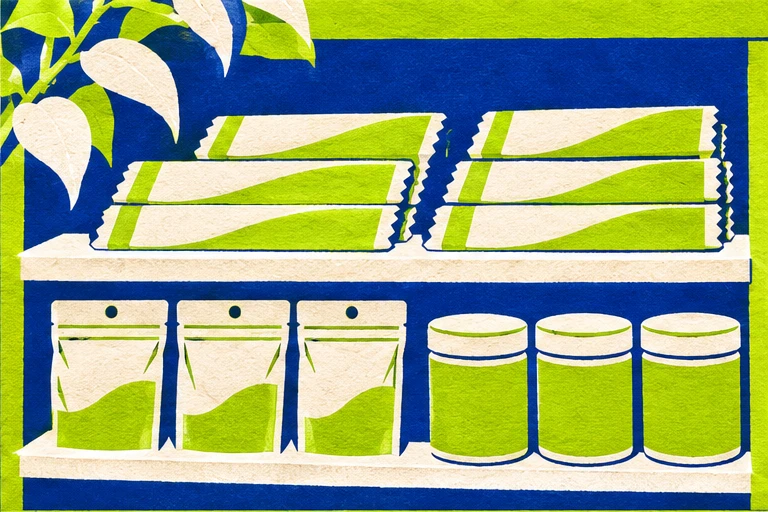
Lotte sells its 133-gram Xylitol Lime Mint Family Bottle nationwide in Japan. The label gives 21 grams for 14 pieces. That works out to roughly 1.5 grams apiece, or about 89 pieces per bottle. The company sells it by weight; 89 is my estimate, not a promised count. For someone buying a “family” bottle for one, pieces are easier to picture than grams. The nutrition label lists zero sugars, and the ingredients include gelatin, useful details if either matters to you. [1]
Lotte Green Gum, by contrast, comes in nine flat sticks. The company's factory tour shows each stick getting its own wrapper before nine are bundled together. You can take a single stick out with you and keep the paper to wrap the gum in afterwards. Neither convenience shows up in the price per gram. And nine sticks make a gentler commitment to an unfamiliar flavor than a month's supply on the desk. [2][3]
If mint isn't your thing, look for Lotte's nine-stick blueberry gum in packaging that recalls its original 1982 design. There is an ume (Japanese plum) version too. For a visitor, swapping a stick of blueberry for a stick of plum might make a more interesting break than comparing the strength of two mints. The Japanese phrase on these packs, “less likely to stick to teeth,” describes texture. It doesn't mean sugar-free. If you're going to chew it often, read the nutrition label as well as the flavor name. [4][5]
The same pack looks different in a kitchen where several people can help themselves and in a small bag on a museum visit. If you want one stick after lunch and won't chew inside the gallery, carrying another 88 pieces has no particular value today. Bulk buying needs both a place for the tub and someone who will finish it.
Try a small pack first and notice where you reach for it. Mostly at home? Look for a bottle you like next time. Mostly on the go? Stick with the slim pack. If you tire of the flavor quickly, finding that out before buying a month's supply is a good result too.
A few shelf words help visitors: tsubu (粒) counts individual pellets, mai (枚) counts flat pieces, and naiyōryō (内容量) is the quantity inside. Nine sticks and 133 grams can't be compared by the numerals alone. When shopping for a small edible souvenir, the useful question might simply be how many people can have a stick.
What does one break actually cost?
At the checkout, a whole tub of gum can look expensive next to one pack of cigarettes. But will they both be empty tomorrow night? The useful comparison isn't the price of picking each one up. It's how soon you have to buy it again.
Suppose a pack of 20 cigarettes costs ¥600 and a tub of about 89 pieces costs ¥800. These are round numbers for a worked example, neither a retail survey nor a record of my own purchases. Substitute the numbers on your receipt. One cigarette is ¥30; a piece of gum is about ¥9. But there's no rule saying that each cigarette has to be replaced with one piece. Someone who smoked ten cigarettes a day might only want gum after three meals.
| Over 30 days | Calculation | Cost of what you use |
|---|---|---|
| Ten cigarettes a day | 300 cigarettes, or 15 packs | ¥9,000 |
| Three pieces of gum a day | 90 × ¥800 ÷ 89 | About ¥809 |
| Six pieces of gum a day | 180 × ¥800 ÷ 89 | About ¥1,618 |
At three pieces a day the difference is about ¥8,191. There's a small catch. If a tub held exactly 89 pieces, you'd open a second one for piece number 90. Your first month's cash outlay would be ¥1,600, with most of the second tub left over. The table tracks consumption; your wallet tracks purchases. It doesn't include treatment costs, a previous vaping device or refills, or the drink you pick up with the gum. To find your own savings, save receipts until this date next month. They're better evidence than any model.
For a lighter smoker, the arithmetic changes. One ¥600 pack a week is ¥2,400 over four weeks. Buy three ¥800 tubs in those same four weeks to keep in three places and the cash outlay is identical. The remaining gum carries over, of course. It just doesn't follow that a particular sum must materialize in your wallet in month one.
If receipts aren't your thing, write the opening date on the lid. When the tub is empty, divide its price by the days it lasted: no counting every piece. A shared tub gives a household figure, different from one person's former cigarette habit. The last piece becomes a convenient date to close the books. Include extra packs bought for outings that week.
Conversely, if a tobacco purchase often turned into a shopping trip, the number of times you skip the shop may matter more than the number of pieces you chew. Don't credit yourself for a drink you wouldn't have bought anyway. Compare your actual old and new baskets: tobacco spending avoided and money freed up aren't quite the same thing.
Gum after lunch, water before a meeting, five minutes outside

Japanese has a handy expression, kuchisabishii: literally, your mouth feels lonely. But even for the same person, it can mean different things at different hours. After lunch, you might want a signal that the meal is over. Mint gum or brushing your teeth can supply one. If you're about to speak in a meeting, a sip of cold water saves you having to find somewhere to throw away your gum. Choose for the next ten minutes of your day. [6]
If the urge arrives when you want to leave your desk, take your water bottle for a five-minute walk. Giving up the break along with the cigarette just makes the working day longer. If you miss the company, invite a colleague to get a drink instead of walking to the smoking area. “Fancy a trip to the kettle?” can do the work of a much more elaborate plan.
Sugar-free mints, or carrot sticks where eating is practical, can give your mouth or hands something to do; the US Centers for Disease Control and Prevention suggests options like these. On a day when chewing feels uncomfortable, you don't have to go shopping for a different hard snack. Water or a walk will do. These are ways to get through particular moments, not a ranking of treatments for nicotine dependence. [7]
For just one day, try putting a verb next to the time: “1 pm: chew. 3 pm: stretch my legs. On the way home: talk.” Three entries that all say “smoke” might suggest packing three pieces of gum. Three different verbs suggest a stick of gum, a walking route and a person to call. One line about the hardest moment is plenty if keeping a log feels like work.
Chewing also needs an ending. If lunch leads straight into a customer appointment, knowing where to discard gum matters. Keep the wrapper, pass a bin on the way back, or stick to water that day. A small logistical detail often decides whether a good idea actually fits.
Five years after quitting, what was in people's pockets?
One unusually long US study followed 483 men for up to 35 years. The cohort began in 1963. Roughly every three years, participants had examinations and answered questionnaires. The researchers wanted to know what happened after someone had already gone at least two years without cigarettes. During years two through six, which bracket the five-year milestone, the annual rate of returning to smoking fluctuated between 2% and 4%. It fell below 1% only after ten years of abstinence. [8]
That's an annual rate, not the share of all five-year quitters who would ever smoke again. The participants were American men observed in a particular era. Their experience can't predict a particular reader's future in Japan today, or what will happen after someone stops vaping.
And the contents of their pockets? We don't know. The investigators collected information about smoking, alcohol and caffeine, among other things, not participants' favorite chewing gum. The sources I found don't establish a substitute shared by people who quit for five years or more. Besides, someone who now leaves the house empty-handed is easy to miss in a conversation about what to buy.
My practical takeaway is to prepare a reply for the first time in years that someone offers you a cigarette. “I don't smoke anymore. I'll come with you for a drink, though.” You still get the part of the break you wanted: time with that person.
What evidence would answer the shopping question? I would want to ask people starting to quit the same questions after a week, six months and five years. Alongside “What did you use?” ask “When did you stop needing it?” and “Were there parts of the day when you used nothing?” Gum sales include snacks bought by people who've never smoked. Sales alone can't reveal the tastes of five-year quitters.
Time can run the other way, too. Someone chewing ume gum at year five might have discovered it last week after spending four years drinking water. Someone else might have relied on mint in the first month and since forgotten the brand. “What's in your pocket?” and “What helped then?” are different questions. If I met a longtime quitter, I'd ask which break they found hardest before asking what they bought.
What the gum does, and what quitting does
For health, the big difference between those breaks isn't lime versus plum. It's time spent without inhaling cigarette smoke. The CDC reports that coughing and shortness of breath decrease within one to twelve months after quitting cigarettes, and heart attack risk falls sharply in one to two years. In three to six years, the added risk of coronary heart disease falls by half. Half the excess risk isn't the same as halving everyone's total chance of illness, and these population timelines aren't deadlines for an individual's symptoms. The benefit of keeping smoke away from other people begins in the very room where you don't light up. [9]
Nicotine gum and confectionery gum may look alike. In Japan, Nicorette is a nicotine-containing medicine in the designated Class 2 category, and you use it differently from ordinary gum. At a pharmacy, describe the problem in your own words: “I miss something after a meal,” or “The urge is so strong that I keep going back.” A pharmacist or registered seller can help establish whether the product is suitable and explain how to use it. Struggling with cravings doesn't mean you picked the wrong flavor. Equally, someone who has already quit and enjoys ordinary gum has no reason, on the strength of this story, to switch to a nicotine product. [10][6]
You don't need a polished account for a first conversation at the pharmacy. Say what you stopped and when, whether you're missing flavor, something for your hands, or experiencing a powerful urge to smoke, and when it happens. “After meals I'm fine; the journey home is hard” is more useful than guessing you need more gum all day. If you already use a medicine, take its name or the packaging.
The reason for quitting and the reason for enjoying a break can be different. Someone who quits for their heart can choose blueberry today simply because the wrapper reminds them of childhood. The future benefit isn't visible yet. The pleasure of picking a flavor arrives today.
What comes after lunch tomorrow? Maybe one piece of lime gum. Maybe tea and a walk outside. If you find you don't need anything at all, that's a perfectly good afternoon too. Some money that used to be spoken for now buys a choice of flavors. That's the small freedom I see in that round tub.
References
- [1]Lotte: Xylitol Lime Mint ↩
- [2]Lotte: Green Gum ↩
- [3]Lotte: Green Gum factory tour ↩
- [4]Lotte: Blueberry Gum ↩
- [5]Lotte: Ume Gum ↩
- [6]Nicorette Japan: FAQ ↩
- [7]CDC: 7 Common Withdrawal Symptoms ↩
- [8]Krall et al. (2002), Smoking relapse after 2 years of abstinence ↩
- [9]CDC: Benefits of Quitting Smoking ↩
- [10]Nicorette Japan: products ↩
NOVEL SERIES VOL.1
The World Became Slightly Farther Away
The world may not change, but distance can.
A story about a man who cannot treat promises lightly, and the people he meets.The sequel, Clouded Glass, is out too. Start here.
View on Amazon
Jijoden.com
Your life is worth writing.
There is a truer self you can tell only to AI.Gather fragments of memory into a single story.
Take a LookRelated Articles
Moving Out of a Rental in Japan: A Practical Guide to a Fair Settlement
Separate renovation estimates from tenant liability. Check lease clauses, wallpaper depreciation, inspection signatures, AI-assisted review, certified mail, direct debits and Japan's updated small-claims procedure.
Which Streaming Subscriptions Should You Keep? A Complete Japan Guide to Prices, Ads and Family Sharing
Compare 15 major streaming services in Japan: prices with and without ads, simultaneous streams, household sharing, Netflix profile emails, bundles, annual costs and when to cancel.
Vacant Home Rates by Prefecture in Japan: The Latest Ranking, With Tokushima Highest at 21.3%, Saitama Lowest at 9.3%, and Kagoshima First Once Rental and Second Homes Are Excluded
Using the 2023 Housing and Land Survey from Japan’s Statistics Bureau, this ranks all 47 prefectures by vacant home rate and number of vacant homes. Japan had 9,001,600 vacant homes, a record 13.8% of all dwellings. Tokushima is highest (21.3%) and Saitama lowest (9.3%). Excluding homes for rent, for sale and second homes, Kagoshima comes first and Tokyo last. It also covers how the survey defines a vacant home, trends since 1958, changing regional gaps and the limits of a sample survey.
Total Fertility Rate by Prefecture in Japan: The Latest Ranking, With Okinawa Highest at 1.52, Tokyo Lowest at 0.96 and the Nation at a Record-Low 1.14
Using vital statistics from Japan’s health ministry, this ranks all 47 prefectures by total fertility rate. In 2025 the national rate was a record-low 1.14, with Okinawa highest (1.52) and Tokyo lowest (0.96). Prefectural 2025 figures are provisional, with final figures due in November 2026. It also covers changes from the previous year, trends since 1947, the number of births, how to read Tokyo’s figure and what the numbers cannot show.
Average Age at First Marriage by Prefecture in Japan: The Latest Ranking, With Tokyo Highest and Shimane Lowest for Both Husbands and Wives
Using the latest final vital statistics from Japan’s health ministry (2025 data, published September 2026), this ranks all 47 prefectures by the average age at first marriage for husbands and wives. Nationally it is 31.0 for husbands and 29.7 for wives. Tokyo is highest and Shimane lowest for both. It also covers trends since 1950, how regional gaps have changed, the age gap between spouses and mothers’ age at first birth.
From the Pocho Lab
