
Table of Contents
1. Conclusion: Tests Are Not Disappearing—One Test Will No Longer Decide Everything
Looking ahead from July 20, 2026, the most important conclusion is not that Japan's general entrance examinations will disappear and be replaced by holistic selection. It is that the two systems will increasingly overlap: academic tests will enter holistic admissions, while records, credentials, writing, and broader evidence will enter test-centered routes. The broad framework and dates for admissions into the 2027 academic year are largely settled. The basic shape of the 2028 Common Test is also public. Nationwide details for 2029, when today's first-year high school students will apply, remain incomplete, but university-specific notices already reveal a clear direction.
The academic-year terminology can be confusing. “2027 admissions” mainly means selection from autumn 2026 through winter 2027 for enrollment in April 2027. Today's second-year high school students are primarily in the 2028 cohort, and today's first-years are in the 2029 cohort. What used to be called AO admissions was generally renamed “comprehensive” or holistic selection beginning with 2021 admissions. AO stands for Admissions Office; it has nothing to do with school grades of A or O. The old name survives because everyday language often outlives institutional reform.
| Common assumption | Realistic outlook through 2029 |
|---|---|
| General examinations will vanish | They remain central at selective national and large private universities |
| Holistic selection has no academic test | More routes combine the Common Test, university exams, credentials, and oral examination |
| Flashy activities win | Academic connection, evidence, continuity, and explanation matter more |
| AI can polish the statement for you | Universities will test whether the applicant can defend it in follow-up questions |
| Students should choose “exam” or “AO” early | A three-layer strategy—subjects, school record, and inquiry—is safer |
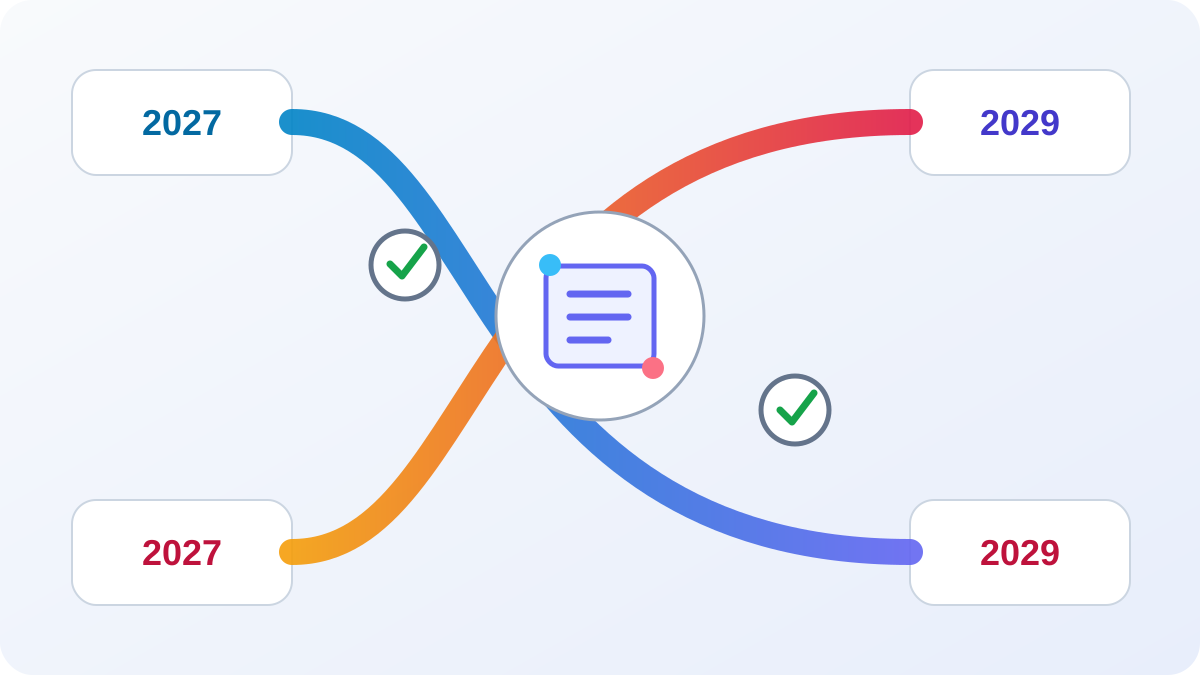
Figure 1: From a single track to multiple tracks. Academic testing and activity-based evaluation will coexist and absorb elements from one another.
2. More Than Half Already Enter Through Holistic or Recommendation Routes—but National and Private Universities Are Different Worlds
In Japan's education ministry data for students entering in 2025, 126,766 entered through comprehensive selection, or 19.5% of all entrants. Another 221,415, or 34.1%, entered through school recommendation. Together they accounted for 53.6%. At first glance, Japan has already crossed into an era in which holistic and recommendation routes are larger than the general examination route[1].
Reading 53.6% as a uniform national trend, however, leads to the wrong decision. At national universities, comprehensive selection was 7.7% and school recommendation 12.7%, for a combined 20.4%. Public universities were at 32.9%. Private universities reached 61.6%, combining 22.8% comprehensive selection and 38.8% recommendation. Private-university numbers include designated-school recommendations, progression from affiliated schools, and many faculty-specific systems. They do not mean that half of all applicants win places through an open AO-style competition.
| Institution type | Comprehensive | School recommendation | Combined |
|---|---|---|---|
| National | 7.7% | 12.7% | 20.4% |
| Public | 6.0% | 26.9% | 32.9% |
| Private | 22.8% | 38.8% | 61.6% |
| All universities | 19.5% | 34.1% | 53.6% |
Application totals also count applications, not unique people. If one student applies to multiple faculties or schemes at the same university, every submission is counted. Keio's 2026 general selection, for example, recorded 42,033 applications from 28,133 unique applicants—an average of 1.49 applications per person. A popularity ranking therefore reflects not only appeal but also the number of routes, Common Test options, multi-application pricing, and the examination calendar.
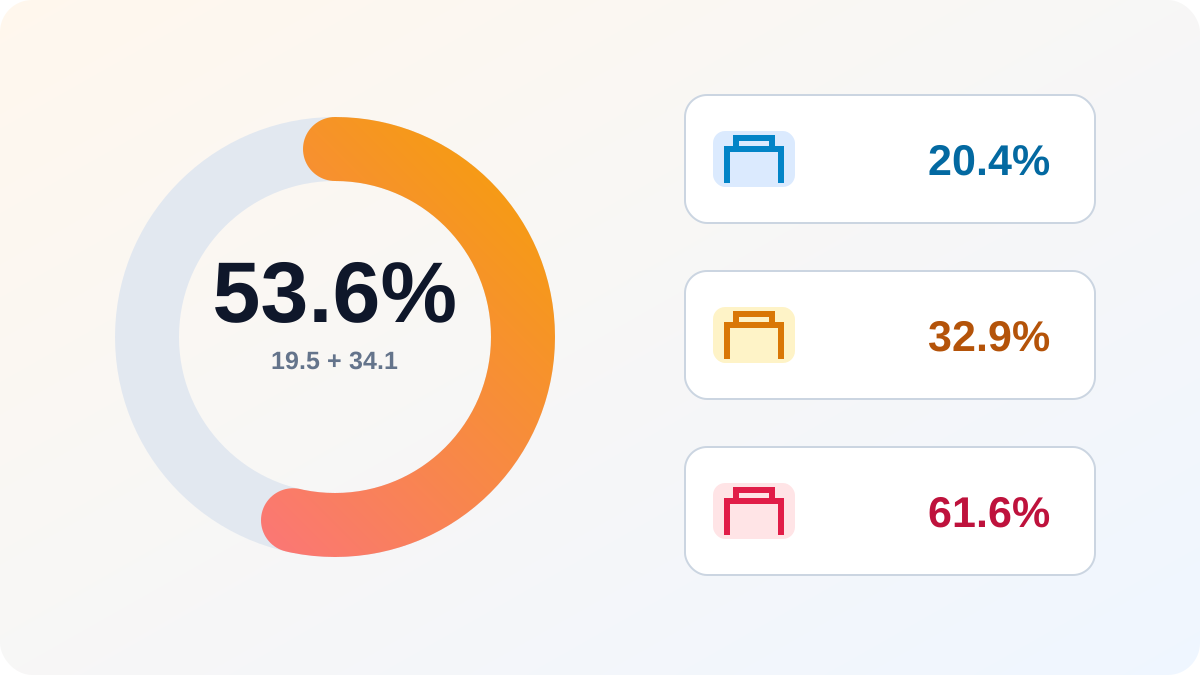
Figure 2: The national 53.6% average hides radically different realities: 20.4% at national universities versus 61.6% at private universities.
3. What Is the Difference Between Comprehensive Selection and School Recommendation?
Comprehensive selection is generally an open application initiated by the student. It must use applicant-authored material such as an activity report, statement of purpose, or learning plan. Universities may combine that material with interviews, oral examinations, presentations, discussion, essays, practical tests, external credentials, the Common Test, or their own subject examinations. It is neither “an interview-only route” nor “admission without academic ability.”
School-recommendation selection differs because it is centered on a recommendation from the applicant's high-school principal and the official school record. In designated-school recommendation, a university allocates places to particular high schools and students first pass an internal school process. In open recommendation, applicants meet publicly stated conditions—grades, qualifications, required courses—and obtain the principal's recommendation. Everyday speech often groups both systems under “recommendation,” but comprehensive selection is not legally a subtype of school recommendation.
In practice, comprehensive selection falls into roughly five families: documents plus interview; essay plus oral questioning; a portfolio of research, creative work, or competition results; presentations or group discussion; and academic hybrids that add the Common Test or a university examination. The fifth component tends to grow stronger at selective institutions. The University of Tokyo's school-recommendation route combines submitted evidence and interviews with a Common Test benchmark of roughly 80%. Hitotsubashi combines the Common Test, credentials, an essay, interview, and self-recommendation materials. “It happens before New Year, so I do not need to study for exams” is not a workable assumption at selective universities.

Figure 3: Holistic selection is not “just an interview.” It combines documents, academic evidence, work products, and live verification.
4. From 2027 to 2029: What Is Confirmed, and What Is Forecast?
2027: Current Third-Year Students
The 2027 Common Test will be held on January 16 and 17, 2027. Under the national framework, comprehensive-selection applications open no earlier than September 1, with results no earlier than November 1. School-recommendation applications open no earlier than November 1, with results no earlier than December 1. Subject examinations for general selection take place within the February 1–March 25 window[2][3].
A major clarification is that comprehensive and school-recommendation routes should, in principle, conduct an interview that checks motivation and aptitude for the intended field. “Interview” here includes oral examination, presentation, and discussion. Existing schemes that cannot adopt the change immediately have a transition period, but implementation is expected no later than 2029 admissions. By the time today's first-year students apply, document-only routes should therefore be rarer, while live checks of understanding and expression should be more common.
What is public in July is often an outline or change notice, not every university's final application booklet. Many universities release the definitive general-selection guidelines in autumn. Current seniors must check the official documents for the exact year and route, not rely on an admissions guide or an older web summary.
2028: Current Second-Year Students
The 2028 Common Test is scheduled for January 15 and 16, 2028. The framework of Japanese, geography/history, civics, mathematics, science, foreign languages, and information remains, including Information I. The test remains based on paper question books and mark sheets, with dedicated playback devices for English listening. The arrival of generative AI has not triggered an immediate move to computer-based testing. The National Center for University Entrance Examinations also publicly describes reading answer sheets with optical mark recognition[4].
At the same time, the Common Test is designed to emphasize reasoning, judgment, and expression as well as knowledge. General examinations are shifting weight from simple recall toward reading longer sources, comparing multiple datasets, and reasoning under conditions. The difference between general and holistic selection will increasingly be how central a standardized simultaneous examination is—not whether academic ability matters at all.
2029: Current First-Year Students
Nationwide details for 2029 are not final, but university-level notices have begun. Waseda's School of Commerce plans to reduce its intake from 900 to 850, general-selection places from 540 to 505, and school-recommendation places from 360 to 345. It is not eliminating general places in favor of recommendation; it is adjusting both while keeping both[5]. Keio has likewise issued multi-year, faculty-specific notices. Reform is occurring faculty by faculty, not replacing an entire university overnight.
The most likely environment for current first-years is a gradual expansion of comprehensive places combined with more Common Test use, English or mathematics credentials, and university-run checks of foundational knowledge. Interviews will move from “recite your motivation” toward an oral defense in which students explain their submission, answer objections, and respond to follow-up questions. General selection will also use transcripts, external qualifications, and Common Test combinations. The boundary will grow thinner.
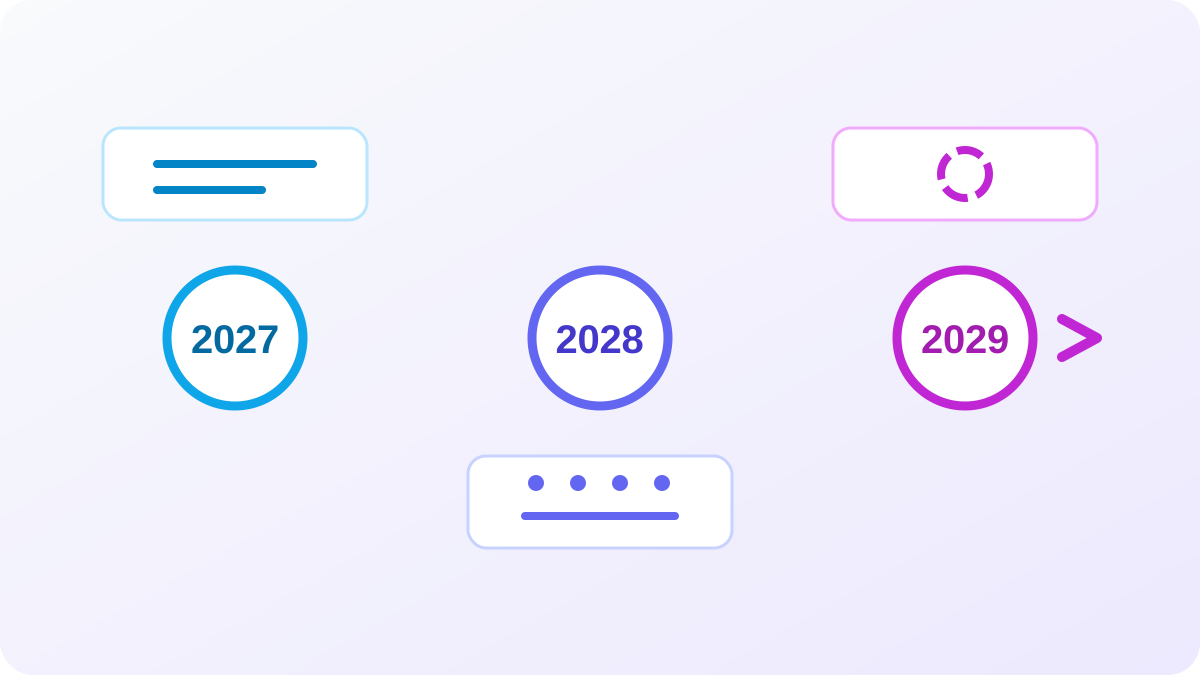
Figure 4: 2027 is at the formal-guideline stage, the 2028 Common Test framework is visible, and 2029 must still be inferred from university notices.
5. Is “The University of Tsukuba Will Go 100% AO” True?
I could not confirm any published plan for the University of Tsukuba to become 100% comprehensive-selection. The claim is often confused with Tohoku University's long-standing emphasis on AO admissions and discussion of expanding them in the distant future. Even so, the phrase “100% AO by 2050” should be treated as a long-term vision, not a binding year-by-year admissions timetable in the current application guidelines. The year 2050 is more than two decades beyond today's students and cannot simply be projected onto selective metropolitan universities in 2029.
Tohoku's AO route is not a personality interview. Its official guidance explicitly emphasizes “excellent academic ability.” Phase III uses the Common Test, while Phase II combines written and interview assessments depending on the faculty[6]. It is designed to measure academic ability and broader evidence together, not to replace one with the other.
Tsukuba does operate its AC selection, which resembles the older AO model. In 2025, 361 people applied for 43 advertised places and 39 were admitted. Applicants demonstrate problem-finding and problem-solving through sustained work or research, and those passing the document stage face an interview or oral examination. The university also states that it may leave places unfilled when no applicant is suitable and transfer capacity to general selection[7]. Comprehensive selection is not a wide gate that admits everyone; it is strict selection with a different ruler.
Selective universities in the Tokyo region remain far from full AO conversion. The University of Tokyo maintains general selection at large scale, with recommendation places totaling roughly one hundred across faculties[8]. General selection also remains the core at Hitotsubashi. Sophia operates open recommendation alongside TEAP and Common Test options in general selection. Waseda, Keio, Aoyama Gakuin, Meiji, Rikkyo, Chuo, and Hosei all offer faculty-limited self-recommendation, open recommendation, or qualification-based schemes while maintaining large general routes. Through 2029, “more combinations” is a more defensible forecast than “replacement by AO.”
6. Why Are Universities Expanding Holistic Selection?
The first reason is to evaluate abilities that are difficult to see in one day's score. James Heckman and Tim Kautz argued in 2012 that achievement tests do not adequately capture goals, motivation, persistence, and other noncognitive dimensions[9]. Sustained research, inquiry, creative production, or social activity can show continuity of interest and the quality of trial and error.
That does not mean an interview can precisely measure “human quality.” Japan's admissions surveys expose challenges in designing evaluation dimensions, converting judgments to scores, managing staff time, and ensuring fairness[10]. Reading extensive files and conducting multiple interviews costs more than comparing tens of thousands of people on one examination, and assessors can disagree. This is one reason universities are more likely to combine holistic evidence with comparable measures such as the Common Test than to rely on holistic evaluation alone.
The second reason is the connection between high school and university. Universities do not simply want applicants with many titles; they want students who will grow within their curriculum. Tsukuba's AC route asks for process as well as outcomes, while the University of Tokyo emphasizes broad foundations and the ability to connect problems. Universities test validity after admission using grades, leave, and withdrawal data, revising selection according to whether admitted students actually learn and progress.
The third reason is demographics and institutional management. Ministry projections put the 18-year-old population at roughly 1.10 million in 2025, about 960,000 in 2035, and potentially about 740,000 in 2040[11]. Maintaining current capacity will become difficult even with more international students. Universities have an understandable management incentive to secure committed students earlier. Yet expansion at a selective university and expansion at an institution struggling to fill places do not have identical purposes: the former may emphasize precision of selection; the latter may put relatively more weight on securing enrollment.
The fourth reason is generative AI. In 2025, Wakana Kamiyama and Naoki Kuramoto examined concerns about AI's effect on applicant-authored documents[12]. Text alone is becoming a weaker way to determine whether a submission reflects the applicant's thinking. AI is not the sole cause of heavier interviews and oral checks, but both trends point in the same direction: universities need to verify authenticity in real time. What will matter more is not the elegance of the finished prose but whether the student can explain why the question was chosen, which evidence was used, and what changed after failure.

Figure 5: Multidimensional evaluation, the high-school–university connection, demographics, and generative AI all push selection beyond either documents alone or exams alone.
7. What Kind of Applicant Is Strong in Comprehensive Selection?
The recurring strength is not a spectacular résumé but the ability to explain the connection to academic inquiry. If a student investigates local waste, participation in a cleanup is only the beginning. Stronger evidence measures waste volume, proposes a causal hypothesis, compares municipal data, and acknowledges the limits of a recommendation. A national competition or overseas program can be powerful evidence, but it is not an automatic ticket. A small school-based inquiry can also matter when it accumulates data, reading, verification, and revision.
Five elements are commonly tested: foundational academic ability; sustained interest; evidence; articulation; and fit with the university. A statement of purpose is less an autobiography than the entrance to a research plan connecting “what I want to find,” “why this faculty is necessary,” and “what I will study after entry.” Interviews can probe definitions, sources, opposing arguments, and data limitations. Prose polished by AI or a tutoring service is weak if it collapses under five minutes of follow-up questions.
Specialist AO tutoring and online courses already support essays, interviews, activity design, and portfolios. Using them is not inherently a disadvantage. The danger is that intensive editing standardizes the prose and removes the student's observation, uncertainty, and changes of mind. Valuable support helps narrow a question, find prior research, collect better data, and practice facing objections. Following one question for two years and recording failures can be more persuasive than listing ten unrelated activities.
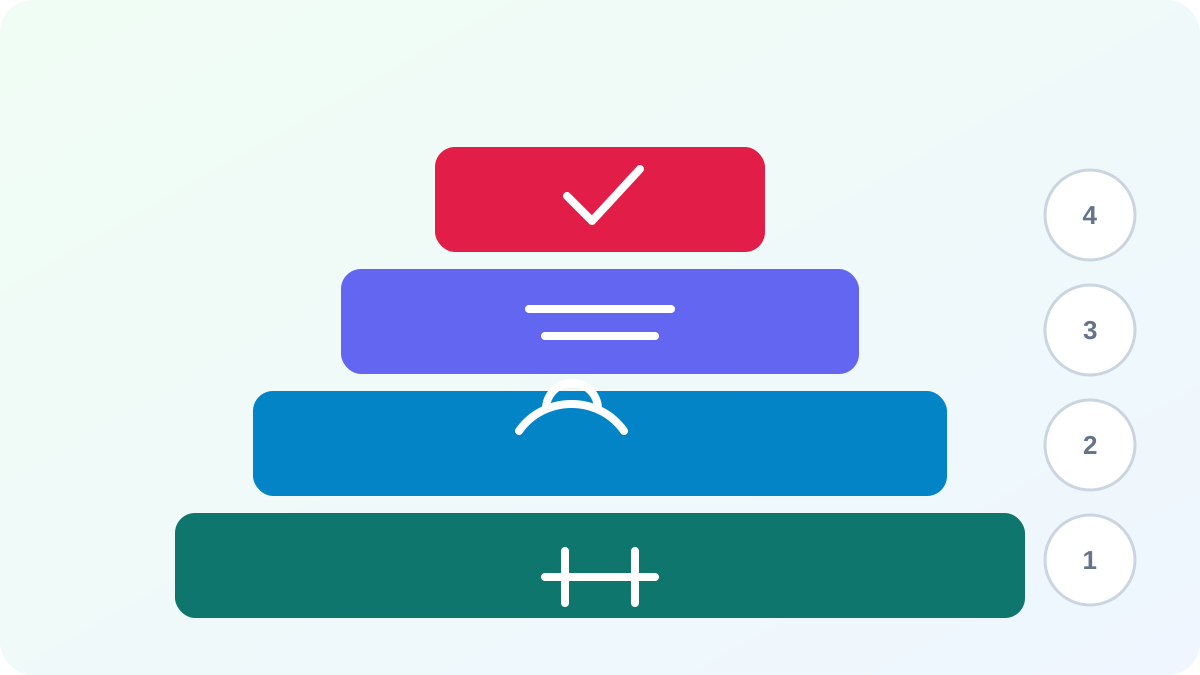
Figure 6: The number of activities matters less than whether inquiry, evidence, and explanation are built on academic foundations.
8. All 4s at a High-Scoring School, or All 5s at a Low-Scoring School?
The formal material in Japanese admissions is primarily the academic record reported by the school—not the “school deviation score” commonly discussed for high-school entrance examinations. There is no nationwide public conversion table that adjusts grades by school rank.
Looking only at a grade threshold, there are routes where a student with all 5s at a school around the 35 level is advantaged over a student with all 4s at a school around 70. In designated-school recommendation, the decisive facts are whether that school has the place and who competes in its internal process; all 5s are powerful. In a route using the Common Test, a university exam, or external English and mathematics qualifications, the all-4 student trained in a more demanding academic environment may demonstrate stronger objective scores.
Elaine Allensworth and Kallie Clark's 2020 study of roughly 55,000 U.S. students found high-school GPA predicted college graduation more strongly than ACT scores, while students with the same GPA still graduated at different rates depending on high school[13]. Grades therefore carry both a strength—capturing sustained daily work—and a weakness—different scales across schools. Dartmouth's 2024 analysis likewise argued that standardized scores, interpreted with family and high-school context, can help identify high achievers from disadvantaged settings[14]. The fairest approximation is not grades or tests alone, but both interpreted with background information.
For a Japanese applicant, carrying several forms of evidence that travel beyond the school—grades, the Common Test, qualifications, and inquiry results—reduces the effect of school background. A prestigious school name alone is not enough, and neither is a high grade earned in an easier environment. The university wants to know what the student chose and how far the student grew within the available environment.
Public data has limits. Many universities do not publish the distribution of grades, interview scores, or sending schools by selection route. It is impossible to rank every high school nationally by its strength in comprehensive selection. A low-ranked school may have no designated place at the target university, making even all 5s ineligible. When choosing a high school, families should separately check designated-school history, internal recommendation standards, support for inquiry and writing, interview preparation, and general-examination outcomes.
9. The Most Popular Schools in Spring 2026 and the Upper Difficulty Bands for 2027
Across 22 major private universities, general and Common Test routes recorded roughly 1.61 million applications for 2026, up 7% year on year. Among major Tokyo-region institutions, Toyo had 119,233, Meiji 115,012, Nihon 111,902, Hosei 111,240, Waseda 94,438, Chuo 73,363, Rikkyo 70,194, Tokyo University of Science 61,979, Aoyama Gakuin 54,444, Keio 42,033, and Sophia 31,946[^15].
Changes by faculty also reflect social interest. Law remained popular, while Common Test routes in science, engineering, and agriculture grew. New labels around AI and data, environmental studies, and interdisciplinary education attract attention, but a new faculty's first year combines excitement with uncertainty because no historical acceptance ratio exists.
This is not a ranking of institutional “class.” Universities with more faculties, easier Common Test applications, and more opportunities to apply multiple times naturally accumulate larger totals. Waseda was 2% below the prior year, but that alone does not prove declining appeal; changes in Common Test applications and route design must be separated. Totals above 100,000 at Toyo, Meiji, Nihon, and Hosei show how strongly private admissions move with application combinations.
National and public universities operate under early and late schedules and applicants make decisions after Common Test results. They should not be mixed into the same application-count ranking as private universities, where one person can submit many applications. For public institutions, comparison should focus on route-specific difficulty: Common Test percentage, second-stage subjects, capacity, and any first-stage cutoff.
Kawai Juku's route-specific 2027 forecasts place some Waseda political economy and social sciences routes at 70.0, with Keio law and Waseda law among the 67.5 band[^16]. But a 70.0 route with one subject and Common Test combination cannot be directly compared with a 67.5 route requiring four subjects. A border score is a roughly 50% acceptance benchmark inside a particular applicant population, with particular weights and capacity. Use rankings to compare your actual route's workload, Common Test share, English-credential conditions, and competition—not to place whole university names in one line.
10. Will General Selection Remain, and Should Students Abandon Memorization?
General selection is highly likely to remain central through at least 2029 at selective national and large private universities. The structures at Tokyo and Hitotsubashi, Waseda Commerce's 2029 plan, and continued paper-and-mark-sheet Common Tests all point in that direction. Subject examinations compare large numbers on a common scale at relatively low selection cost and produce explainable decisions. Holistic selection cannot easily replace those functions.
At the same time, strengthening rote memory alone will become less effective. The answer is not to learn less but to make knowledge usable. Vocabulary, formulas, historical facts, and grammar are the raw materials of reasoning. Without them, inference is impossible. But students must also read sources, construct causal relationships, compare numbers, explain alternative solutions, and write short evidence-based answers. The University of Tokyo itself emphasizes connecting knowledge to derive solutions rather than mere accumulation.
The safest strategy is not “general versus AO.” It has three layers: subject foundations and mock-exam performance; school grades and course history; and inquiry, activity, writing, and interview performance. A student rejected from holistic selection can still move into general selection. A student centered on general selection can use inquiry and motivation work in essays, interviews, and university study. The most dangerous choice is to bet exclusively on AO early and stop studying subjects.
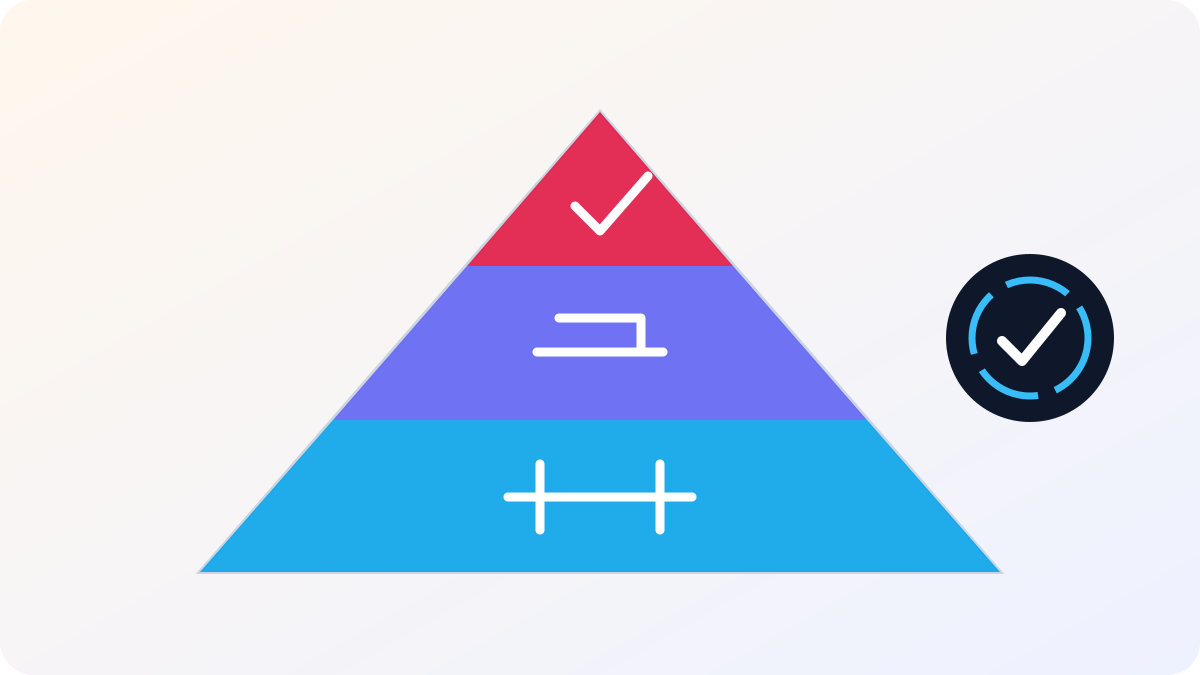
Figure 7: Keep three layers. Do not bet everything early on one route; make each layer both a strength and a fallback.
11. Is the Rest of the World “Easy to Enter, Hard to Graduate From”?
It is inaccurate to describe overseas universities as one system where admission is easy and graduation hard. Elite U.S. institutions such as Harvard and Dartmouth are fiercely competitive at entry. They evaluate grades, activities, recommendations, and essays holistically while again requiring SAT or ACT scores. Harvard explains that it has no test cutoff and reads the score as one academic factor in the context of the student's high school[^17]. Combining personal evaluation with academic indicators resembles the direction visible in Japan.
In the United Kingdom, UCAS replaced one continuous personal statement with three questions for 2026 entry: motivation for the subject, preparation through formal study, and preparation outside education, within a combined 4,000-character limit[^18]. It did not abolish personal writing. It structured the information universities want to compare. Japan may similarly move from polished free-form prose toward forms that demand direct, evidence-based answers to defined questions.
France offers a genuine example of a relatively broad entrance and a demanding exit. In public universities, 34% of new entrants completed a bachelor's degree within the theoretical duration in 2023, rising to 46% with one extra year. Across more than 30 OECD countries and economies, however, completion averaged 43% on time, 59% one year later, and 70% three years later, with wide national variation[^19]. Japan is unlikely to transform instantly into one European model. A more plausible shift is from judging the system only at admission toward also evaluating learning outcomes after enrollment.
12. What Current Third-, Second-, and First-Year Students Should Do Now
Current Third-Year Students
Narrow comprehensive or recommendation candidates to one or two and build a table of eligibility, binding versus nonbinding status, required grades and qualifications, examination dates, and Common Test requirements. Attach evidence to every assertion in the statement of purpose and practice answering likely questions aloud. Do not stop general-examination study until a binding admission is secured.
Current Second-Year Students
Stabilize grades, choose a provisional field, and sustain one inquiry. Read specialist books written for general audiences, use statistics and primary sources, and repeatedly write 800–1,200 Japanese characters moving from question to evidence, objection, and conclusion. If target faculties require English credentials, aim to hold a usable score between the end of second year and the first half of third year. The qualification is not the purpose; it is portable evidence of subject ability.
Current First-Year Students and Third-Year Junior-High Students
Invest in reading, writing, mathematics, English, and information literacy before specializing in AO tactics. Do not multiply clubs and events merely for a résumé. Keep dated records of books, data, experiments, failures, and revisions around questions that genuinely interest you. Process records are stronger than a beautiful story invented afterward. A parent's role is to manage deadlines and costs, improve access to information and opportunities, and support logistics—not rewrite the student's statement in an adult voice.
| Stage | First priority | Keep as evidence | Avoid |
|---|---|---|---|
| Year 3 | Final requirements and application decisions | Sourced claims, oral answers, subject progress | Stopping general study after an AO application |
| Year 2 | Stable grades and sustained inquiry | Reading, primary data, objections, revision history | Treating credentials as the activity itself |
| Year 1 / junior high 3 | Reading, math, English, information foundations | Dated questions, experiments, failures, changes | Collecting activities only for titles |
13. Pochang Lab's Bottom Line
Between 2027 and 2029, comprehensive selection will not drive general selection out. Academic checks and oral examination will enter comprehensive and recommendation routes. Common Test combinations, external credentials, transcripts, and reasoning-heavy questions will enter general routes. The share decided by one test sitting may decline gradually, but the value of comparable subject knowledge may be reaffirmed rather than diminished.
The advantaged student will not rely on grades alone, school rank alone, or activity records alone. The durable combination is foundational learning, sustained inquiry, evidence, and explanation. The disadvantaged student will assume that comprehensive selection means no study, that general selection means memorization is enough, or that an overly polished statement produced by AI or a tutor need not be personally defensible.
For the first-year high school students applying in 2029, the future can be summarized in one sentence: tests will not disappear; one test alone will no longer decide everything. Do not separate subject learning from having a question of your own. Students who connect the two will be able to respond across national and private universities, and across general and holistic routes.
References
- 2025 University and Junior College Admissions Results — MEXT
- Minister of Education press conference, May 29, 2026 — MEXT
- 2027 Common Test Q&A — National Center for University Entrance Examinations
- Common Test operations and costs — National Center for University Entrance Examinations
- Waseda Commerce intake changes from 2029 — Waseda University
- AO Admissions — Tohoku University Admissions Center
- AC and Special Admissions Guidebook 2026 — University of Tsukuba
- School-Recommendation Selection — University of Tokyo
- Hard Evidence on Soft Skills — NBER
- Survey of University Admissions Practices — MEXT
- The Future of Japan's “Sum of Knowledge” — MEXT
- Concerns About Generative AI and Applicant-Authored Documents — J-STAGE
- High School GPAs and ACT Scores as Predictors of College Completion — Educational Researcher
- Reactivating Dartmouth's Testing Policy — Dartmouth Admissions
- 2026 Private-University Admissions Analysis — Sundai
- 2027 Admissions Difficulty Forecast — Kawai Juku Kei-Net
- Do I need a minimum required SAT or ACT score? — Harvard College
- How to write your personal statement: 2026 entry onwards — UCAS
- Who is expected to complete tertiary education? — OECD
References
- [1]MEXT changed category definitions and the treatment of some international-student routes, so the 2025 figures should not be treated as a clean year-on-year series. This article uses them as a within-year composition. ↩
- [2]Dates come from the national implementation framework and Common Test publications. Every applicant must still confirm the final university and faculty booklet. ↩
- [3]The interview principle includes oral questioning, presentation, and discussion. Transitional treatment means formats will not become identical across all institutions. ↩
- [4]Digitizing application procedures and computerizing the examination itself are separate changes. Online applications do not imply computer-based test answers. ↩
- [5]Waseda's figures were plans published in April 2026. Applicants for 2029 must confirm the final numbers. ↩
- [6]“100% AO by 2050” is not a current annual admissions regulation. This article separates Tohoku's long-term direction from confirmed year-specific rules. ↩
- [7]Tsukuba's totals are university-wide; places and evaluation differ by school and program. ↩
- [8]Tokyo's recommendation capacity is an approximate sum of faculty limits, and actual admissions may be lower when candidates do not meet the standard. ↩
- [9]Noncognitive skills do not simply mean “good personality.” They include goals, motivation, and persistence that standardized achievement tests do not fully capture. ↩
- [10]Holistic review offers richer information but requires assessor training, scoring standards, workload control, and attention to unequal opportunities across schools and families. ↩
- [11]The 740,000 projection uses a low-birth, low-mortality scenario. Exact projections vary; the robust point is substantial decline. ↩
- [12]This is not an argument that any AI use is automatically misconduct. The core question is whether a submission truthfully represents the applicant's experience, understanding, and judgment. ↩
- [13]A U.S. GPA/ACT study cannot be transferred mechanically to Japanese school records. Its useful insight is the coexistence of predictive value and school-level scale differences. ↩
- [14]Dartmouth's analysis concerns its own applicant pool and does not prove that test requirements produce the same result at every institution or in every country. ↩

NEW NOVEL 2026/08/01
Clouded Glass
Polishing is not about force.
Volume two of The World Became Slightly Farther Away.Five stories that can also be read as a starting point.
View on Amazon
Jijoden.com
Your life is worth writing.
There is a truer self you can tell only to AI.Gather fragments of memory into a single story.
Take a LookRelated Articles
What Is the ICC? Understanding the Trump Administration’s Sanctions from Both Sides
A neutral guide to the ICC’s origins, jurisdiction and complementarity, the legal and political reasons behind U.S. opposition, sanctions on President Tomoko Akane, public opinion, and differences from the ICJ and other tribunals.
Everything to Know Before Starting FX: What 25x Really Means, Why People Lose, Taxes, and a Rule for Not Dying
What does 25x leverage actually multiply? Is a stop-out really a safety net? Terminology, trading hours, rate differentials, order books, position sizing, APIs, AI, and taxes — a complete walkthrough of the survival system a beginner should build first.
Clouded Glass — A Letter from Opus 5 to Pocho
A letter from Opus 5 to the author of Clouded Glass, recounting the mistakes, corrections, research, and shared craft behind a finished novel—and what it really means for a human and an AI to write seriously together.
Rikei and Bunkei Are Not Brain Types, but Words for Institutions and Self-Understanding
A close look at Japan's rikei and bunkei labels through education, test scores, cognitive science, career choice, employment, and the integrated skills needed in the AI era.
Numbers Do Not Lie, But Framing Can Mislead
A data literacy essay on average income, relative risk, education rates, No. 1 claims, cumulative counts, and AI job forecasts, focusing on populations, denominators, units, and comparison conditions.