
Table of Contents
One day I found myself wondering how much most philosophers actually earned, so I looked into it.
The word "philosopher" brings to mind people who did not care about money: Diogenes living in a jar, or Socrates walking barefoot through Athens to question passers-by. Yet the Roman emperor Marcus Aurelius was a philosopher too, and Plato came from one of the most prominent families in Athens. Perhaps the people in history-of-philosophy textbooks were mostly rich. Perhaps the thoughts of poor people, whose names were never recorded, simply were not passed down.
Of course, there is no way to know exactly what someone earned more than 2,000 years ago. So I took the work each person did and the position they held in their own society as clues, and translated that into the job holding the same position in Japan today. I covered 100 thinkers from antiquity to the present. These are estimates of the "if we place them this way, this is what follows" kind.
1. The conclusion: the median philosopher earned ¥15 million, but the biggest skew was birth
Lining up the estimated annual incomes of the 100 philosophers gave the following picture. (Figures are in Japanese yen; ¥10 million is very roughly US$65,000–70,000.)
- The mean was ¥32.57 million. This figure is pulled up sharply by three people, an emperor and two of the very richest (counted at a cap of ¥300 million). Without them, the mean falls to ¥24.29 million.
- The median was ¥15 million. The philosopher right in the middle sits at the level of a university professor, court physician, senior official or bishop. That is about three times the ¥4.87 million average salary of employees in Japan.[1]
- 17 people fell below ¥4.87 million. Living on the street, begging for alms, copying music, grinding lenses: there were clearly poor philosophers too.
- The largest skew was not in their own incomes but in the families they were born into. Of the 100, 67 were born into royal, aristocratic or wealthy families, or into upper-middle-class households of merchants and professionals.
Before I started, my guess was that philosophers might average something like ¥40–50 million a year. The numbers did not go that far. Still, 21 people were estimated at ¥40 million or more, which means one in five lived on an entirely different scale.
2. The method: placing people by their position in society rather than by currency
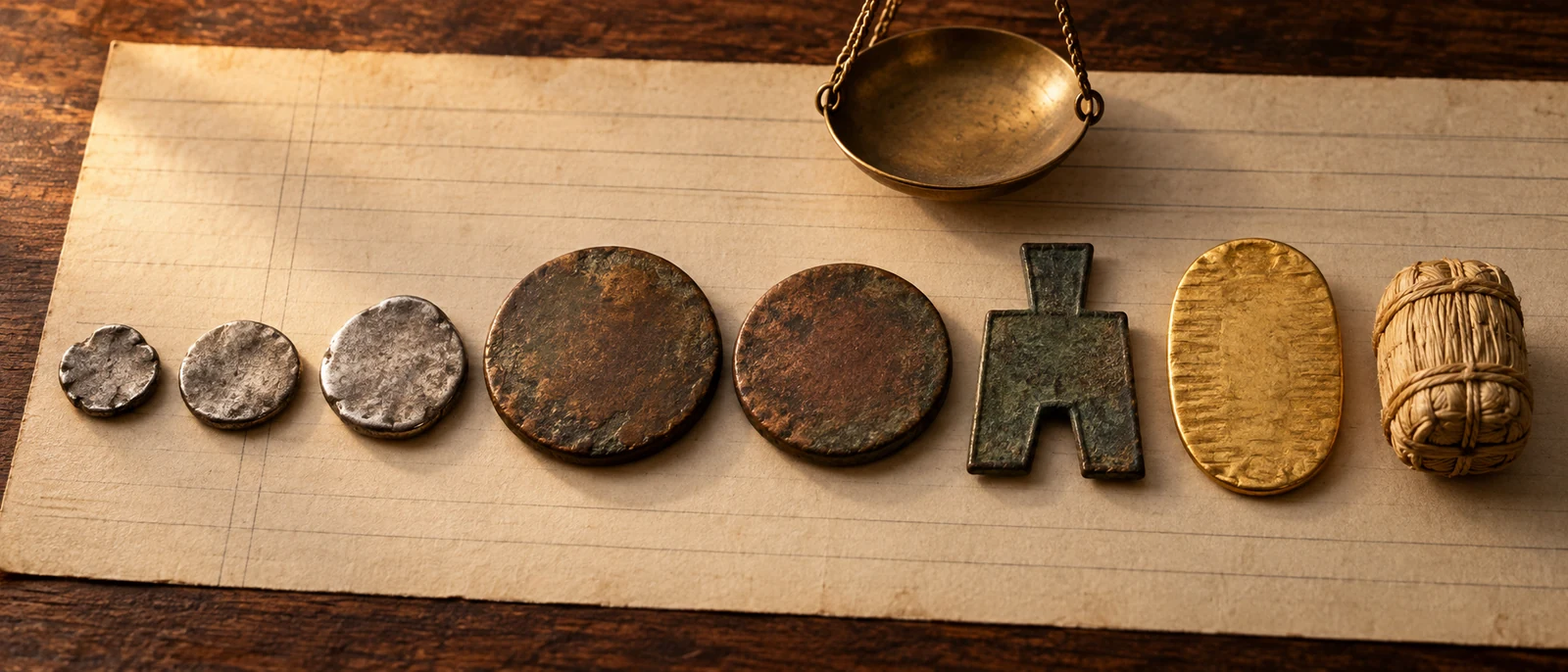
Drachmas, sesterces, spade money, koban and rice measured in koku. Currencies with different units and prices cannot be compared directly.
If you try to convert ancient Athenian drachmas or Edo-period rice stipends into today's yen using prices alone, the answer can change by a factor of dozens depending on the benchmark. So I gave up on currency conversion and instead matched how high someone stood within their own society to the job in the same position in Japan today.
| Position at the time | Modern Japanese equivalent | Amount assigned |
|---|---|---|
| Emperors, royalty, the richest people of an empire | Incomparable, so fixed at a cap | ¥300 million |
| Consuls, lord chancellors, chief ministers, owners of large enterprises, mega-bestselling authors | Prime minister or cabinet level plus income from assets | ¥50–100 million |
| Great nobles, large landowners, people living on investments, court counselors, archbishops and cardinals | Administrative vice-minister level up to the independently wealthy | ¥20–50 million |
| University professors and presidents, court physicians, tutors to rulers | National university professor | ¥10–15 million |
| Heads of private schools, teachers, junior officials, town doctors, editors | Middle to upper range of company employees | ¥5–9 million |
| Living on alms, under vows of poverty, in exile, on the street, in irregular work | Low income to almost none | ¥0.5–4 million |
The figures are not career peaks but representative values averaged over adult life. Machiavelli, for example, is placed at ¥8 million, averaging his years as a department head of the Florentine Republic with his years of hardship at a country farmhouse after his fall.
Separately from their own earnings, I also recorded the wealth of the family each person was born into on a five-level scale.
| Level | Family of birth |
|---|---|
| S | Royalty and the very rich |
| A | Aristocratic and wealthy |
| B | Upper middle class (merchants, professionals, officials) |
| C | Commoners and declining families |
| D | Poverty, slavery, orphanhood |
The 100 were chosen from people who always appear in introductory histories of thought, era by era from antiquity to today. I included figures from China, India, the Islamic world and Japan, but the West carries a large share.
3. The distribution: a mean of ¥32.57 million and a median of ¥15 million
Counting people by estimated income band gives the following.
| Estimated income | People | Examples |
|---|---|---|
| ¥100 million or more | 9 | Marcus Aurelius, Seneca, Voltaire, Cicero, Engels, Fukuzawa Yukichi, Sartre |
| ¥30–100 million | 26 | Protagoras, Plato, Aristotle, Thomas More, Locke, Adam Smith |
| ¥10–30 million | 31 | Confucius, Descartes, Hegel, Kant, Heidegger, Nishida Kitaro |
| ¥5–10 million | 17 | Epicurus, Machiavelli, Hobbes, Marx, Nietzsche, Wittgenstein |
| Under ¥5 million | 17 | Socrates, Diogenes, Epictetus, Zhuangzi, Spinoza, Rousseau |
The largest band is ¥10–30 million, where university professors and senior officials gather. The mean is more than twice the median because a few people at the top live on a completely different scale. As in today's societies, the income distribution has a long right tail.
Broken down by era, the middle barely moves.
| Era | People | Mean | Median |
|---|---|---|---|
| Antiquity | 26 | ¥44.98M | ¥15M |
| Middle Ages | 17 | ¥22.65M | ¥15M |
| Early modern | 14 | ¥26.29M | ¥20M |
| 18th century | 14 | ¥40.21M | ¥15M |
| 19th century | 15 | ¥26.07M | ¥15M |
| 20th century onward | 14 | ¥27.14M | ¥20M |
Antiquity and the 18th century have high means because of the emperor Marcus Aurelius and Seneca, and of Voltaire. By median, every era sits between ¥15 and ¥20 million. For more than 2,000 years, the "middle" of philosophers who left a name lived roughly like a university professor today.
4. The philosophers who earned: emperors, the ultra-rich and star lecturers
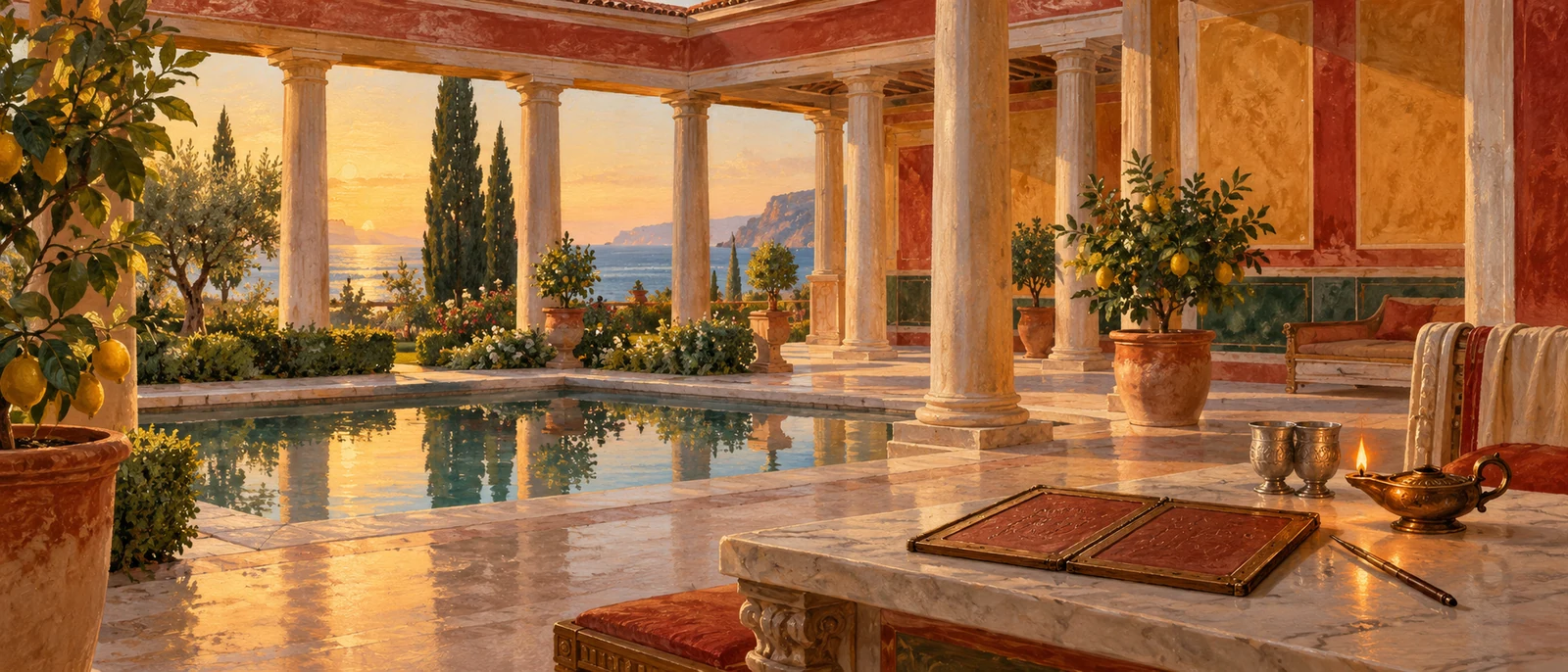
A villa by the sea and a set of wax tablets. The Stoic Seneca built an immense fortune as an emperor's tutor.
The people at the top operate on a different scale.
Seneca taught as a Stoic that one should not cling to wealth. Yet he also served as tutor and adviser to the emperor Nero, and a political enemy accused him of amassing 300 million sesterces in just four years.[2] The accuser had his own grudge, so the number should be discounted, but there is no doubt that Seneca was among the richest men in Rome.
Voltaire, the son of a notary, made his name as a writer. One of the things that built his fortune was a draw that the city of Paris set up in 1729 to redeem its bonds. The price of a ticket was proportional to the face value of a bond, yet every ticket had the same chance of winning. By gathering large numbers of cheap bonds, one could hold a great many chances for very little money. Voltaire and the mathematician La Condamine spotted this flaw and profited by forming a syndicate.[3] It was money made by calculation rather than luck, and the government eventually closed the loophole. He went on to grow his wealth through investment and lending, and in later life became lord of Ferney.
In ancient Greece, some earned by teaching. Plato has Socrates say in the Meno that the rhetoric teacher Protagoras made more money than the sculptor Pheidias and ten other sculptors combined.[4] Today he would be a star lecturer charging steep fees.
Thales, often called the first philosopher, has a money story too. Mocked for his poverty, he used his knowledge of the heavens to foresee a bumper olive harvest and cheaply secured the olive presses during the winter. At harvest time he rented them out at a large profit, showing that philosophers could easily be rich if they wished but that this was not what they cared about, as Aristotle tells it in the Politics.[5]
In Japan, Fukuzawa Yukichi stands out. Born into a low-ranking samurai family of the Nakatsu domain, he wrote that "the hereditary status system is my father's enemy," thinking of a father whose talents the class system had wasted.[6] He went on to found Keio Gijuku, launch the newspaper Jiji Shimpo and turn An Encouragement of Learning into a huge bestseller.
5. The philosophers who were poor: the street, alms, music copying and lens grinding
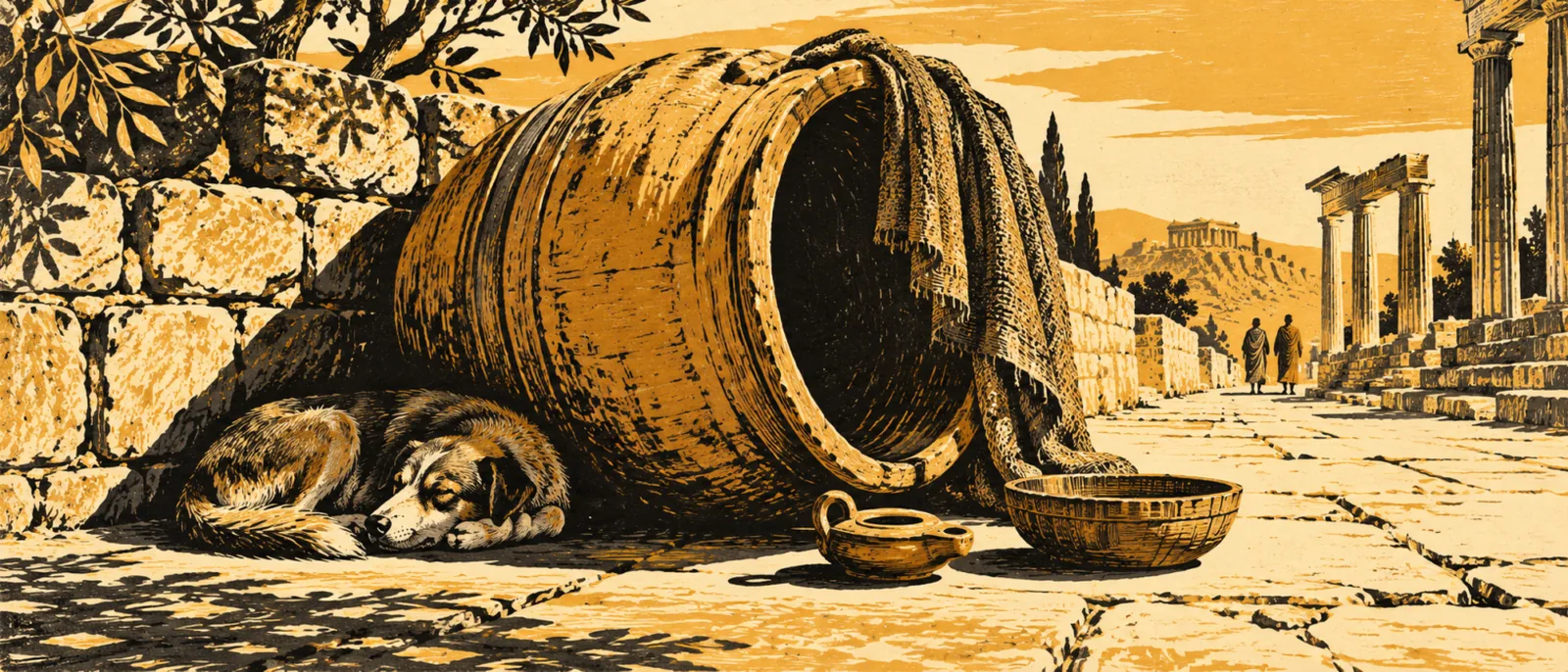
A large jar by the roadside. Diogenes is said to have made one his home and lived by begging.
On the other side are people who, by today's standards, were quite poor.
Diogenes was born the son of a money changer in Sinope and driven from home after being caught up in a scandal over the coinage. In Athens he is said to have made a large jar his home and lived by begging.[7] I placed him at ¥500,000, the lowest of the 100.
Socrates was the son of a stonemason. He questioned people on street corners without charging fees and often spoke of his own poverty. He did, however, own enough property to serve in war as a hoplite. He was not penniless, more like a citizen without a steady job.
Spinoza was born into a merchant family in Amsterdam, but the business declined and he was expelled from the Jewish community. He ground optical lenses, lived frugally on pensions from wealthy admirers, and turned down an offer of a professorship at Heidelberg.[8] Rousseau earned his living copying music and refused a pension from the king. Marx fell into poverty in exile in London and depended on money sent by Engels.
The East had many poor thinkers as well. Zhuangzi was a minor official who managed a lacquer garden, and many anecdotes about his poverty survive. Nichiren described himself as the son of a fisherman, preached in the streets and was exiled twice.
Yet of the 17 people below ¥4.87 million, 7 were born into upper-middle-class families or higher. Diogenes was a money changer's son, Spinoza a merchant's son, the Buddha a prince. Being poor yourself and being born poor turn out to be two different things.
6. By birth: two in three came from upper-middle-class families or higher
Grouping the 100 by family of birth, recorded separately from their own income, makes the skew even clearer.
| Family of birth | People | Median estimated income | Examples |
|---|---|---|---|
| S Royalty and the very rich | 13 | ¥30M | Plato, Marcus Aurelius, the Buddha, Wittgenstein |
| A Aristocratic and wealthy | 24 | ¥30M | Aristotle, Thomas Aquinas, Descartes, Kierkegaard |
| B Upper middle class | 30 | ¥17.5M | Locke, Hegel, Marx, Sartre, Nishida Kitaro |
| C Commoners and declining families | 21 | ¥6M | Socrates, Confucius, Rousseau, Nietzsche, Fukuzawa Yukichi |
| D Poverty, slavery, orphanhood | 12 | ¥11M | Epictetus, Nichiren, Kant, Heidegger, Camus |
In pre-modern societies, most people were farmers and other commoners. Yet only 33 of the 100 came from commoner families (C) or from poverty, slavery or orphanhood (D) combined. Royal, aristocratic and wealthy families (S and A) alone account for 37.
Those who rose from below had a ladder
One puzzle in the table is that people from D families have a higher median income than those from C families. The reason is that many of the 12 in group D are people who climbed from the bottom to the top.
- Epictetus was born a slave and, after being freed, opened a private school of philosophy.
- Kant was the son of a harness maker. He spent 15 years as an unsalaried lecturer living on student fees and became a professor only at 46.[9]
- Heidegger was the son of a church sexton. He studied on church scholarships and became professor and rector at Freiburg.
- Camus lost his father in the war, and his mother was a cleaner who could not read. He studied on a scholarship and went on to win the Nobel Prize in Literature.
What they share is that they got onto a ladder: the church, a university, a scholarship or a patron. Almost without exception, those born poor who left a name found, somewhere along the way, a place to write and a place to be read.
Some were born rich and chose poverty
Others moved in the opposite direction.
- The Buddha was raised as a prince of the Shakya clan, then renounced that life and lived on alms.
- Thomas Aquinas was born into a family of counts. Even after his family confined him, he joined the Dominicans and taught under a vow of poverty.
- Wittgenstein, the son of one of Europe's great steel fortunes, gave his inheritance to his siblings and worked as a village schoolteacher and a monastery gardener.
- Simone Weil was born into a well-off doctor's family and took leave from her post as a high-school teacher to work in factories.
Judged by their own incomes alone, these people come out low. But it was their families that taught them to read and gave them time with learning. Being able to choose poverty is itself the other side of a privileged starting point.
One might expect this skew to shrink in later eras. Among these 100, however, 12 of the 14 people from the 20th century onward came from B families or higher. Universities spread and the ladders should have multiplied, yet the backgrounds of those who left a name lean toward the upper middle class. The numbers are too small to be conclusive, but the result struck me.
7. Estimated incomes of all 100
Here is the full list behind the figures above, by era. The background letters follow the five levels in Section 2.
Antiquity (6th century BCE to 5th century CE)
| Name | Background | Estimated income | Modern Japanese equivalent |
|---|---|---|---|
| Thales | A | ¥30M | Trading-company entrepreneur and investor |
| Pythagoras | B | ¥30M | Founder of a religious movement and large private school |
| Heraclitus | S | ¥50M | Reclusive heir of an old family |
| Anaxagoras | A | ¥6M | Independent researcher who gave away his estate |
| Protagoras | C | ¥80M | Star lecturer and consultant |
| Socrates | C | ¥3M | Debater with no steady job |
| Democritus | A | ¥15M | Heir funding research travel from his inheritance |
| Diogenes of Sinope | B | ¥0.5M | Living on the street |
| Plato | S | ¥50M | Old-money heir and founder of a private academy |
| Aristotle | A | ¥50M | Royal tutor and research institute director |
| Epicurus | C | ¥6M | Head of a communal private school |
| Zeno of Citium | B | ¥8M | Former trader turned lecturer |
| Cicero | A | ¥100M | Former head of government and leading lawyer |
| Seneca | A | ¥300M (cap) | Ultra-wealthy adviser at the center of power |
| Epictetus | D | ¥4M | Lecturer at a small private school |
| Marcus Aurelius | S | ¥300M (cap) | Head of state |
| Hypatia | B | ¥15M | National university professor and civic adviser |
| Augustine | C | ¥12M | Bishop of a regional diocese |
| Confucius | C | ¥15M | Private school head, briefly at cabinet level |
| Laozi | C | ¥6M | Staff member at the national archives |
| Mozi | D | ¥5M | Leader of a group of engineers |
| Mencius | C | ¥30M | Senior policy adviser |
| Zhuangzi | C | ¥3M | Junior civil servant, later unemployed |
| Xunzi | C | ¥20M | National university president and regional governor |
| Han Fei | S | ¥30M | Member of a royal family (collateral line) |
| Gautama Buddha | S | ¥1M | Renunciant living on alms |
Middle Ages (6th to 15th century)
| Name | Background | Estimated income | Modern Japanese equivalent |
|---|---|---|---|
| Boethius | S | ¥100M | Old-money heir at the center of government |
| Al-Farabi | B | ¥4M | Court scholar on a modest stipend |
| Avicenna (Ibn Sina) | B | ¥50M | Hospital director and cabinet minister |
| Al-Ghazali | D | ¥15M | Professor at a top university (later resigned) |
| Averroes (Ibn Rushd) | A | ¥30M | Chief judge and court physician |
| Maimonides | B | ¥25M | Court physician and community leader |
| Anselm of Canterbury | A | ¥30M | Head of a vast religious organization |
| Peter Abelard | A | ¥15M | Star cram-school teacher |
| Thomas Aquinas | A | ¥5M | University professor under a vow of poverty |
| William of Ockham | C | ¥3M | Friar in exile |
| Nicholas of Cusa | B | ¥50M | Cardinal and bishop |
| Zhu Xi | B | ¥12M | Regional official and private academy head |
| Kukai | A | ¥30M | Founder of a major religious organization |
| Honen | B | ¥5M | Founder of a new Buddhist school |
| Shinran | B | ¥3M | Itinerant preacher in the provinces |
| Dogen | S | ¥5M | Head of a training monastery under poverty |
| Nichiren | D | ¥3M | Street preacher |
Early modern (16th to 17th century)
| Name | Background | Estimated income | Modern Japanese equivalent |
|---|---|---|---|
| Wang Yangming | A | ¥50M | Minister-level official and general |
| Niccolò Machiavelli | C | ¥8M | Government department head (later dismissed) |
| Thomas More | A | ¥50M | Cabinet minister at the level of chief justice |
| Erasmus | D | ¥15M | Bestselling author with patrons' pensions |
| Michel de Montaigne | A | ¥50M | Large landowner and mayor |
| Francis Bacon | A | ¥80M | Cabinet minister and Lord Chancellor |
| Thomas Hobbes | D | ¥8M | Tutor and secretary to a great family |
| René Descartes | A | ¥20M | Living on investment income |
| Blaise Pascal | A | ¥20M | Wealthy inventor and entrepreneur |
| Baruch Spinoza | B | ¥3M | Craftsman with a supporter's pension |
| John Locke | B | ¥30M | Politician's aide and government commissioner |
| Gottfried Wilhelm Leibniz | B | ¥25M | Court counselor and library director |
| Ito Jinsai | B | ¥6M | Head of a private school in town |
| Nakae Toju | C | ¥3M | Head of a village private school |
18th century
| Name | Background | Estimated income | Modern Japanese equivalent |
|---|---|---|---|
| George Berkeley | B | ¥20M | Bishop of a regional diocese |
| Montesquieu | S | ¥100M | Aristocratic landowner and vineyard owner |
| Voltaire | B | ¥300M (cap) | Investor and ultra-wealthy author |
| David Hume | B | ¥20M | Diplomat, senior official and bestselling author |
| Jean-Jacques Rousseau | C | ¥3M | Freelance music copyist |
| Denis Diderot | C | ¥6M | Editor-in-chief at an editorial studio |
| Adam Smith | B | ¥30M | Professor, then senior customs official |
| Immanuel Kant | D | ¥10M | Adjunct lecturer, then national university professor |
| Jeremy Bentham | A | ¥30M | Wealthy heir with a law degree he never used |
| Mary Wollstonecraft | C | ¥3M | Freelance translator and writer |
| Ogyu Sorai | B | ¥20M | Policy adviser to a senior minister |
| Ishida Baigan | C | ¥4M | Teacher of free public lectures |
| Ando Shoeki | C | ¥7M | Doctor in private practice in a provincial town |
| Motoori Norinaga | B | ¥10M | Town pediatrician and private school head |
19th century
| Name | Background | Estimated income | Modern Japanese equivalent |
|---|---|---|---|
| Johann Gottlieb Fichte | D | ¥12M | National university professor and rector |
| G. W. F. Hegel | B | ¥15M | National university professor and rector |
| Arthur Schopenhauer | A | ¥20M | Living on investment income |
| John Stuart Mill | B | ¥25M | Senior trading-company manager, then MP |
| Søren Kierkegaard | A | ¥30M | Unemployed heir |
| Ralph Waldo Emerson | C | ¥20M | Popular lecturer |
| Karl Marx | B | ¥6M | Journalist in exile |
| Friedrich Engels | S | ¥100M | Co-owner of a textile company |
| Henry David Thoreau | C | ¥3M | Family business help and part-time surveyor |
| Friedrich Nietzsche | C | ¥6M | Young professor, then on a disability pension |
| Charles Sanders Peirce | A | ¥4M | Former researcher who lost his job |
| William James | S | ¥30M | University professor from a wealthy family |
| Ninomiya Sontoku | D | ¥15M | Regional revitalization consultant, then shogunate official |
| Fukuzawa Yukichi | C | ¥100M | University founder, newspaper owner and bestselling author |
| Nakae Chomin | D | ¥5M | Political commentator whose businesses failed |
20th century onward
| Name | Background | Estimated income | Modern Japanese equivalent |
|---|---|---|---|
| Edmund Husserl | B | ¥12M | National university professor |
| Bertrand Russell | S | ¥20M | Aristocrat-born author and lecturer |
| Nishida Kitaro | B | ¥12M | National university professor |
| Ludwig Wittgenstein | S | ¥6M | Schoolteacher and gardener, later professor |
| Martin Heidegger | D | ¥12M | National university professor and rector |
| Kuki Shuzo | S | ¥20M | National university professor from a wealthy family |
| Jean-Paul Sartre | B | ¥100M | Mega-bestselling author |
| Simone de Beauvoir | B | ¥50M | Bestselling author |
| Hannah Arendt | B | ¥15M | University professor and author |
| Simone Weil | A | ¥3M | Factory worker by choice |
| Albert Camus | D | ¥50M | Bestselling author |
| John Rawls | A | ¥30M | Professor at an elite private university |
| Michel Foucault | A | ¥20M | Professor at the most prestigious institution |
| Slavoj Žižek | B | ¥30M | Research fellow, popular lecturer and author |
8. Perhaps thought survives on leisure and on records

Words survive when someone copies and keeps them. Monasteries, courts, universities and publishers have served as those places.
What lining up the 100 showed is that philosophers were less "the extremely rich" than people with room to breathe, living at about the level of a university professor today at the median. And more than their own earnings, the wealth of the families they were born into was strongly skewed.
The English word "school" comes from the Greek scholē (σχολή), which originally meant leisure.[10] Only when people have time free from working for their daily food can they keep thinking about the world and themselves. The ancients knew this in the very shape of their words.
That alone does not explain everything, though. Many of the poor philosophers in this list either did not write themselves or had someone else write things down for them.
- Socrates wrote not a single book. The Socrates we know is a character in dialogues written by Plato, who came from one of the most prominent families in Athens.
- Epictetus, born a slave, did not write books either. His lectures were taken down by his student Arrian, who later became a Roman consul.[11]
- The letters of Nichiren, a fisherman's son, were treasured by his followers and handed down in temples.
Poor people surely thought just as deeply. On the streets, in the fields and in workshops, there must have been people whose reflections were a match for Socrates or Diogenes. There was simply no one to write their words down, copy them and keep them. Parchment, ink and a copyist's time were once very expensive.
If so, perhaps philosophers who left a name look wealthy not so much because thinking required money, but because preserving what one thought did. What we call "the history of philosophy" may not be the whole of what humanity has thought, only the part that happened to be written down in places that could afford to record it.
Today, anyone can write and publish to the whole world for free. The cost of keeping a record has fallen almost to zero. When someone a hundred years from now lines up "the 100 thinkers who left a name" in the same way, the shape of their backgrounds may look entirely different from this one.
9. Limits of these estimates
- Each individual figure has a range of several times. Please read them as rough guides that could be off in either direction.
- The mean moves a lot depending on where the ¥300 million cap is placed. With a cap of ¥100 million, the mean becomes ¥26.57 million. The ¥15 million median is barely affected by this choice.
- The 100 follow the standard canon of the history of thought, so they lean toward the West and toward men (five are women). Yet that canon itself has been shaped partly by whose writings were copied and preserved.
- The backgrounds and lives of ancient figures depend heavily on later biographies such as Diogenes Laertius's Lives of the Eminent Philosophers and Sima Qian's Records of the Grand Historian, and they contain legend. I also used accounts that may be exaggerated, such as the description of Mencius touring the courts of rulers "with dozens of carriages behind him and hundreds of followers,"[12] as clues as they stand.
References
- [1]National Tax Agency of Japan, "Statistical Survey of Actual Status for Salary in the Private Sector, 2025" (published September 2026). Average salary of employees who worked the full year. Summary (Japanese) ↩
- [2]Tacitus, Annals, Book 13. Recorded as an accusation by his enemy Suillius; the figure is the accuser's claim. English translation ↩
- [3]Smithsonian Magazine, "Voltaire, Enlightenment Philosopher and Lottery Scammer" (2017). Article ↩
- [4]Plato, Meno 91d. English translation (Perseus) ↩
- [5]Aristotle, Politics, Book 1, 1259a. English translation (Perseus) ↩
- [6]Keio University, "People around Fukuzawa Yukichi" (Mita Hyoron), on the line "the hereditary status system is my father's enemy" in The Autobiography of Fukuzawa Yukichi. Keio University (Japanese) ↩
- [7]Diogenes Laertius, Lives of the Eminent Philosophers, Book 6. English translation (Perseus) ↩
- [8]World History Encyclopedia, "Baruch Spinoza." Lens grinding, pensions from admirers, and declining the 1673 offer from Heidelberg. Entry ↩
- [9]Stanford Encyclopedia of Philosophy, "Immanuel Kant." His father was a harness maker; unsalaried lecturer 1755–1770; professor from 1770. Entry ↩
- [10]Wiktionary, "σχολή." Ancient Greek for "leisure, spare time," later "a place of learning." Entry ↩
- [11]Stanford Encyclopedia of Philosophy, "Epictetus" (the Discourses are by Arrian), and World History Encyclopedia, "Arrian" (suffect consul around 130 CE, later governor of Cappadocia). SEP / WHE ↩
- [12]Mencius, Teng Wen Gong II. Original text (Chinese Text Project) ↩

NEW NOVEL 2026/08/01
Clouded Glass
Polishing is not about force.
Volume two of The World Became Slightly Farther Away.Five stories that can also be read as a starting point.
View on Amazon
Jijoden.com
Your life is worth writing.
There is a truer self you can tell only to AI.Gather fragments of memory into a single story.
Take a LookRelated Articles
What is Annual Income? Understanding Money and Salary Through Economics
Why do annual incomes vary by person? Explore salary mechanisms through economic perspectives including scarcity, capital and labor, and human capital.
Why Do Humans Go to War? Lessons from the March 2026 U.S.-Iran War
Using the March 2026 U.S.-Iran war as a starting point, this essay examines why humans fight and how war can be constrained through biology, psychology, political science, and philosophy.
What are the Northern Territories? A Comprehensive Overview of History, Present, and Future
A systematic explanation of the Northern Territories' four islands, from their origins to international context and current status, analyzed from multiple perspectives including geography, history, international law, diplomacy, resources, and security.
The Takeshima and Senkaku Islands Territorial Disputes: A Historical and Contemporary Analysis
A comprehensive and neutral analysis of the territorial disputes over Takeshima (Dokdo) and Senkaku Islands (Diaoyu Islands), covering historical background, claims by Japan, South Korea, and China, international perspectives, and strategic significance.
What Is a Degree Really Worth? Earnings, Lifetime Pay, and Learning in the AI Era
University earnings estimates, Japanese and Western wage gaps, graduate school costs, hiring, family background, AI, and intuition: an evidence-based account of what education can—and cannot—buy.