
Table of Contents
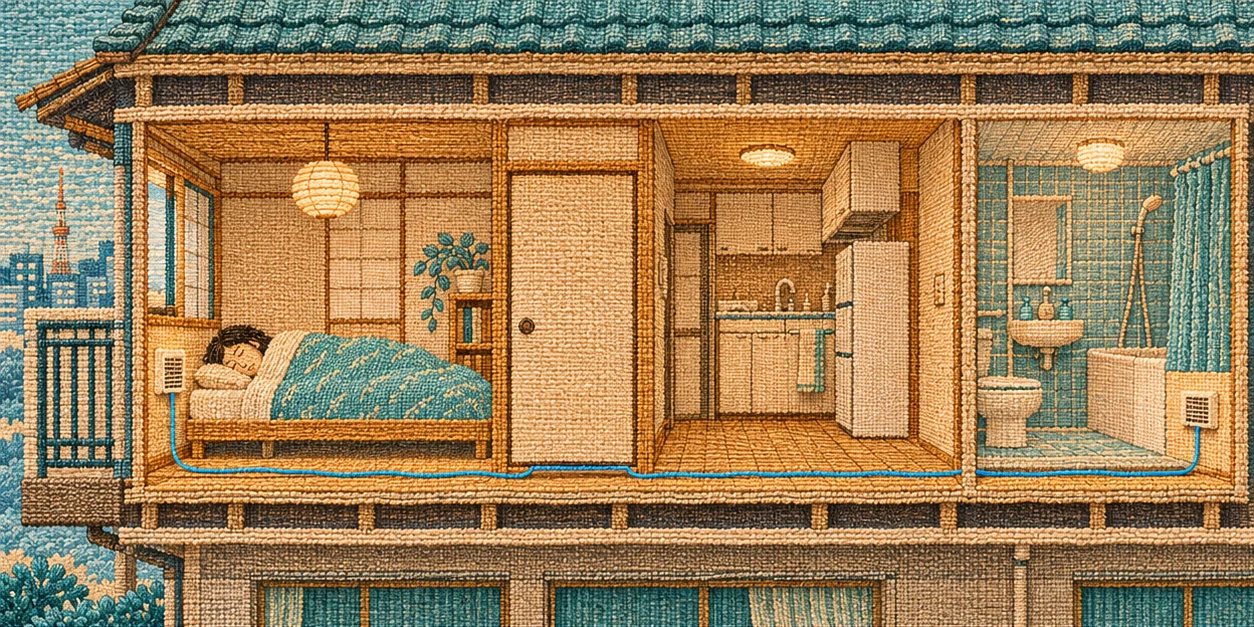
Close the bedroom door and turn out the light. Nobody plans to open a window before morning. Yet the fan humming in the bathroom may be pulling outdoor air into the bedroom at the other end of the hall. The floor plan divides the apartment into rooms. Its ventilation drawing connects them.
One of the best places to start reading that drawing is the narrow gap beneath the bedroom door. What is it doing there? Why might the bedroom feel stuffy even when the fan is running? Follow the air through an ordinary apartment, a Japanese test dwelling, and a 2026 renovation that took a surprisingly different route beneath the floor.
How a bathroom fan draws air into a bedroom
In a Japanese Type 3 system, air enters through inlets on the outside walls of living spaces. A fan extracts it from places such as the bathroom or toilet. Extraction brings indoor pressure slightly below outdoor pressure. That difference draws air through the inlet. Where a closed door separates the bedroom from the bathroom, a door undercut or transfer grille can complete the route. Inlets and outlets vary by dwelling. On your own ventilation drawing, pick one room and see if you can trace a continuous line from outdoors to the exhaust. [1]
Imagine closing the inlet beside your bed because you can feel a cold draft. The bathroom fan still sounds exactly the same. Yet less air may now enter through the bedroom, and more through other gaps. The sound tells you something about the last step in the journey. It tells you very little about the first.
A Type 1 system uses fans for both supply and exhaust. Adding a heat exchanger allows outgoing air to warm incoming winter air and reduce the heating load. An enthalpy exchanger can also transfer moisture. “Type 1” describes what moves the air. “Total heat recovery” describes what the equipment retrieves from it. If a property listing gives you one specification, ask about the other. [3]
At half an air change per hour, how much original air remains after two hours?
Japan’s infrastructure ministry explains that homes generally require mechanical equipment capable of at least 0.5 air changes per hour under the sick-house measures introduced in July 2003. To work out what an individual apartment has today, look at the original plans, subsequent alterations and the equipment actually installed. The year of construction alone cannot answer that question. [1][2]
Take a rectangular space covering 70 square metres with a 2.4-metre ceiling. Its volume is 168 cubic metres. Half an air change per hour means 84 cubic metres of incoming air each hour. After two hours, 168 cubic metres have entered. But some of that new air has already left. What comes out of the exhaust is a mixture of old and new.
If the room mixes perfectly and the flow stays constant, the fraction of original air remaining is the exponential of minus the air-change rate times elapsed hours. After two hours about 37% remains. After four hours it is about 14%. Those figures describe a model. Real apartments have partitions and changing winds, and sleepers keep breathing. A whole-dwelling design rate alone cannot predict what happens behind a closed bedroom door.
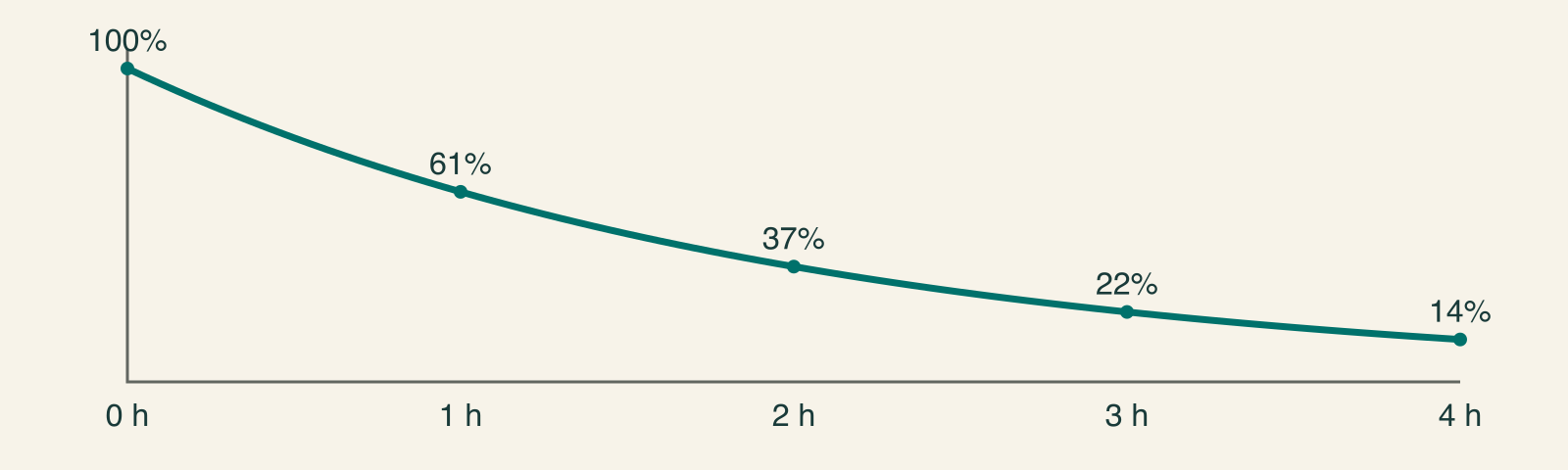
Original air remaining at 0.5 air changes per hour under perfect mixing. Time in hours.
An experiment recreates a night with two sleepers in a 6.5-tatami bedroom
Panasonic publishes measurements from a 75.1-square-metre test apartment at Haseko’s technical centre in Tama, Tokyo. Researchers released carbon dioxide equivalent to two people sleeping in a 6.5-tatami bedroom. They measured CO₂ in the centre of each room, 1.1 metres above the floor. This setup follows a continuous source in one room and records what happens elsewhere in the dwelling. [3]
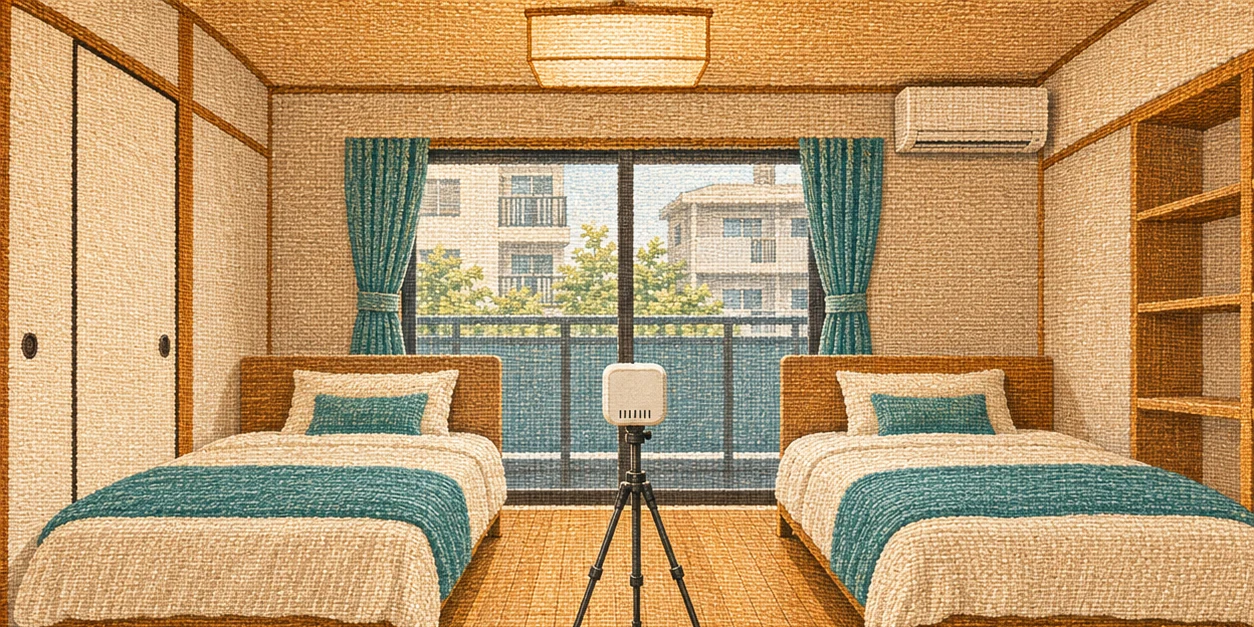
Illustration of the test setup. The publisher specifies the bedroom size, source and measurement height.
The comparison paired individual air conditioning and bathroom extraction at 0.5 air changes per hour with whole-dwelling conditioning and heat-recovery ventilation at 0.59. Panasonic reports that concentrations stayed at or below 1,000 ppm in the latter test. Notice what changed between the two setups. Outdoor-air flow increased, and air circulation within the apartment changed too. The experiment cannot tell you how many ppm you would gain by installing a heat exchanger alone. [3]
If you have a CO₂ monitor, record how many people slept in the room, when they entered and left, and the positions of the door and inlet. Keep the monitor in the same place for several nights, away from anyone’s exhaled breath and the incoming air jet. When one condition changes, look at when the reading starts to rise and how quickly it falls in the morning. The trace can help you explore the relationship between occupants and outdoor air. Pollen, odours and humidity each need a different observation.
Two routes through a Japanese apartment in 2026: above the ceiling and beneath the floor
In February 2026, Hinokiya announced its Z Kuchō apartment model. To fit the limited ceiling void, the company reduced its air-conditioning duct diameter from 150 mm in the detached-house model to 100 mm. One concealed air conditioner can serve up to eight outlets. Those outlets deliver conditioned air. To find the amount of fresh air the dwelling receives, ask for the ventilation drawing as well. [4][5]
A September renovation announcement from Fukuoka describes a different answer. Hapirino installed total heat-recovery ventilation in a 27-year-old condominium and ran the pipes beneath the floor. The project also added interior windows, insulated party walls and created an entrance vestibule. Its reported change in energy costs reflects a package of measures. It cannot establish savings from the ventilator alone. What it does demonstrate is a physical possibility: replacing the floor can open up a duct route when ceiling space is scarce. [6]
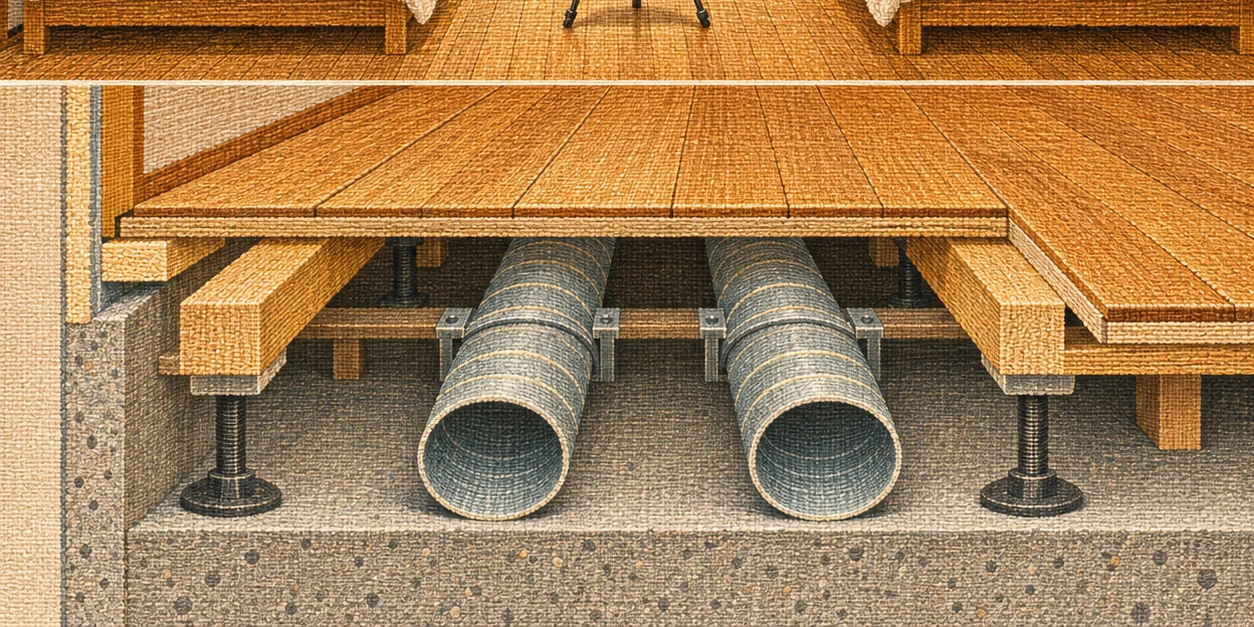
A raised floor provides a possible duct route. The drawing illustrates the principle.
At a viewing, ask where outside air enters and where you would stand to change the filter. If you are buying to renovate, check the available floor depth, beams, existing exterior openings and access panels on the drawings. Two apartments of equal size can have different options. Before paying for a design that involves an external wall or common duct, check the building rules and the management association’s approval process.
Separate the fan’s electricity bill from the heating and cooling calculation
Look up the input power of the mode you normally use. On a bathroom control panel, drying clothes, heating the bathroom and continuous ventilation operate different functions. Suppose the continuous mode draws 10 W and electricity costs 31 yen per kWh. Over 30 days, 0.010 kW × 24 hours × 30 days gives 7.2 kWh, or about 223 yen. At 20 W it would be about 446 yen. Substitute your unit’s wattage and your tariff to get a household estimate.
Heat recovery primarily changes the energy needed to bring outdoor air to room temperature. The financial result also depends on fan power, climate, occupancy, thermostat settings and replacement filters. For renovation estimates, establish which quote includes new ducts, access panels and reinstatement of interior finishes. There may also be a benefit that will never show up on an electricity bill: being able to place a desk beside a winter inlet without a cold draft on your hands.
When the bedroom graph looks suspicious, check the instrument first
An instrument marked “CO₂” can conceal very different measurement methods. Japan’s economy ministry identifies optical sensing, including NDIR, and a calibration function as selection criteria. Check the sensor specification and maintenance instructions before treating the last two digits on the display as meaningful. A value estimated from other gases can respond to a different event from an increase in exhaled CO₂. [7]
A useful overnight record has a beginning and an end. Note the reading before anyone enters, leave the monitor in position, and mark the time the last person leaves. Suppose a reading starts high before bedtime. The evening’s activity may matter as much as the closed door. If it begins rising only after the second sleeper arrives, that timing helps frame a more precise question about occupancy and supply. A single peak seen in a screenshot cannot distinguish the two stories.
If you try opening a window, record the weather and which other opening provides an exit. Air may travel directly between two adjacent windows while the bed across the room sees little change. Daikin illustrates how openings across the room provide a longer path and how a fan facing outward can assist extraction where flow is weak. A permanently running mechanical system and a short burst of window ventilation serve different time scales. [8]
Cooking, laundry and a quiet bedroom produce different clues
A frying pan releases odours at a particular point. Capture them at the cooker hood while cooking and check the intended make-up air inlet. Steam from a bath calls for the bathroom's appropriate extraction mode. A bedroom occupied for eight hours produces a smaller but sustained load. The time and place of the source help explain why the kitchen is the wrong place to measure bedroom performance, even though both rooms share one address.
A cooler bedroom window can collect condensation even while the living-room humidity looks unremarkable. Note which surface is wet, when droplets appear, whether washing is drying indoors, and the local temperature and humidity. The pattern gives a technician a way to separate a cold surface, a temporary moisture source and a ventilation issue. Replacing a filter may help restore airflow, but its colour alone cannot diagnose the cause of condensation.
What to ask for when a system needs replacing
Bring the old model number, plan and service history to the installer. Ask which rooms the new unit serves when bedroom doors are closed, how the outdoor air reaches them, and where a technician can measure the installed flow. A quoted maximum fan capacity does not give the delivered flow through the bends, filters and branches in your home. Ask what commissioning measurements you will receive and keep them with the drawings.
Work backward from a future filter change, too. Can someone reach the panel after the wardrobe is fitted? Can the filter slide out fully? Will the old unit come out through the same opening at the end of its life? A flush ceiling looks attractive on handover day. The location and size of the access panel become much more interesting the first time a part needs replacing.
Keep the as-built duct drawing, terminal positions, filter part numbers and normal settings together. A sales brochure may identify the product without showing the branches serving each room. Tenants can ask which parts they should clean and which are serviced by the building manager, and who to contact if airflow changes.
Walk the route tonight, from the bedroom inlet to the bathroom exhaust
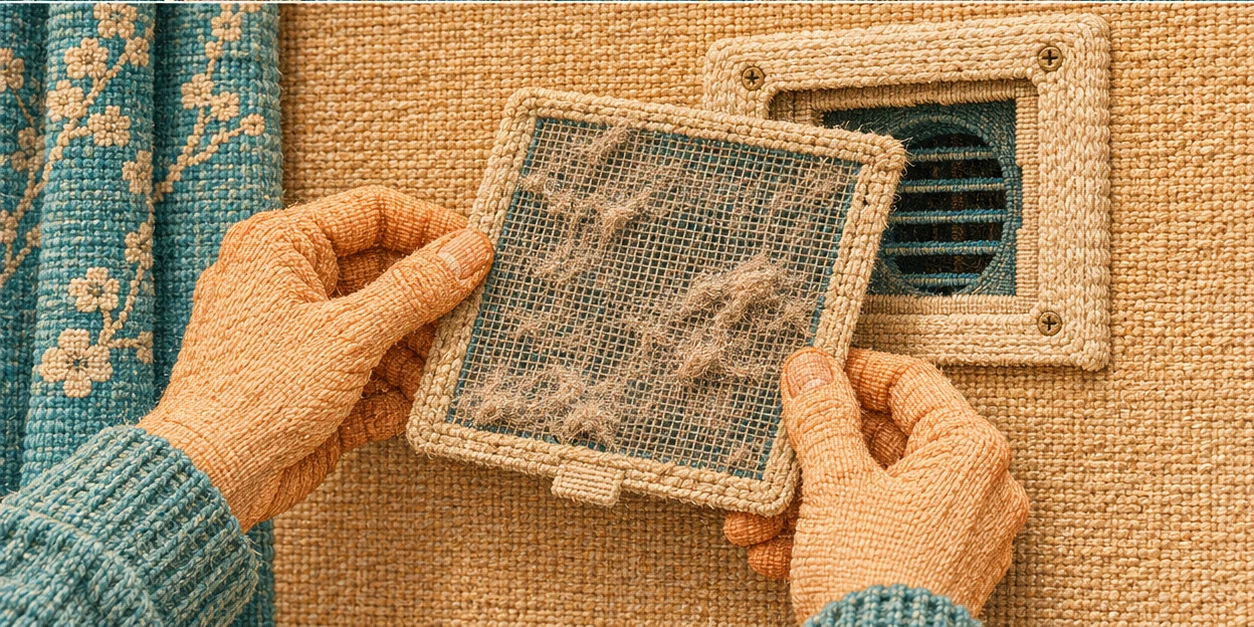
Write down the inlet model number before looking for its cleaning instructions or a replacement filter.
- Start at the outside wall. Check whether furniture or heavy curtains cover the inlet and whether its opening matches the normal position in the manual. For pollen season, look up compatible filters and their replacement intervals. Adding a layer of fabric yourself changes the resistance to airflow.
- Put the door in its usual position. Look for a thick rug or draught strip blocking the undercut or transfer grille. If the intended route is unclear, ask the building manager for the equipment drawing before altering the door.
- Read the bathroom controls. Match the continuous-ventilation indicator to the manual. Find the separate boost and drying settings. Follow the model’s instructions for shutdown during cleaning, washable parts and restarting. Check that it has returned to normal operation afterward.
- Write one sentence for the maintenance team. For example, “Only the bedroom feels stuffy in the morning. Two sleepers, inlet in its normal position, filter replaced, bathroom run light on.” This gives the team a starting point for distinguishing a whole-home fault from a room-specific problem. Ask the technician to measure airflow if needed.
The next time you close the bedroom door, picture the bathroom fan at the far end of that small gap. Once you can draw the route through your own home, you can point to the particular room and stretch of the journey you would like someone to investigate.
References
- [1]国土交通省 / MLIT — 住宅等における換気等に関する情報提供 ↩
- [2]経済産業省 / METI — 家庭用換気システム ↩
- [3]Panasonic — ウイズエアーキューブ・実験住戸の測定条件と結果 ↩
- [4]Hinokiya — Z空調 マンションTYPE(2026-02-19) ↩
- [5]Hinokiya — マンション向け空調・換気の系統図 ↩
- [6]はぴりの / Hapirino — 築27年の中古マンション改修(2026-09-25) ↩
- [7]METI — CO₂ sensor selection and calibration ↩
- [8]Daikin — 上手な換気の方法 / Residential ventilation ↩

NOVEL SERIES VOL.1
The World Became Slightly Farther Away
The world may not change, but distance can.
A story about a man who cannot treat promises lightly, and the people he meets.The sequel, Clouded Glass, is out too. Start here.
View on Amazon
Jijoden.com
Your life is worth writing.
There is a truer self you can tell only to AI.Gather fragments of memory into a single story.
Take a LookRelated Articles
Japan’s Most Expensive Condominiums: 2026 Price Rankings as Tokyo-Area New Builds Average Over ¥100 Million
In the first half of 2026 the average new condominium in greater Tokyo topped ¥100 million for the first time (¥142.49 million in the 23 wards). Here are the reported record prices (about ¥20 billion, ¥6.76 billion, ¥5.5 billion), the ten priciest homes on sale now, and Nagoya’s ¥600 million penthouse — with sources and caveats.
When Your Nose Blocks Again After a Spray: A Guide to Nasal Sprays in Japan
Compare Japanese nasal sprays by their active ingredients, see which contain a vasoconstrictor, and learn when recurring congestion calls for an ENT visit.
Catch Up on 2026 in Ten Minutes
From New Year's Day in Noto to November diplomacy, revisit the year month by month through our daily news archive.
Where the Hakone Ekiden turns uphill: a spectator’s field guide for January 2027
Follow the sash from Tokyo to Lake Ashi and back. Mountain splits, the first torchlit race, qualifying, Olympic careers, TV audiences and a two-night viewing itinerary.
Send Content-Certified Mail Online in Japan—A Practical Guide to e-Naiyo Shomei
Send content-certified postal mail from your computer in Japan. Learn the cost with delivery certification, how to prepare a letter, a rental-charge example, and when to use other Web Yubin services.
From the Pocho Lab