
Table of Contents
An employee wants to study at home. Who else needs a login screen?
Imagine an employee taking a company training course on her phone from home. Does an unknown device on the other side of the planet also need a route to the training server? I would like those questions asked separately at the first product meeting.
Multi-factor authentication helps stop someone signing in with a stolen password. Software also runs before the application asks for that second factor. It receives messages, interprets them and chooses where to send them. A remote code execution flaw in that path can take effect before a user ever signs in. Deciding which traffic can reach that software is a design choice in its own right.
Japanese breach statistics explain why that distinction matters. The Personal Information Protection Commission processed 4,602 reports concerning personal information in the final quarter of fiscal 2025. A report processed is neither a distinct company breached nor proof of a web intrusion. Its annual report describes medical documents handed to the wrong person and cards mailed to the wrong recipient as well as unauthorized access. Giving the wrong customer an invoice is a disclosure even when the perimeter works perfectly. [9][10]
Take the staff entrance to wherever the staff are
Allowing only the office’s fixed IP address narrows the entrance. It also locks out the employee who has gone home. A corporate VPN can give remote staff a common exit address. Someone still has to maintain its gateway and decide which destinations a connected device can reach. AWS PrivateLink provides private routes to services without exposing them to the public internet. Identifying the employee’s phone is a separate job. [1]
Google’s BeyondCorp put user identity and device state to work in deciding access to business applications. [2] For training, a current employee with an enrolled device can be granted access to the course alone. Revoke a lost phone’s credentials or update the policy when someone leaves. Close alternative public routes to the training server so that the policy actually applies. Give employees a way to enroll a replacement phone so they can resume the course from home.
Recovery belongs in the product demonstration. Researchers configured two-factor authentication on 78 online services and apps, then examined the interfaces people faced when they lost the second factor. They identified usability problems that designers could fix. A 2025 study of 111 websites extended that question to finding, setting up, using and removing passkeys. For a procurement trial I would give a colleague a replacement phone, the published instructions and no coaching. Time the return to work and check whether the original device can still reach the course. [11][12]
Open the shelves. Who can authorize a refund?
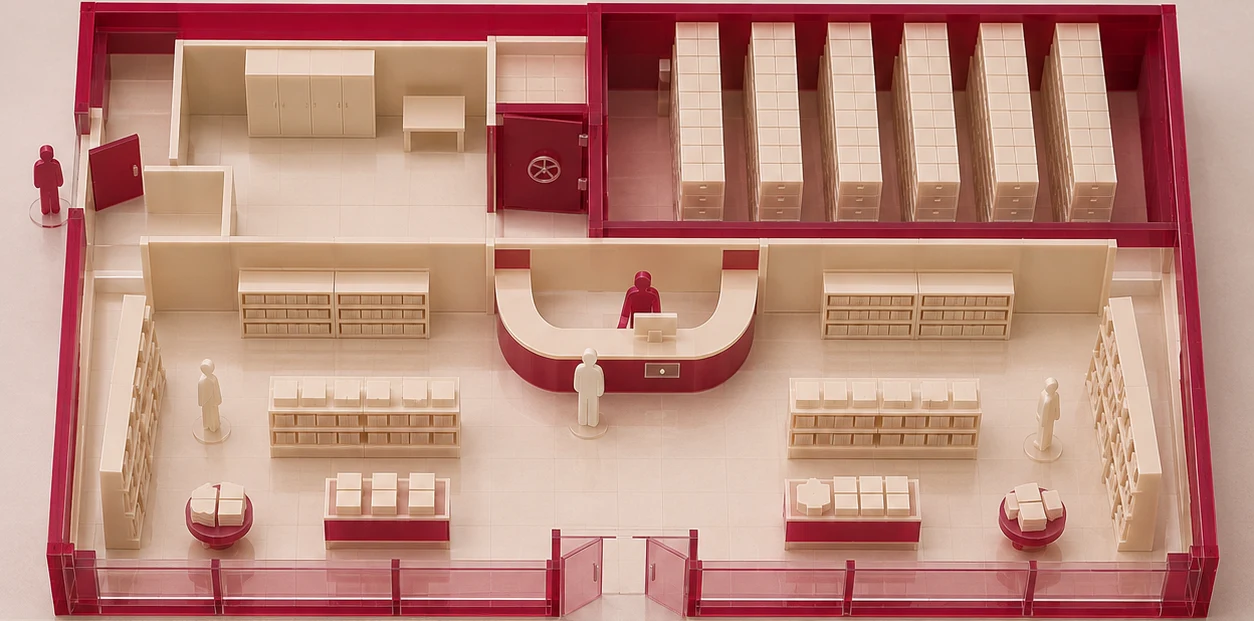
A shop needs strangers to walk in, browse colors and fill a basket. Give the public catalog published product information. Recalculate prices and check stock on the server when an order is placed. Show the delivery address to the customer and the staff handling that order. The person receiving a returned item need not have authority to approve a large refund.
An AI shopping assistant adds a different resource to protect. Set a computation allowance per response, a per-user limit and a store-wide spending ceiling. When demand surges, pause expensive conversations while keeping search and baskets available. A shopping assistant that was never granted refund authority cannot exercise it after receiving a misleading instruction.
What changes when you leave the browser?
Imagine three interfaces for one customer database, built for the browser, iOS and Windows. If all three call the same service, the server has to decide whether this user may read this record every time. Making the client harder to inspect changes nothing about the address the server releases. HTTP GET and POST describe request semantics. Neither determines who may see the result. Moving personal details into a URL also risks putting them into history and logs. [3]
A voice diary offers a more persuasive case for changing the architecture. Transcribe on the device and keep the recording there. A breach of the central service cannot expose recordings it never received. Losing the phone creates a different problem, one that local encryption and user-controlled backups can address. Browsers can also do work locally. I expect demand for engineers who can decide which computations and records can stay with the user.
Does the king’s adviser need the entire customer ledger?

A thick castle wall offers little protection against someone standing beside the king. A support agent can be a genuine employee whose device is under someone else’s control. The agent may need the delivery status of one order. That gives the desk no reason to open the address book for every customer.
I like to imagine data that could duck out of the way when someone tried to take it. A practical version checks the requester, purpose, order and expiry just before releasing the address. Someone arriving at a new branch on their first day will also look unusual. Ask for additional verification on a single read and require a separate approval for a bulk export. Give legitimate users a recovery path and retain a record of the decision.
Revocation introduces a difficult timing question. After a colleague is removed from a case, how long could an old copy of their permission still grant access? Google’s Zanzibar paper describes shared object-level permissions that respect the ordering of content and permission changes across services. [4] Google’s 2026 Beyond Zero proposal extends the question to individual actions by people and AI agents. [5] Authority to consult a ledger need not give a delegate authority to send every entry outside the organization.
Make safety a promise that buyers can test
Formal verification takes another route. For supported configurations and explicit assumptions, seL4 provides mathematical proofs about its kernel, including prevention of unauthorized information flows. [6] A buyer can borrow that discipline on a smaller scale. Show how to disable one lost device, revoke a departing colleague’s rights or constrain where an assistant sends its output. Those are promises a customer can test.
Four companies to watch and what to ask them
- HENNGE, Japan. Its access controls use device certificates. Ask how an administrator revokes one lost phone and enrolls its replacement. [7]
- IIJ, Japan. Its remote-access case study combines connectivity with device-aware controls. Compare what a managed home device and a device of unknown status can reach. [8]
- Google, United States. Read BeyondCorp, Zanzibar and Beyond Zero together to see the unit of decision move from enterprise access to individual resources and delegated actions. [2][4][5]
- Amazon Web Services, United States. PrivateLink changes how traffic reaches a service. Put the network diagram beside the data-permission chart to see exactly which problem it addresses. [1]
What I want to revisit in a year is whether buyers can verify these promises before signing. Consider the weight people willingly add to a slim phone by fitting a protective case. Being able to use the device the day after a fall has a value of its own.
When an intrusion is suspected, the first decisions also belong on the defender’s side. Suspend a risky session, preserve timestamps and logs, establish the affected scope and share evidence with investigators. The machine recorded as the source and the person operating it can be different. Prompt reporting and evidence preservation help investigators without putting uninvolved third parties at risk.
What frustrates me about breaches is the creative time they consume. Someone set aside a month to build a better service and spent it repairing damage instead. At the next product meeting I would put a second sheet beside the feature list. What information can this product avoid holding altogether? What can everyone else keep doing on the day one device is lost? I would pay for a product that can write concrete answers on that sheet.
References
- [1]AWS PrivateLink の概要 ↩
- [2]Google Research, BeyondCorp ↩
- [3]IETF, HTTP Semantics, RFC 9110 ↩
- [4]Pang et al., Zanzibar, USENIX ATC 2019 ↩
- [5]Google, Beyond Zero ↩
- [6]seL4 Foundation, verification and assumptions ↩
- [7]HENNGE デバイス証明書 ↩
- [8]IIJ 導入事例・日立システムズ ↩
- [9]個人情報保護委員会・令和7年度第4四半期 ↩
- [10]個人情報保護委員会・令和7年度年次報告 ↩
- [11]Gerlitz et al., Adventures in Recovery Land ↩
- [12]Ramat et al., A Systematic Analysis of the Passkey User Experience ↩

NOVEL SERIES VOL.1
The World Became Slightly Farther Away
The world may not change, but distance can.
A story about a man who cannot treat promises lightly, and the people he meets.The sequel, Clouded Glass, is out too. Start here.
View on Amazon
Jijoden.com
Your life is worth writing.
There is a truer self you can tell only to AI.Gather fragments of memory into a single story.
Take a LookRelated Articles
PHP2Shell Response Guide — AWS, Legacy PHP, and Vulnerability Response in the AI Era
A primary-source guide to PHP2Shell disclosed on October 21, 2026, updated the night of October 22: exploitation attempts before disclosure, Japan’s government response and preventive outages worldwide, Amazon Linux fixes, AWS WAF limits, legacy backports, deployment verification, and AI-assisted discovery.
Where Does Stolen Personal Data Go? How Real Fraud Cases Change the Way We Verify Trust
A caller who knows your address or booking date is not necessarily genuine. Cases from Japan, the US, Europe and Hong Kong show how stolen data is reused and what practical verification looks like.
Tomcat Vulnerability Response — Eight Flaws, AWS, Spring Boot, and Legacy Deployments【October 2026】
A primary-source guide to eight Tomcat vulnerabilities disclosed October 20, 2026: authentication bypass, HTTP/2 and AJP mix-ups, fixed releases, Amazon Linux status, embedded Tomcat, containment, and deployment verification.
Why Personal Data Breaches Keep Happening — Japan’s Incidents and What Businesses and Individuals Should Check
As of October 21, 2026: official disclosures from Times Car, Lawson, Furusato Choice and others, with practical guidance on AI-related threats, reporting, password hashes, MFA, AWS monitoring and personal responses.
Ten AI Stories from the First Half of October 2026: Gemini 4 Argon, GPT-6.1 Sol, Claude Haiku 5.5 and Meta’s 816B Open Model
Ten AI stories from 1–19 October 2026 that matter to people who use, build or work alongside AI — checked against primary sources and reporting. New models and their prices, agents everywhere, a safety report, the EU AI Act timeline and new rules for voice actors’ voices.
From the Pocho Lab