
Table of Contents
1. Start with entry points, data extraction and retention
A service you use announces that your personal information has escaped. Was it just a name and email address, or a copy of your driving licence? Could your employer have the same weakness? Japan’s autumn 2026 disclosures bring these questions into both everyday life and work.
Businesses should examine publicly reachable entry points, monitoring for abnormal data retrieval, and information they no longer need to retain. Individuals should establish which fields were affected, eliminate password reuse and prepare for follow-on fraud. A single security product cannot cover all three business responsibilities.
On October 9, Japan’s Information-technology Promotion Agency (IPA) urged executives to review protections. It identified a pattern involving exposed applications and compromised accounts, while declining to attribute the incidents to a vulnerability in one particular product.[1]
This article reflects public information checked through October 21, 2026, Japan time. The cases below are representative domestic examples, not a comprehensive incident count or a league table. It is intended for readers who want more depth than a headline and people responsible for their company’s services. Confirmed findings, open questions and practical actions need to remain distinguishable.
2. Japanese incidents: distinguish disclosure dates, scope and exposed fields
The announcement date, intrusion date and discovery date can differ. Counts describe accounts, application records or reservations. One person can appear in several services, so adding the numbers does not produce a count of affected individuals. A potentially exposed population does not mean every record has been confirmed stolen.
| Organization and disclosure | Status and scale | Information and findings |
|---|---|---|
| Park24 / Times Car: September 25 initial notice; September 28–29 counts; October 16 update | Confirmed: approximately 6.6 million accounts; identity-document images affected approximately 1.6 million accounts within that population | Names, addresses, birth dates, contacts and licence information, varying by person. Images included licences, address evidence, student cards and family evidence. Card-data leakage was ruled out. Passwords were described as stored in a non-recoverable form.[2][3][4] |
| Lawson ID / app reservations: October 8; updated October 19 | Confirmed: 2,155,345 ID records and 26 reservation records | ID: names and emails, plus addresses, phones and other fields where registered. Reservations: names, phones and partial card numbers. An information-display security mechanism was accessed unlawfully. Reservations resumed October 19.[5] |
| skyticket server intrusion: October 9 | Confirmed: approximately 14.64 million records, including approximately 4.13 million containing password hashes | Names, birth dates, contacts and addresses. An administrative function led to other servers and cloud data. Intrusion October 2–4; discovery October 5.[6] |
| skyticket business administration: October 9 | Disclosed or potentially disclosed: 17,780 records, including duplicates; additional scope under investigation | Names, phones and refund bank-account details. A business-system vulnerability was exploited. Passport-number exposure remained under investigation.[6] |
| skyticket bus reservations: October 9 | Viewed or potentially viewed: approximately 12,000 reservations | Names, contacts, journeys and companion information. Completion pages were accessible without login and retrieved mechanically. People including companions outnumber reservations.[6] |
| Sourcenext: October 15 | Leakage confirmed; potentially affected population: 22,519,960 records | Emails, passwords, names, addresses and other fields; not every field affected every person. A member-information API was misused. Card details were not stored in the affected system.[7] |
| Furusato Choice application-restoration defect: October 5 | 254 application records accessible in another user’s browser | Potential exposure of names, addresses, phones, emails and delivery details, November 13, 2025–September 7, 2026. A defect in Trustbank’s restoration process after Amazon Pay authentication, not the payment function.[8] |
| Furusato Choice intrusion: October 20 | Confirmed: 4,454,097 records; subject to revision | Names, emails, addresses, phones, password hashes and estimated donation deductions. Intrusion October 17; detection and suspension October 19. Reopening undetermined in the October 20 notice. Separate from the 254-record incident.[9] |
The Times population includes former members and incomplete applications. The disclosure concerns Times Car and related membership data; it should not be expanded to everyone who rented a car. Lawson’s listed fields do not include passwords. Establishing the specific exposure is the starting point for a useful response.
skyticket states that it does not retain card numbers or passport images and these did not leak. Nevertheless, account takeover can enable misuse of a saved payment method even without disclosure of its number. It suspended payments using saved cards. Data theft and unauthorized service use require separate checks.[6]
3. Why disclosures cluster: concentrated data and more visible incidents
Registration, identity checks, deliveries, support and payment integrations connect systems and place personal information at their boundaries. If privileges available through one entry point are too broad, an intruder can follow ordinary business pathways to a large collection. skyticket’s disclosure illustrates why fixing an entry point and separating privileges both matter.
Furusato Choice’s restoration defect presents a different problem: insufficient checks when a user identifier could not be obtained. Preventing unauthorized login does not ensure that a legitimate process never returns somebody else’s information. Public notices do not necessarily identify every mechanism or cloud provider. General explanations cannot be worked backwards into unannounced findings about individual companies.

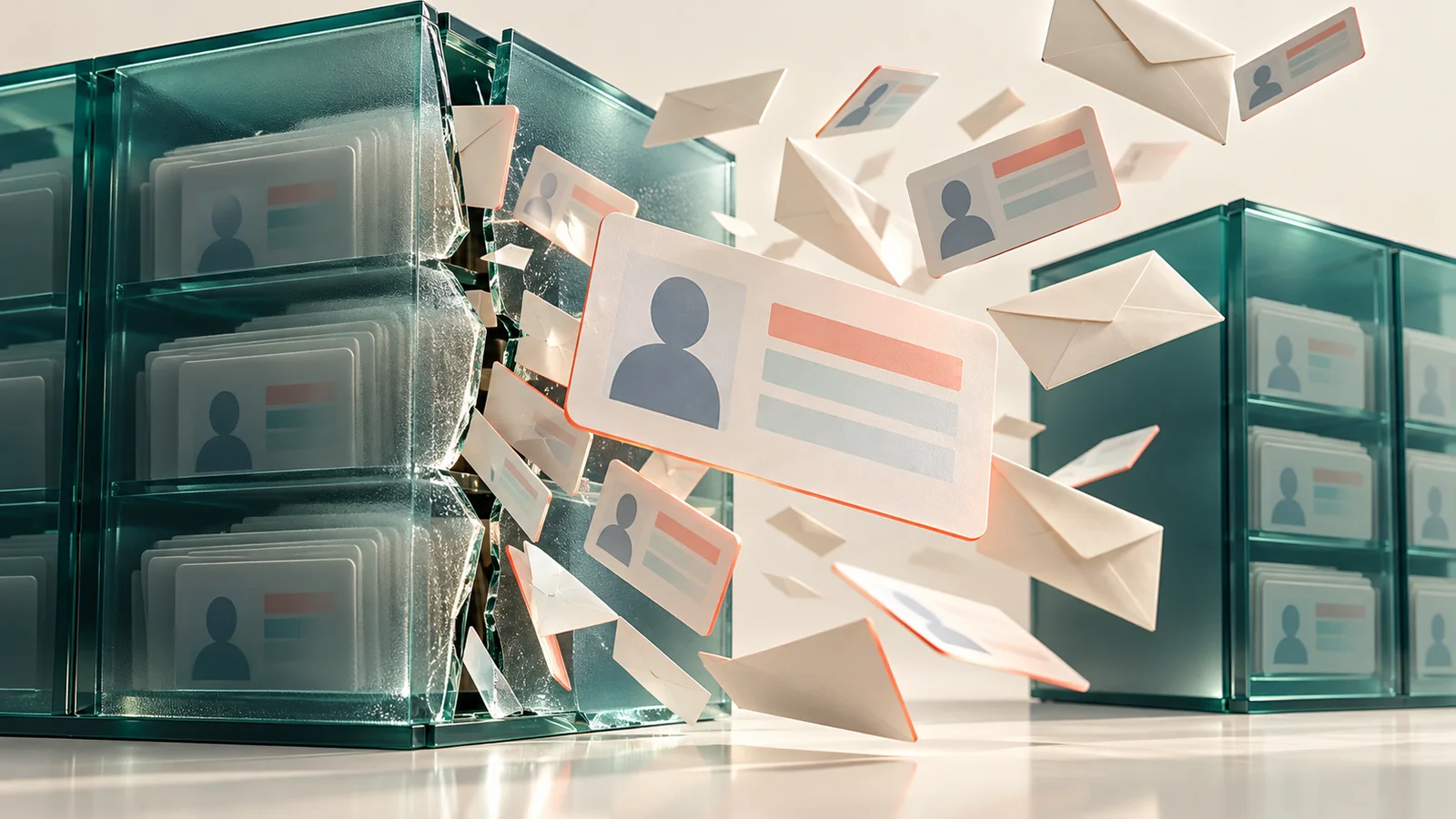
Names and service histories can become ingredients for another fraud. This conceptual illustration is not evidence of secondary harm in a listed incident.
Published incidents are not the whole population
The Personal Information Protection Commission (PPC) reports processing 17,139 breach-related reports under Article 26(1) in fiscal 2025. Reports involving special care-required information accounted for 61.9% in its classification; those potentially involving improper intent accounted for 22.3%. These are neither solely cyberattacks nor companies appearing in newspapers.[10]
Working reporting systems make previously invisible incidents visible. Detection and investigations can also produce announcements together. The volume of autumn headlines cannot establish an attack growth rate.
Undetected or unreported incidents may exist, but the evidence reviewed here does not support a multiplier for that population. Company size alone does not establish reporting behavior or protection quality. Disclosure, prevention and response are separate dimensions of performance. In finance, core banking systems, public websites, suppliers and individual account takeovers must be distinguished. Sector labels cannot establish safety; IPA’s warning explicitly covers financial institutions among a broad range of businesses.[1]
4. What AI changes, and what is known about Chinese-developed models
Observed activity is more informative than a model’s reputation. On October 7, CrowdStrike described activity against South Korean financial organizations, based on tool configurations and session histories in attacker-controlled open directories. It involved ARTEX, a penetration-testing tool developed in China, alongside multiple LLMs. Researchers assessed a likely Chinese-speaking, financially motivated actor with moderate confidence, without attribution to a named adversary.[11]
That is a concrete observation of AI use. It does not establish that the Japanese organizations in our table were attacked by the same actor. In an October 20 interview, VLC Security Lab’s Yuya Nakamoto clarified that his firm had not directly confirmed Chinese LLM use in Japan’s recent cluster of incidents.[12]
AI can change the cost of connecting reconnaissance, repeated attempts, analysis and subsequent operations. An attack that once stalled may become easier to continue. For defenders, this reduces the credibility of leaving an administrative interface or authorization gap exposed because it is unlikely to be found.
It does not imply that AI universally breaks cryptography or makes MFA worthless. Faster attackers increase the value of knowing where assets are, who owns remediation and how to contain an incident before one occurs. New AI-oriented products can be evaluated while existing entry points and permissions receive immediate attention.
5. Business checks: beyond SSO and MFA to authorization
Authentication establishes who is acting. Authorization establishes whether that person may perform a particular operation on particular information. SSO centralizes sign-in; it does not inherently enforce MFA or validate access to every record.
MFA combines different factors, such as something known, something possessed and a biometric characteristic. A password followed by a security question is two steps of knowledge verification. For administrators and important services, prioritize phishing-resistant authentication, including appropriate FIDO/WebAuthn passkeys or security keys. CISA recommends this direction. Recovery, exceptions, enrolment, lost authenticators and departing employees must be included in the design.[13]
The following is the author’s proposed review order, not a diagnosis of the listed breaches. Assign an owner and deadline to each system and preserve the evidence supporting each conclusion.
| Area | Evidence to seek | Priority if the check fails |
|---|---|---|
| Exposure and patching | Inventory of websites, APIs, VPNs, administrative interfaces and old subdomains with owners, versions and patch status; review exploited vulnerabilities | Remove unnecessary exposure and apply fixes or mitigations. Preserve evidence and investigate signs of compromise |
| SSO and administrative privileges | Enforced administrator MFA, separate everyday accounts, disabled departed users and identified local-login paths bypassing SSO | Resolve administrator exceptions first. Control and monitor emergency accounts rather than leaving permanent bypasses |
| APIs and user boundaries | In authorized testing, user A cannot retrieve or modify user B’s records; missing identity and unauthenticated requests fail safely | Enforce server-side authorization every time; stop unidentified requests instead of falling back to another user |
| Bulk retrieval and sessions | Limits on export permissions, volume and speed; unusual retrieval and session alerts demonstrably reach an owner | Define per-API baselines and rehearse token revocation, containment and on-call escalation |
| Suppliers and retention | Inventory of fields, storage, vendors and deletion dates; evidence of deletion and incident communications | Reduce copies and access. Check legal, contractual and investigation-preservation duties before deleting |
Testing users A and B checks the object-level authorization failures described by OWASP. Unpredictable identifiers do not replace permissions. Use authorized scope and dummy records, rather than extracting real personal information in bulk as a test.[14]
On AWS, ask more than whether GuardDuty is enabled
GuardDuty detects signs of threats. Review covered accounts and Regions, necessary protection plans, notification destinations and response ownership. S3 Protection analyzes object-level S3 data events. Foundational detection being enabled does not settle whether relevant storage is covered.[15]
CloudTrail’s default event history contains the previous 90 days of management events in a Region, not data events. Recording and retaining required operations through trails or other appropriate storage requires separate design. GuardDuty findings and the underlying records required for investigation serve different purposes.[16]
Also review S3 public access settings and bucket policies, least-privilege IAM, application data permissions and protection of retained logs. A cloud monitor may not identify an application returning another person’s data through otherwise legitimate cloud permissions. Combine WAF controls, vulnerability management, authorization tests and monitoring according to their roles.

Combine authentication, internal privilege separation and extraction monitoring so one failed layer need not expose everything.
Keeping less data limits potential damage
On October 16, Park24 announced a change from retaining identity-document images during membership and for seven years after departure to not retaining them after registration completes. Existing images were scheduled for deletion by October’s end. As of October 21, this was a plan, not confirmed completion.[4]
Distinguish information needed to perform a check from images needed afterward. Preserve required records while reducing unnecessary licence images, former-user data and analytical copies. Encryption at rest helps, but an application with decryption privileges can read data after compromise. Retention, access rights and storage protection belong in the same review.
6. Can stolen password hashes immediately be used to sign in?
A typical password system transforms a supplied password and compares it with a stored value. Proper hashing has no decryption procedure returning the original string. A leaked hash does not mean every original password is immediately readable.
An attacker can transform candidate passwords under the same conditions and compare results: offline guessing. Short or common passwords, fast hashing functions and low computational cost make this easier. A unique salt impedes precomputation and shared comparisons; password-oriented algorithms such as Argon2id increase work per guess. SHA-256 alone does not constitute adequate password storage.[17]
In an ordinary web login, pasting a stolen hash into the password box does not normally authenticate. Other mechanisms can permit attacks reusing hash-equivalent material, and stolen sessions or tokens present separate risks. “It was hashed, so no action is necessary” is an unsafe generalization.
Furusato Choice disclosed password hashes and asked users reusing an email/password pair elsewhere to change those passwords. Without algorithms and parameters, an outsider cannot calculate a meaningful cracking time. Times’ description of a non-recoverable format likewise does not disclose its implementation.[9][2]
Businesses should avoid plaintext storage and verify algorithms, salts, cost settings and legacy migration. Individuals should remove reuse to reduce future misuse, without assuming cracking has already occurred. Reviewed sources do not establish the share of companies storing plaintext or the distribution of storage methods across Japanese businesses.
7. Responding to a disclosure: individual actions and company obligations
Individuals should act according to the affected information
- Open the official website or app independently before following a notification link. Check affected dates, fields and eligibility instructions. Do not submit another licence image or password to an unfamiliar security-verification site.
- Replace reused passwords on relevant services. Prioritize email, finance, payments and important identity accounts. Use unique passwords and available passkeys or MFA. Review login history, recovery contacts and connected apps; revoke other sessions where appropriate and supported.
- Expect plausible fraud when contacts or service histories are exposed. Knowing your booking date or address does not authenticate a caller. Verify refund, compensation and urgent reauthentication requests through official channels.
- Record anomalies involving cards, accounts or identity images. Review statements and bookings; contact the financial institution or card issuer about unfamiliar transactions. For suspected identity-document misuse, contact the provider’s incident desk or police, retaining notices, dates and communications.
Addresses and birth dates cannot be replaced like passwords. This heightens the responsibility of identity-document holders. On October 9, Japan’s Financial Services Agency called for security reviews and stronger application and transaction controls after disclosures involving identity images. Recipients must also improve checks that do not equate possession of an image with identity.[18]

Turn uncertainty into specific actions: confirm official information, eliminate password reuse and review activity.
Companies should not wait for a finished investigation to respond
Appoint an incident owner and work in parallel on containment, preservation of logs and devices, scoping, and communications with specialists and relevant clients or vendors. Avoid indiscriminate resets or log deletion that destroys evidence. Build a timeline separating suspected and confirmed extraction, established and unknown fields.
Private-sector statutory reporting triggers include special care-required data, possible financial harm, suspected improper intent and incidents exceeding 1,000 individuals. Once a reportable event is known, the initial report should be prompt, with roughly 3–5 days as guidance. A final report is generally due within 30 days, or 60 for the improper-intent category. Notification to affected people is also generally required, promptly according to circumstances.[19]
Reporting to the PPC or another competent authority, notifying individuals and publishing a website notice are distinct actions. The rules cannot be reduced to every incident requiring public announcement within three days. Alternative measures when individual notification is difficult and sector-specific rules may apply. Consult legal specialists about the case; duties are not limited to large companies.[20]
8. Outlook: match faster attacks with faster review and containment
The following is a forecast based on disclosed cases. Over the next 6–12 months, AI-assisted exploration combined with known weaknesses and authorization defects deserves attention. More convincing follow-on fraud using exposed contacts and histories is another scenario to prepare for. Evidence does not support a reliable numerical multiplier for future incidents.
Assessment should progress from installed products to whether detection and containment work. The author would track unowned public exposure, administrator MFA exceptions, time exposed to exploited vulnerabilities, alert-to-response time and unnecessary retained personal information. Fixing weaknesses, narrowing permissions, detecting anomalies and retaining less reduce opportunities for compromise and potential damage.
Start concretely. An individual can eliminate reuse on one important account. A business can establish the owners of exposed services and verify one alert reaches its responsible person. Layered measures reduce risk. Confidence should come from verified operations, rather than a promise that breaches can never occur.
Update history: first published October 21, 2026. Covers domestic disclosures, observed AI use, reporting duties and protections. Future updates will revise counts, fields, causes and mitigations. Revisit Times’ announcement scheduled for October 23 and end-of-October image deletion, and Furusato Choice’s investigation and reopening. This is general information, not a substitute for an individual incident investigation or legal assessment.
References
- [1]IPA, urgent security review (October 9, 2026). https://www.ipa.go.jp/security/security-alert/2026/alert20261009.html ↩
- [2]Park24, second notice (September 28, 2026). https://www.park24.co.jp/news/2026/09/20260928-1.html ↩
- [3]Park24, third notice (September 29, 2026). https://www.park24.co.jp/news/2026/09/20260929-1.html ↩
- [4]Park24, fourth notice (October 16, 2026). https://www.park24.co.jp/news/2026/10/20261016-1.html ↩
- [5]Lawson, disclosure (October 8, updated October 19, 2026). https://www.lawson.co.jp/contents/cont07/1533174_3310.html ↩
- [6]Adventure, disclosure (October 9, 2026). https://skyticket.jp/news/maintenance/67603 ↩
- [7]Sourcenext, disclosure (October 15, 2026). https://www.sourcenext.com/support/i/2026/1015_info/ ↩
- [8]Trustbank, application defect (October 5, 2026). https://www.trustbank.co.jp/newsroom/news/news261005/ ↩
- [9]Trustbank, intrusion (October 20, 2026). https://www.trustbank.co.jp/newsroom/newsrelease/news261020/ ↩
- [10]PPC, fiscal 2025 annual report. https://www.ppc.go.jp/aboutus/report/annual_report_2025/ ↩
- [11]CrowdStrike, “Unknown Threat Actor Uses AI-Driven ARTEX to Target South Korean Finance” (October 7, 2026). https://www.crowdstrike.com/en-us/blog/unknown-threat-actor-uses-artex-to-target-south-korean-finance/ ↩
- [12]ITmedia AI+, interview with the expert (October 20, 2026). https://www.itmedia.co.jp/aiplus/article/2610/20/2000002430/ ↩
- [13]CISA, “Require Multifactor Authentication.” https://www.cisa.gov/audiences/small-and-medium-businesses/secure-your-business/require-multifactor-authentication ↩
- [14]OWASP, “API1:2023 Broken Object Level Authorization.” https://api-security.owasp.org/editions/2023/en/0xa1-broken-object-level-authorization/ ↩
- [15]AWS, “GuardDuty S3 Protection.” https://docs.aws.amazon.com/guardduty/latest/ug/s3-protection.html ↩
- [16]AWS, “Working with CloudTrail event history.” https://docs.aws.amazon.com/awscloudtrail/latest/userguide/view-cloudtrail-events.html ↩
- [17]OWASP, “Password Storage Cheat Sheet.” https://cheatsheetseries.owasp.org/cheatsheets/Password_Storage_Cheat_Sheet.html ↩
- [18]FSA, security and transaction controls (October 9, 2026). https://www.fsa.go.jp/news/r8/sonota/20261009/20261009.html ↩
- [19]PPC, breach response resources. https://www.ppc.go.jp/personalinfo/legal/leakAction/ ↩
- [20]PPC, General Guidelines, section 3-5. https://www.ppc.go.jp/personalinfo/legal/guidelines_tsusoku/ ↩

NEW NOVEL 2026/08/01
Clouded Glass
Polishing is not about force.
Volume two of The World Became Slightly Farther Away.Five stories that can also be read as a starting point.
View on Amazon
Jijoden.com
Your life is worth writing.
There is a truer self you can tell only to AI.Gather fragments of memory into a single story.
Take a LookRelated Articles
What Can You Share with AI? Approval Criteria for Enterprise Code and Customer Logs
Authorize enterprise AI use with six repository acceptance criteria, log-sanitization examples, contract decisions and a reusable approval template. Primary sources checked September 19, 2026 distinguish permitted work, prohibited transfers and case-specific review.
Designing Web APIs on AWS in 2026: A Practical Architecture Guide to Auth, Performance, Security, and Cost
A deeply researched guide to designing Web APIs on AWS in 2026, covering internal, B2B, B2C, and agentic workloads; API Gateway, Lambda, Fargate, OIDC, RDS Proxy, asynchronous processing, 10,000-user scale, cost, and multi-cloud portability.
What is OIDC? How is it Different? Why is it "Amazing"? (Complete Guide with AWS×GitHub Examples)
Learn OIDC (OpenID Connect) from the ground up. Understand the differences from OAuth2.0 and SAML, with practical examples of AWS and GitHub implementations.
Why AGENTS.md Won by Standardizing Almost Nothing — The 18-Month End of the AI Coding Rules War
Why did a landscape of tool-specific instruction files converge on AGENTS.md, a standard with no required fields? This evidence-based history follows its path from Amp's singular AGENT.md to Linux Foundation stewardship, rule-sync tools, invisible-Unicode attacks, and a practical 2026 setup.
AWS’s AI Counteroffensive: How Amazon Reframed the Perception That It Was Behind
A detailed look at how Amazon moved from being seen as late to generative AI into a central AI infrastructure contender through AWS, Trainium, Bedrock, Anthropic, and OpenAI.