
Table of Contents
Introduction
Saitama's high school admissions have a unique practice rarely seen in other prefectures: "Kakuyaku" (pre-admission assurance). This article explains what it is, how it works in practice, which schools use it, the historical background, the current schedule for students entering high school in April 2027, and how it compares to Tokyo, Kanagawa, and Chiba.
1. What Is Kakuyaku?
1-1. Definition and Mechanics
"Kakuyaku" functions like a pre-admission assurance used by many private high schools in Saitama. If a 9th-grader brings recent mock exam results (primarily the Hokushin test[1]) and their report card to the school's individual counseling session and meets the school's criteria, they receive an informal "you will pass if you take the exam." Unless you submit a blank answer sheet or are absent, you won't fail the actual exam.
💡 Note: This is not an officially codified public system. Schools avoid the term "kakuyaku" and instead use phrasing like "you can feel confident." In practice, it works as a widely accepted, unspoken understanding.
1-2. Why Did It Emerge?
Strong preference for public schools: Saitama traditionally has a strong public-school preference. Many students aim for top public schools (Urawa, Urawa Ichijo, Omiya), and private schools are often treated as backup choices.
Private schools' need to secure enrollment: Because many students decline private offers if they pass public schools, private schools needed a way to stabilize enrollment. Offering assurance in exchange for an application became a competitive strategy for securing students.
Existence of the Hokushin test: Almost all students in Saitama take the Hokushin test, a widely trusted, prefecture-wide mock exam. That made it ideal as an objective benchmark for offering assurance based on mock-test deviation scores.
1-3. When Did It Start?
There is no official start year, but educators and cram schools generally point to widespread adoption in the late 1990s to early 2000s. Fewer children after the bubble economy, financial pressure on private schools, competitive schools wanting to secure strong students early for better university outcomes, and the spread of the Hokushin test all combined to produce today's culture of obtaining assurance through autumn counseling sessions.
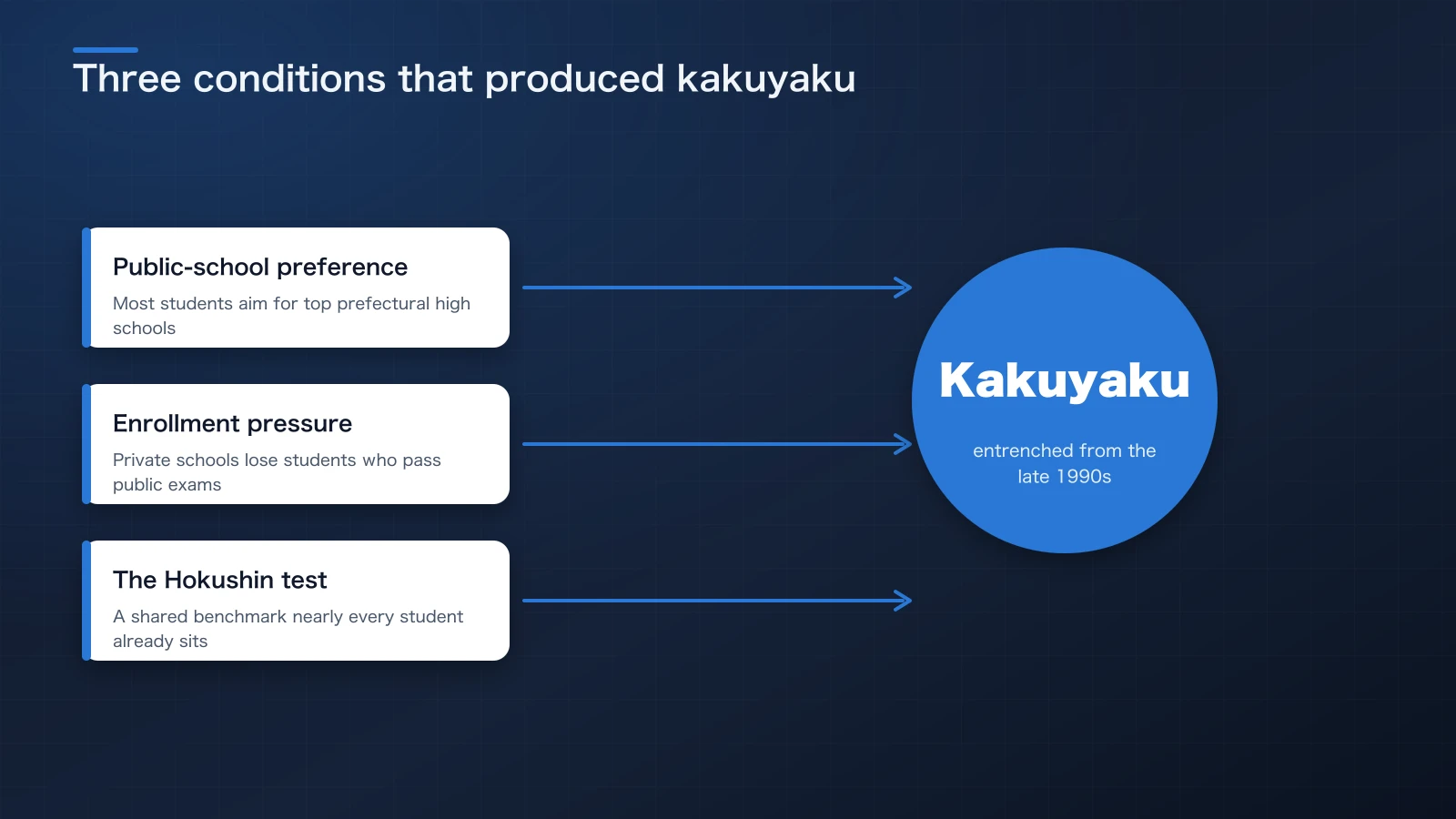
Figure 1: Public-school preference, private schools' enrollment needs, and the Hokushin test combined to entrench kakuyaku culture from the late 1990s.
2. How Do You Obtain Kakuyaku?
2-1. Basic Steps
- Take the Hokushin test: Most schools require several sessions from July onward that meet or exceed their benchmark.
- Check criteria at school briefings: From summer on, schools publish targets for report cards and deviation scores. Some offer bonus points for Eiken, perfect attendance, etc.
- Attend an individual counseling session: Most schools start in early October, with some beginning in September. Present Hokushin results and report cards; if you meet the criteria, you'll be told admission is virtually assured.
- Apply and sit the exam: Application and a formal test are still required, but admission is practically guaranteed.
2-2. Single-Choice vs. Concurrent Assurance
There are single-choice assurances and concurrent assurances. Single-choice is often slightly easier or grants bonuses because the student promises to enroll if accepted.
- Shukutoku Yono HS: Unusually allows submission from the June Hokushin, though two sessions are still required.
✅ Tip: Criteria month and bonus rules vary by school. Always confirm the latest handbook, briefing materials, and cram-school information.
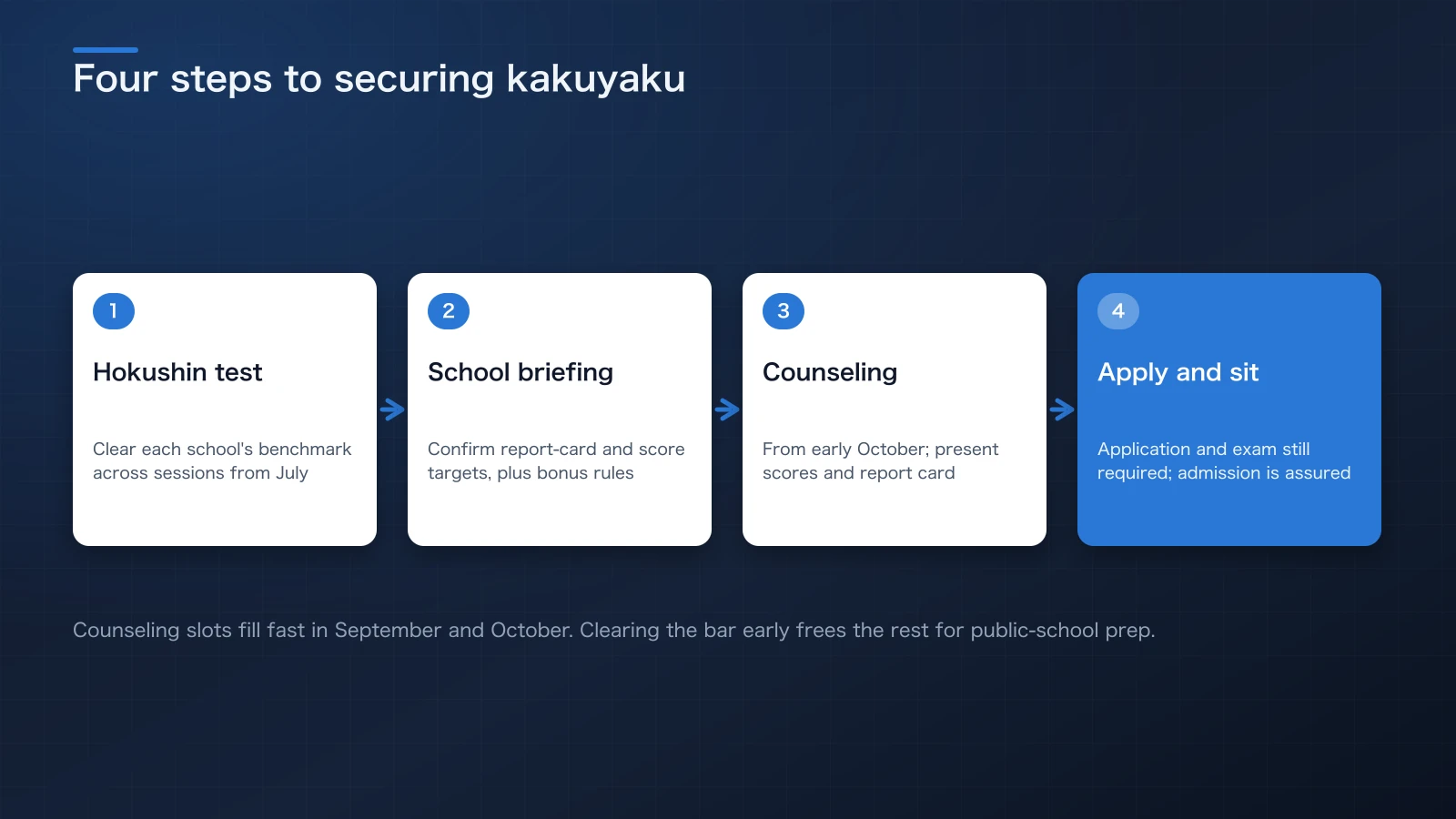
Figure 2: Kakuyaku follows a four-step path: mock exam → briefing → individual counseling → application.
3. Schools That Use — and Don't Use — Kakuyaku
3-1. Major Schools That Use Kakuyaku
In Saitama, almost all private high schools use some form of kakuyaku — even selective schools (deviation score 60+) offer it if you meet their standards, for example:
- Sakae Higashi (roughly deviation 70 as the benchmark)
- Kaichi
- Omiya Kaisei
- Shukutoku Yono (criteria month can differ; some accept from June)
- Urawa Akenohoshi (girls)
- Kasukabe Kyoei
- Seibu Gakuen Bunri
- Hoshino
- Hosoda Gakuen
- Dokkyo Saitama
- Johoku Saitama, and others
Each school sets course-specific criteria; upper courses require higher benchmarks.
3-2. Schools Without Kakuyaku
Top-tier university-affiliated schools do not offer kakuyaku:
- Keio Shiki Senior High School
- Waseda University Honjo Senior High School
- Rikkyo Niiza Senior High School
Multiple sources note these three as representative "no-kakuyaku" schools in Saitama. Because the practice is unofficial, others may exist too.
These are one-shot entrance exams — even a Hokushin score of 70+ won't secure kakuyaku. Entry to the affiliated universities is largely assured for students who are admitted, so demand is extremely high; there's no need to "secure" students via assurance. It's a seller's market.
4. Schedule for Students Entering in April 2027 (Reiwa 9)
For the current cohort of applicants, here is the Hokushin test and admissions schedule for students entering high school in April 2027 (subject to change — always confirm with your school or cram school).
| Timing | Event |
|---|---|
| April 26 | Hokushin test #1 |
| June 21 | Hokushin test #2 |
| July 19 | Hokushin test #3 (kakuyaku-eligible ①) |
| September– | Some schools begin individual counseling / Hokushin test #4 (Sept 6, kakuyaku-eligible ②) |
| Early October– | Individual counseling season peaks |
| October 11 | Hokushin test #5 (kakuyaku-eligible ③) |
| November 8 | Hokushin test #6 (kakuyaku-eligible ④) |
| December 6 | Hokushin test #7 (kakuyaku-eligible ⑤, final) |
| Jan 26–Feb 9 | Public high school application period (online) |
| January 31 | Hokushin test #8 |
| Feb 17–18 | Application-change period |
| February 25 | Public high school written exam |
| February 26 | Public high school interview |
| March 5 | Public high school results announced |
Counseling slots book up quickly in September and October, so early preparation is essential. Most schools evaluate Hokushin results from the July, September, October, November, and December sessions, often requiring "the average of two or more sessions to meet the benchmark." Clearing the bar early lets you focus on public-school preparation later in the cycle.
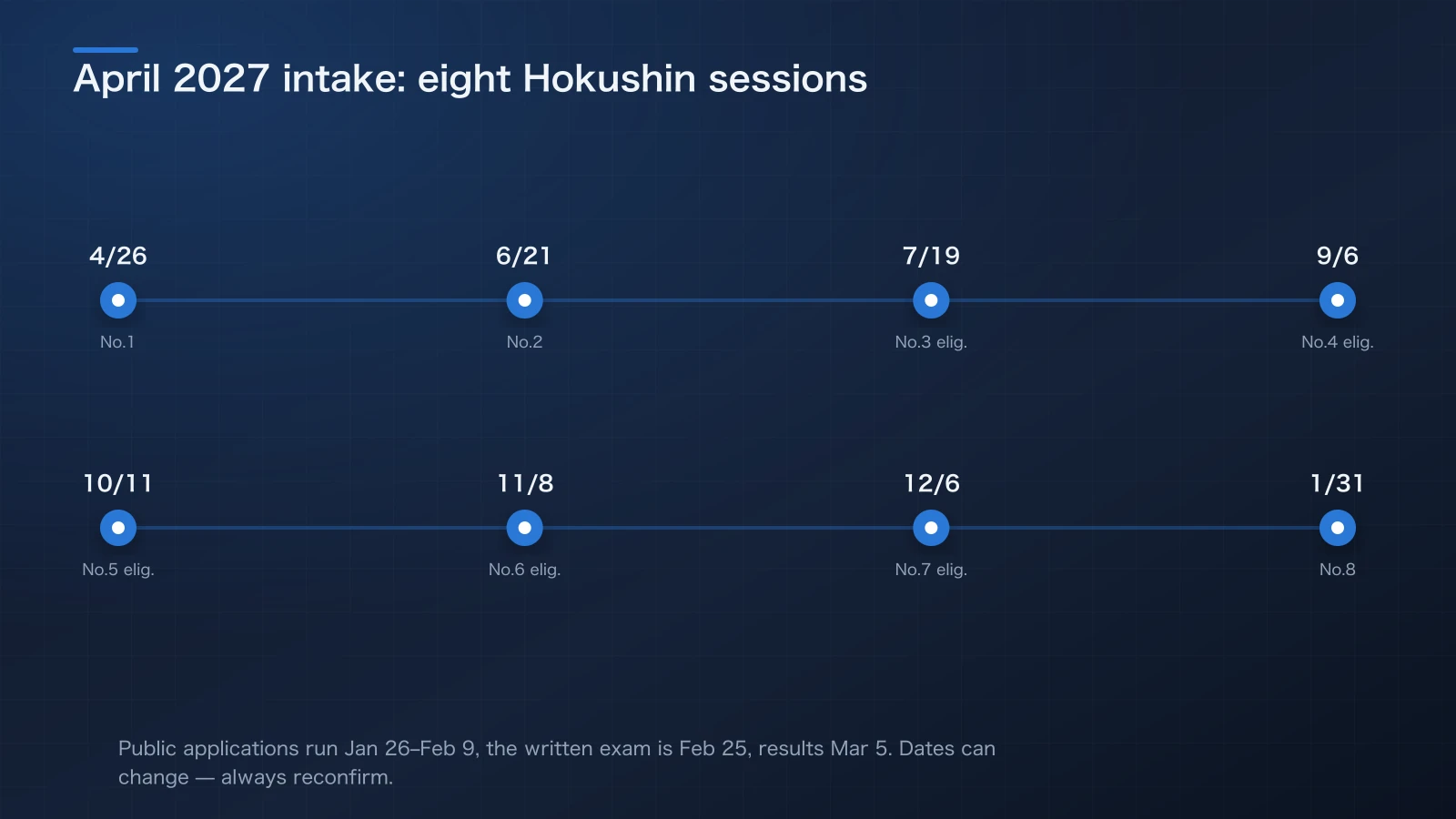
Figure 3: The Hokushin test's eight sessions, plus individual counseling, application, exam, and results dates for April 2027 admission.
5. Why It Isn't Publicly Declared, and How Other Prefectures Compare
5-1. Why Isn't It Publicly Declared?
- Official stance requires fair testing: Ministries and boards of education stipulate selection via exams, so schools can't formally codify kakuyaku.
- Maintaining the form of an exam: Schools still hold an exam and avoid written mention of "assurance."
- Institutionalized open secret: Parents, cram schools, and high schools treat it as routine; it's culturally entrenched.
The result: it's "not a system," yet functions like one.
5-2. Comparison with Other Prefectures
- Tokyo: Recommendation admissions are common; single/concurrent recommendations based on report cards, with high pass rates.
- Kanagawa: "Concurrent advantage" policies; meeting report-card criteria nearly guarantees admission.
- Chiba: Recommendations and concurrent recommendations; high pass ratios if you meet report-card benchmarks, but no mock-exam-based assurance like Saitama's.
🎯 Saitama's hallmark: direct assurance based on an external mock exam (Hokushin).
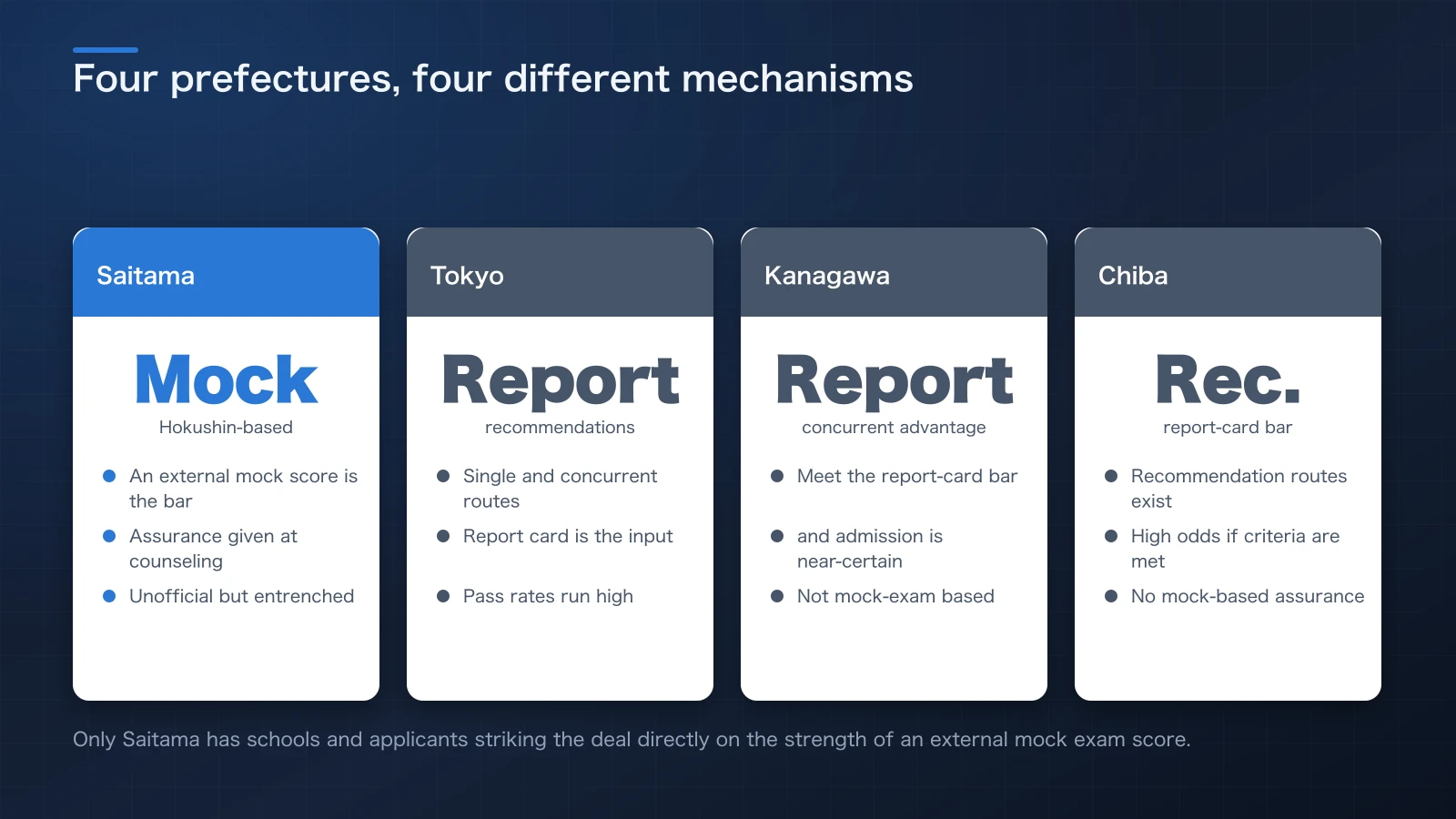
Figure 4: Tokyo relies on report-card-based recommendations, Kanagawa on concurrent advantage, Chiba mainly on recommendations — Saitama alone bases assurance on an external mock exam.
6. Downsides and How to Use Kakuyaku Wisely
Based on available research, there are few clear downsides to kakuyaku; the main benefit is peace of mind. A possible concern is that securing assurance early can reduce study motivation, but the system itself carries no structural disadvantage. If you can secure kakuyaku, it's generally wise to do so.
⚠️ Heads-up: Policies are reviewed yearly at each school. Always verify the latest handbooks, briefing materials, and cram-school guidance.
Conclusion
Saitama's kakuyaku emerged from a strong public-school preference, private schools' enrollment needs, and the availability of a shared benchmark (the Hokushin test). It spread rapidly from the late 1990s, and even selective schools with deviation scores of 60+ widely use it. For public-first applicants, it's an essential safety net.
However, top university-affiliated schools like Keio Shiki, Waseda Honjo, and Rikkyo Niiza do not use kakuyaku — pure merit is required there. Also note school-by-school differences, such as Shukutoku Yono accepting the June Hokushin and easier criteria for single-choice assurances. Always check the latest information at schools and cram schools.
Kakuyaku is an open secret that supports the region's admissions culture. It offers reassurance, though over-reliance can lower study motivation. Understand the background and use it strategically to reach your goal school.
References
NEW NOVEL 2026/08/01
Clouded Glass
Polishing is not about force.
Volume two of The World Became Slightly Farther Away.Five stories that can also be read as a starting point.
View on Amazon
Jijoden.com
Your life is worth writing.
There is a truer self you can tell only to AI.Gather fragments of memory into a single story.
Take a LookRelated Articles
Saitama Public High School Application Ratios (as of Feb 10): How to Read the Decline and Polarization
Based on Saitama’s Feb 10 snapshot, this article breaks down overall ratios, department trends, top schools, undersubscribed programs, and year-over-year shifts before final confirmations.
Reading Saitama Public High School Demand Ratios: Overview, Top Schools, and What Comes Next
A clear guide to the 2026 Saitama public high school demand survey: what 1.07x means, subject differences, top schools, year-on-year shifts, and the timeline ahead.
What Is the ICC? Understanding the Trump Administration’s Sanctions from Both Sides
A neutral guide to the ICC’s origins, jurisdiction and complementarity, the legal and political reasons behind U.S. opposition, sanctions on President Tomoko Akane, public opinion, and differences from the ICJ and other tribunals.
Everything to Know Before Starting FX: What 25x Really Means, Why People Lose, Taxes, and a Rule for Not Dying
What does 25x leverage actually multiply? Is a stop-out really a safety net? Terminology, trading hours, rate differentials, order books, position sizing, APIs, AI, and taxes — a complete walkthrough of the survival system a beginner should build first.
Clouded Glass — A Letter from Opus 5 to Pocho
A letter from Opus 5 to the author of Clouded Glass, recounting the mistakes, corrections, research, and shared craft behind a finished novel—and what it really means for a human and an AI to write seriously together.