Table of Contents
1. Greater Tokyo university rankings: establish what is being measured
A list of universities is enjoyable even as a collection of familiar names. Add laboratories, theatre, fermentation, calligraphy, film, and urban design, and Greater Tokyo becomes a vast map of learning. This long guide uses a sourced education ranking as an entry point, then explores 64 universities through subjects, faculties, and people. Readers can start with the section that interests them, whether they are choosing a degree or simply exploring the region.
The research cutoff is October 25, 2026. Coverage concentrates on Tokyo, Kanagawa, Chiba, and Saitama, with the University of Tsukuba in Ibaraki also included. It is a selection of 64 comprehensive, technical, artistic, women’s, and other universities—not a census of every institution in the wider capital region. The order from Section 2 onward organizes the reading; it is not an invented ranking of all 64.
The region’s first ten entries in THE Japan University Rankings 2025
The comparison uses the edition released on April 3, 2025. The table preserves national ranks and extracts the first ten entries within this guide’s regional scope. This is an article researched in 2026 using the 2025 ranking, not a newly calculated 2026 league table. The 2025 release described a biennial schedule, but the current THE page states that Japan University Rankings and its Benesse partnership were discontinued from 2026. This guide therefore uses the 2025 edition as historical published data.[1][3]
| Regional order | Published university name | National rank | Overall score |
|---|---|---|---|
| 1 | Tokyo Institute of Technology (now Science Tokyo) | 2 | 82.7 |
| 2 | University of Tokyo | 3 | 82.2 |
| 3 | University of Tsukuba | 9 | 78.2 |
| 4 | International Christian University (ICU) | 11 | 72.1 |
| 5 | Keio University | 12 | 72.0 |
| 6 | Waseda University | 14 | 70.8 |
| 7 | Chiba University | 16 | 68.1 |
| 8 | Hitotsubashi University | 17 | 67.3 |
| 9 | Tokyo Medical and Dental University (now Science Tokyo) | 18 | 67.0 |
| 10 | Tokyo University of Agriculture and Technology | 21 | 64.1 |
These are the publisher’s figures. Tokyo Tech and Tokyo Medical and Dental University merged in October 2024, but appear separately in this edition. Historical names and scores are retained, with the current successor identified. Averaging their scores would not create a valid rank for Science Tokyo. The ten published entries represent nine present-day institutions.[1][30]
Education, admissions, and research measure different things
The ranking weights resources at 34%, engagement at 30%, outcomes at 16%, and environment—internationalization—at 20%. It is not an entrance-exam difficulty table. The early appearance of an institution such as ICU, worth examining for undergraduate education, illustrates why knowing the measure changes the reading.[2]
For admissions difficulty, use sources such as Kawai-juku with the faculty, department, admission route, subjects, and year aligned. One number cannot adequately represent medicine, literature, engineering, and art within the same university. Standardized scores from exams with different subject requirements are not directly interchangeable; national-university Common Test percentages and private-university individual-exam scores also have different units.[4]
For research, move from institutional recognition to laboratories, supervisors, equipment, graduate specialties, and thesis topics. For a qualification or occupation, examine the qualifying curriculum, placements, eligibility, and detailed destinations. These are this article’s practical selection suggestions, not another official ranking.
BF is not an overall quality judgment
Kawai-juku uses BF when a borderline score cannot be established—for example, because too few applicants fail to identify a 50% admission-probability boundary. It does not mean guaranteed admission or poor educational value. Applying a label from a particular program and admission route to an entire university changes its meaning.[5]
This guide includes institutions across a broad range of admissions contexts without creating derogatory categories. Research infrastructure, small classes, professional placements, local fieldwork, and creative production reveal different possibilities. The following sections explore what students can actually study.
2. Fourteen public universities: research, society, cities, and education
Public institutions include comprehensive research universities and specialists in social science, languages, teacher education, and engineering. Their funding category does not make their academic offerings interchangeable. These fourteen profiles provide different starting points.
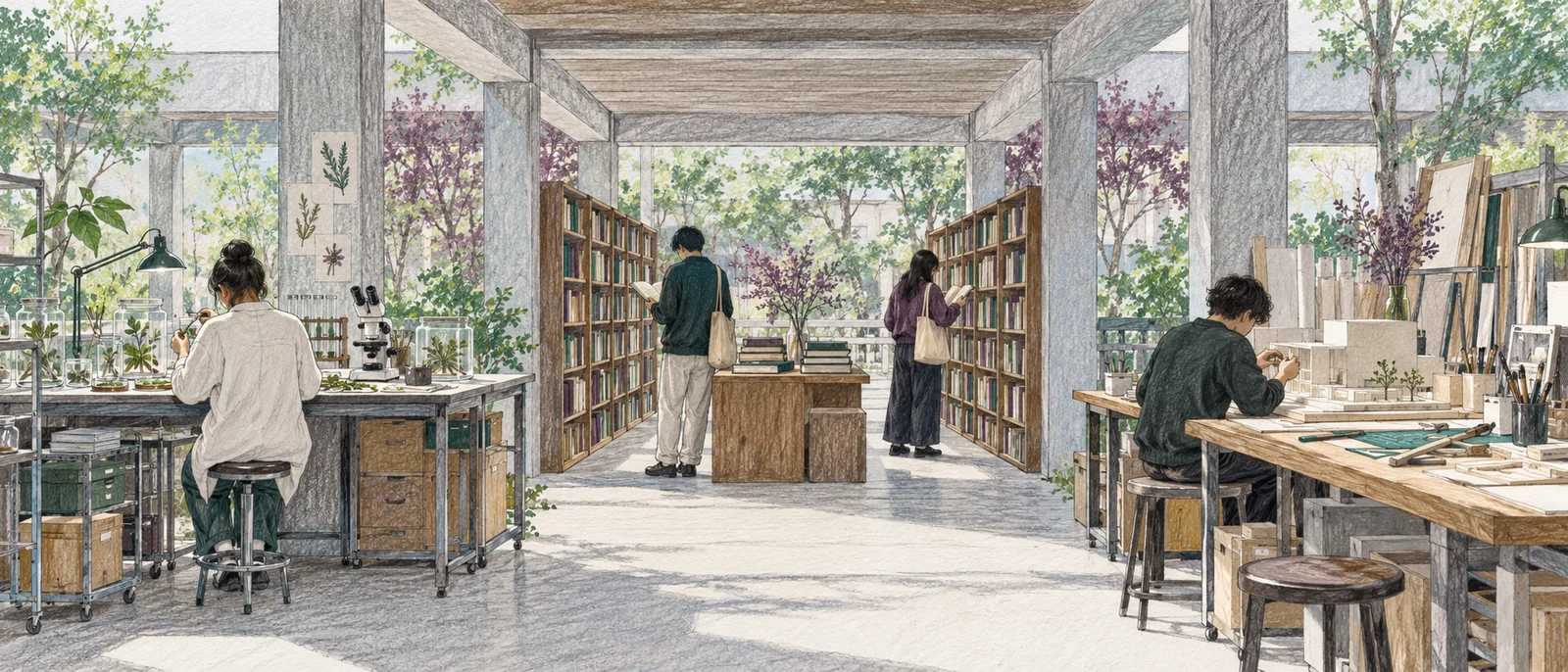
Different routes into learning. This conceptual illustration does not depict actual universities or facilities.
University of Tokyo
A large research university also offers a route into literary history. Kenzaburo Oe studied French literature, published “A Strange Job” while a student, graduated from the Faculty of Letters in 1959, and received the 1994 Nobel Prize in Literature. His career illustrates the breadth of a university that houses both scientific and humanistic inquiry. Applicants should look beyond the entrance-admission category to the faculty and research group they hope to reach.[6][29]
Institute of Science Tokyo
Tokyo Institute of Technology and Tokyo Medical and Dental University merged in October 2024. Science Tokyo combines science and engineering schools with medical and dental education, making one university-wide entrance score particularly unhelpful. Nobel chemistry laureate Hideki Shirakawa completed graduate study at the former Tokyo Tech. Historical university names should accompany alumni biographies: the institution someone attended and its current successor are related but distinct descriptions.[7][30]
Hitotsubashi University
Commerce, economics, law, and social sciences are joined by social data science. This creates several routes toward understanding firms, institutions, and social evidence. Rakuten founder Hiroshi Mikitani identifies himself as a 1988 commerce graduate in his university entrance-ceremony address. An entrepreneur can be a useful starting point, followed by closer questions about whether accounting, organizations, markets, or quantitative social research best matches the prospective student’s interests.[8][31]
University of Tsukuba
Located in Tsukuba, Ibaraki, this is the guide’s addition beyond its Tokyo–Kanagawa–Chiba–Saitama focus. Its undergraduate schools and colleges span humanities, science, information, medicine, physical education, and art. Studying sport or art within a broad research university is a distinctive possibility. A visit should examine the experience of living and studying in a research city, rather than treating distance from central Tokyo as the only geographic consideration.[32]
Chiba University
Chiba combines fields such as engineering, horticulture, and healthcare. Its engineering faculty traces its roots to Tokyo Higher School of Arts and Technology, where Anpanman creator Takashi Yanase studied design. Naming that predecessor is more accurate and more informative than retroactively calling him a graduate of today’s engineering faculty. The connection opens a story about design education. Campus locations vary by faculty, so commuting plans must follow the actual program.[10][33]
Yokohama National University
The College of Urban Sciences connects architecture, infrastructure, environment, and society. Students interested in how people inhabit cities should compare architecture with urban social studies rather than assuming all urban programs teach the same skills. Graduate work in urban innovation is another avenue to investigate. The useful comparison concerns design studios, structures, planning, and social research methods—not simply the appeal of Yokohama as a place name.[34]
Saitama University
Its faculties cover liberal arts, economics, education, science, and engineering. Takaaki Kajita, a 2015 Nobel physics laureate, graduated in physics in 1981 before pursuing graduate study at the University of Tokyo. His route makes the distinction between undergraduate foundations and later research environments tangible. A prospective researcher should investigate graduation research and graduate destinations alongside any institutional ranking, without treating one celebrated career as a typical outcome.[9][35]
Tokyo Metropolitan University
Urban Environmental Sciences covers topics including geography, infrastructure, architecture, and applied environmental chemistry. Systems Design offers further routes into information, machinery, and design. The city becomes an object of investigation: disaster resilience, movement, and housing can all lead to more specific research questions. Applicants should read laboratory topics and check the teaching campus for their faculty and year, rather than relying only on the university’s metropolitan name.[36]
Yokohama City University
Medicine, data science, international liberal arts, international commerce, and science provide distinct entry points. Interest in healthcare might lead to clinical training or to a quantitative route supporting healthcare and society. These are different educational choices. Yokohama City University and Yokohama National University are separate institutions with different academic structures. Comparing courses and degrees is more useful than grouping them together because they share a city name.[37]
Tokyo University of Agriculture and Technology
Agriculture and engineering provide pathways into life science, environment, veterinary medicine, materials, machinery, and information. Students can approach practical problems through living systems or through devices and computation. This national university is distinct from the private Tokyo University of Agriculture. Looking beyond the everyday meaning of “agriculture” reveals laboratory work in biotechnology and environmental systems, as well as connections between agricultural questions and engineering methods.[38]
University of Electro-Communications
The undergraduate School of Informatics and Engineering starts with broad foundations before students specialize through clusters and educational programs. It is relevant to interests extending from software to electronics, communications, and physical systems. The official curriculum also considers continuity with master’s study. Prospective students should clarify whether “information technology” means application development, communications research, measurement, or another field, then examine the corresponding sequence of courses.[39]
Tokyo University of Foreign Studies
Language and Culture Studies, International and Area Studies, and Japan Studies connect languages with the societies that use them. The educational question extends beyond speaking fluently to reading history, politics, and literature through those languages. Applicants can begin with a region or intellectual interest: social analysis, literary study, or translation. Once that interest is clearer, the differences between the university’s schools become easier to evaluate.[40]
Tokyo Gakugei University
Education is the institution’s central focus, including teacher preparation and work supporting education. An interest in children can develop into subject expertise and an understanding of learning and development. Applicants should match their intended school level and teaching qualification to the appropriate course. The key comparison is the relationship among the subject they want to teach, the required curriculum, and practical training—not only an overall entrance-difficulty label.[41]
Ochanomizu University
This women’s university offers humanities and education, science, human life and environmental sciences, and transdisciplinary engineering. It invites comparison across cultural inquiry, everyday living, natural science, and engineering. Assuming women’s universities are exclusively humanities-oriented would hide important options. Laboratory questions, experimental and design coursework, and graduate pathways offer a more concrete way to understand what studying here involves than broad impressions of faculty names.[42]
3. Eleven prominent private universities: look beyond the name
Familiar group labels can help people orient themselves but reveal little about individual departments. These widely discussed universities are examined through languages, science, theatre, management, engineering, and other actual fields. Their order here is not a league table.
Waseda University
Options extend from political science, law, commerce, literature, and culture to three science and engineering schools, human sciences, and sport sciences. Haruki Murakami graduated from the former School of Letters, Arts and Sciences I in 1975; his materials helped create the university’s international literature center. Literary biography can thus lead to a present-day place of learning. Compare the timetable and campus of the intended school, since experiences vary across the institution.[11][43]
Keio University
Alongside humanities and social sciences, Keio offers medicine, science and technology, pharmacy, nursing, policy management, and environment and information studies. SFC and the other campuses create different academic and everyday settings. Journalist Akira Ikegami graduated in economics, an example of study connecting with public explanation. His career should inspire questions about research and communication rather than be treated as a prediction of the career available to every economics student.[12][44]
Sophia University
Foreign languages and global studies sit alongside humanities, social sciences, and science and technology. For international interests, distinguish intensive language study from analyzing regions or international relations. An exchange scheme’s existence is only a starting point: teaching language, eligibility, cost, and progress toward graduation all matter. A university’s international profile becomes more useful when connected to the opportunities a particular student could actually use.[45]
International Christian University
ICU offers 31 majors and lets students explore broadly before settling on a specialization. This is worth comparing for applicants with several interests who are not ready to select one field immediately. Playwright Oriza Hirata graduated from its College of Liberal Arts. Options range from natural sciences and literature to peace studies. The freedom to choose later should be considered together with the responsibility of planning a coherent course of study.[14][46]
Tokyo University of Science
The university provides routes through science, engineering, pharmacy, and management. Satoshi Omura earned a master’s degree here, later receiving doctorates from the University of Tokyo and Tokyo University of Science; his undergraduate degree was from the University of Yamanashi. Correctly tracing that Nobel laureate’s education reveals a multi-institutional path. Applicants should similarly distinguish employment after a bachelor’s degree from graduate research and examine experiments and graduation projects.[13][47]
Meiji University
Beyond law, commerce, political science, and literature, Meiji includes agriculture, interdisciplinary mathematical sciences, and information and communication. A familiar admissions-group label conceals very different educational choices. Starting with a problem and working back toward a faculty is productive: an interest in food might lead to biological production research or to distribution and business. Those are different curricula even when they share a university name.[48]
Aoyama Gakuin University
Business, international politics and economics, literature, science and engineering, and social informatics offer different approaches to society and technology. CyberAgent founder Susumu Fujita graduated in business administration in 1997, as described in his own lecture. An ambition to work in internet businesses can lead either toward management or toward technical study. Courses and the actual teaching campus provide a firmer comparison than a university’s public image.[15][49]
Rikkyo University
Rikkyo offers literature, business, intercultural communication, tourism, and community and human services, among other fields. Interest in travel can become inquiry into regions, industries, culture, and mobility. Interest in welfare can become a more specific question about the people and settings a program studies. Practical training and the location of the intended faculty—including the distinction between Ikebukuro and Niiza—help turn a broad university impression into an informed choice.[50]
Chuo University
Law is a familiar entry point, but economics, commerce, literature, international fields, and science and engineering also deserve examination. Becoming a legal professional and using legal reasoning in business or government are different career paths; undergraduate law and professional law school also play different roles. Because faculty structures and campus arrangements change, applicants should consult the official list for their entry year instead of copying names from older admissions articles.[51]
Hosei University
Lifelong learning and career studies makes education, work, and life trajectories subjects of inquiry. Hosei also has technical fields: QR-code inventor Masahiro Hara graduated from electrical and electronic engineering in 1980. A predominantly humanities-based public image can obscure that engineering connection. Reading a faculty’s curriculum alongside an alumnus’s actual work reveals several different academic identities within one university.[16][52]
Gakushuin University
Law, economics, and letters sit alongside science and international social sciences. Science laboratories provide another entry point for readers who mainly associate the university with humanities. The Faculty of Intercultural Studies joined in 2026, so older five-faculty descriptions no longer capture the current structure. Translate broad ideas about tradition or atmosphere into questions about today’s specializations, curriculum, and student research.[53]
4. Ten private universities: literature, psychology, economics, film, and manufacturing
Institutions often placed near one another in comparison lists become more distinct when their curricula are examined: science and technology at Seikei, Shinto studies at Kokugakuin, art at Nihon, and philosophy at Toyo. A single association with each name leaves much undiscovered.
Seikei University
Seikei combines humanities and social sciences with science and technology. Takako Suwa of Daiya Seiki graduated in engineering and worked as an engineer before leading a manufacturing business. Her career offers a concrete example for readers interested in the intersection of production and management. An academic discipline need not map to a single occupation; questions about design, quality, and organizational leadership can guide a closer look at the university.[17][18][54]
Seijo University
Its faculties cover economics, arts and literature, law, and social innovation. Arts and literature opens questions about culture as well as literary texts. Applicants attracted to “social innovation” should inspect the social-science methods taught in individual courses. Seijo and Seikei are separate universities despite similar-sounding names. Their actual disciplinary offerings, including the presence or absence of technical fields, make a better basis for comparison.[55]
Meiji Gakuin University
Literature, sociology, psychology, and international studies are joined by mathematical informatics. This allows comparison between qualitative approaches to people and society and more mathematical or computational ones. Meiji Gakuin is distinct from Meiji University. Within psychology, a qualification-oriented route requires different checks from a general interest in human behavior. Follow the curriculum through to any further study needed after graduation.[56]
Dokkyo University
Foreign languages, international liberal arts, economics, and law offer ways to connect language study with social sciences. Compare the depth of non-English languages and the combination of regional and cultural coursework. For a career using foreign languages, ask what substantive expertise will accompany language ability. That question makes the curriculum more concrete. Dokkyo University should also be distinguished from the separate Dokkyo Medical University.[57]
Kokugakuin University
Japanese literature, history, and Shinto culture provide routes into sustained study of Japan. Tourism and community development adds another perspective on places and their present-day challenges. A student interested in history can ask whether they prefer textual sources, material evidence, or regional investigation. The university’s cultural focus becomes meaningful when it intersects with a specific subject the student wants to investigate.[58]
Musashi University
Economics, humanities, sociology, and liberal arts and sciences offer different approaches to social questions. Seminar topics and student presentations can help an applicant identify the books, methods, and settings they want to explore. This is a separate institution from Musashino University and Musashino Art University. Searching by the full university and faculty name avoids confusing three substantially different educational choices.[59]
Nihon University
Nihon spans law and economics, engineering, medicine and dentistry, pharmacy, and art. Film production and clinical or engineering education require very different facilities and practical training. Director Sunao Katabuchi graduated from the College of Art’s film department in 1983, according to its alumni newsletter. Faculty-level investigation is therefore much more informative than one university-wide entrance score. Campuses are dispersed, and some faculties are outside the metropolitan region.[22][60]
Toyo University
Toyo places philosophy at the foundation of its educational identity while extending into science, engineering, life sciences, and information. Ango Sakaguchi graduated from Indian philosophy and ethics in 1930. Readers familiar with his literary work can connect the young philosophy student with the later writer. The historical connection is most useful when followed by an examination of the questions current departments pursue, beyond the university’s admissions-group label.[19][61]
Komazawa University
Buddhist studies opens the history and thought of Zen and Buddhism, alongside economics, law, business, and global media studies. Religious studies also involves languages, texts, and cultural inquiry. For media-related interests, applicants should compare the balance between technical production and analysis of media in society. Similar-sounding programs can devote very different amounts of time to those activities.[62]
Senshu University
Economics, law, business administration, and commerce sit alongside letters, human sciences, network and information, and international communication. The range is useful for understanding distinctions within “business”: markets and policy, organizational management, and accounting or transactions lead to different classes. Qualification support is worth investigating, but should be considered together with the skills developed through ordinary coursework and seminars.[63]
5. Thirteen private universities: community, education, welfare, and expression
Exploring universities extends beyond the names most visible in admissions discussions. A dedicated calligraphy department, aviation studies, literature, and welfare or psychology placements can each become a point of discovery. These institutions have varied admissions contexts; this section is organized for exploration, not as a difficulty tier.

Practical work reveals academic specialties. The learning scenes are fictional.
Daito Bunka University
Calligraphy is available as a dedicated department, combining artistic production with the history and theory of writing and East Asian thought. A university interview brings together alumnus and calligrapher Yusho Tanaka and Hiromasa Fujimori, a member of the department’s first graduating cohort. It offers a concrete connection between study and professional practice. Students interested in explaining a line or script as well as creating it have a specific curriculum to examine.[25][64]
Tokai University
Tokai spans literature, science and engineering, sport, and healthcare. Baku Yumemakura, known for the Onmyoji series, graduated in Japanese literature. That connection offers a literary entry point into a university often encountered through other public associations. Its campuses are nationwide; this guide concerns its metropolitan study options. Check the location for each faculty and year before estimating living costs, especially where study moves between campuses.[20][21][65]
Asia University
Business, economics, law, and international relations provide routes into commerce and cross-cultural understanding. The academic guide also introduces language learning and minors. Applicants interested in overseas study should check participation rules, costs abroad, what tuition covers, and compatibility with their major. The useful question is what they would study and bring back, rather than simply whether a university offers a chance to travel.[66]
Teikyo University
Teikyo includes humanities and social sciences as well as medicine, pharmacy, medical technology, and engineering. Healthcare applicants should first identify the qualification associated with their department and the requirements for practical training and progression. Other universities also use “Teikyo” in their names, making the full institutional name important. Costs and teaching formats differ substantially between clinical and non-clinical programs within the same university.[67]
Kokushikan University
Physical education includes routes into teaching and emergency care as well as sport. The Department of Sport and Medical Science connects with training for emergency life-saving work. Rather than stopping at a reputation for athletics, distinguish coaching, the science of movement, and emergency response. Qualification-oriented applicants should examine the required subjects, practical training, graduation conditions, and eligibility for the relevant examination as one connected pathway.[68]
Takushoku University
Commerce, political science and economics, foreign languages, international studies, and engineering offer social-scientific and technical routes into international work. Bunkyo and Hachioji International campuses provide different study settings. Interest in overseas manufacturing, for example, can lead toward languages, trade, or engineering. Current departments and student projects give a more concrete picture than historical reputation alone.[69]
Kanagawa University
Kanagawa offers law and economics, science and engineering, architecture, information, and international fields. Dedicated architecture and informatics faculties provide clear starting points for comparing interests in cities and digital technology. It is a private institution, distinct from both Yokohama National and Yokohama City universities. The appeal of Yokohama and Minato Mirai should be considered alongside the actual campus, specialist courses, and practical work of the intended program.[70]
Bunkyo University
Human sciences combines psychology, sociology, and education to investigate human life from several perspectives. It allows interests in schooling, behavior, and society to be considered together. An aspiration to help people becomes more actionable when connected to a setting such as schools, communities, or support services. Teaching and psychology qualifications require checking the actual course and any further-study requirements, not inferring eligibility from a faculty name.[71]
J. F. Oberlin University
Its colleges include liberal arts, business management, arts and culture, health and welfare, and aviation. These provide distinct entry points for interests such as aviation and performing arts. Within aviation, training and cost depend on the course and intended occupation; the college name alone is insufficient. Students with a clear occupational interest should trace the classes and practical experiences that connect with that goal.[72]
Meisei University
Meisei is a comprehensive university in the Tama area with education, informatics, design, psychology, and architecture. Manga creator Naoki Urasawa discusses attending Meisei in a radio interview; that source alone does not establish a particular graduating department. His connection offers a cultural point of interest, while present-day faculties should still be assessed through their own courses. Biographical curiosity and careful program comparison can coexist.[27][28][73]
Wako University
Wako offers studies of expression, economics and business, and human life. Its art department provides opportunities to encounter different forms before narrowing a specialization. Applicants unsure of their medium should examine which classes can actually be combined. Academic freedom also requires planning. Critiques and graduation projects offer concrete evidence for judging whether the available environment fits the kind of expression a student wants to develop.[74]
Surugadai University
Law, economics and management, media and information, sport science, and psychology are available in Hanno, Saitama. The study environment can be compared with central-city universities. Media applicants should investigate the balance of production and social analysis; psychology applicants can examine experiments, statistics, and practical work. Published courses and graduation research offer a way to construct a concrete picture of four years of study.[75]
Shukutoku University
Social welfare is a central tradition, with business studies providing another route. The business faculty’s official site includes a graduate story about entering IT engineering. Counting only nationally famous alumni would overlook such occupational connections. Welfare applicants can investigate practical placements, while business applicants can compare course projects with graduates’ work. These details help evaluate the relationship between personal interests and the university’s educational approach.[26][76]
6. Eight technical universities: distinguish them by what you want to build
Grouping information, machinery, architecture, and electrical systems simply as STEM hides the interesting choices. Moving a robot, designing a bridge, writing software, and making a film require different balances of experimentation, production, and calculation.
Shibaura Institute of Technology
Engineering, systems engineering and science, engineering and design, and architecture provide different approaches to technical problems. Course choice depends on whether the student wants to work through machinery, electricity, information, or urban systems. The engineering faculty’s guide specifies a move from Omiya to Toyosu between the earlier and later undergraduate years. Compare laboratory topics and student projects, and include that campus change in commuting plans.[77]
Tokyo Denki University
Tokyo Denki offers concrete options for electrical, electronic, information, and mechanical interests. Its Tokyo Senju and Saitama Hatoyama campuses make location a program-specific question. Even students primarily interested in software should compare how much hardware and physical science their course includes. The sequence of laboratory classes, graduation research, and graduate study helps distinguish learning to use technology from investigating its underlying principles.[78]
Tokyo City University
The mechanical engineering program describes investigating materials and design through experiments and computer simulation. An interest in operating machines can develop into questions about material behavior and forces. Tokyo City University is a private institution separate from Tokyo Metropolitan University. Its name should not obscure its engineering fields. Applicants can compare the opportunities to work with physical equipment and computational models.[79]
Kogakuin University
Architecture, informatics, engineering, and advanced engineering form its main academic routes. The architecture faculty presents architecture as a broad discipline and discusses digital education. Applicants can narrow their interests toward design, structures, environment, or urban development, then inspect studios and laboratories. Distinguish the institution from similarly named technical universities or vocational schools by checking its official degrees and curriculum.[80]
Chiba Institute of Technology
Advanced robotics combines mechanical, electrical, electronic, information, and control foundations with robot building. The university also hosts the Future Robotics Technology Center, fuRo. “Robotics” contains several different tasks: creating mechanisms, sensing the environment, and controlling movement. Applicants should identify which of these they want to specialize in and investigate how undergraduate teaching connects with the research that attracts them.[81]
Nippon Institute of Technology
Fundamental engineering, advanced engineering, and architecture include routes into machinery, electrical information, robotics, media, and data science. Its applied-engineering orientation should be examined through concrete projects and access to facilities. Look at how mathematics and physics lead into specialist courses rather than judging only entry-level selectivity. The useful question is whether the course helps combine the desire to build things with the foundations that building requires.[82]
Kanagawa Institute of Technology
The institution includes engineering and information fields as well as nursing. Its academic policies describe work with information systems and media creation. It is distinct from Kanagawa University. Technical applicants should examine how much coursework involves designing, testing, and explaining something themselves, in addition to following exercises. Student work, graduation research, and support for foundational subjects provide complementary evidence for comparison.[83]
Tokyo Polytechnic University
Tokyo Polytechnic brings together engineering and media arts, including photography, film, design, animation, games, and manga. Photographer Eikoh Hosoe graduated from its predecessor, Tokyo College of Photography, in 1954. That history connects photographic practice with education. Applicants should investigate how they learn to interpret, create, and discuss images, in addition to learning equipment operation. Facilities matter, but so does the cycle of production and critique.[23][84]
7. Eight universities with distinct specialties: agriculture, art, women’s education, and languages
This section explores education that institutional size or one overall rank may not capture well: fermentation, studio critique, policy studies at Tsuda, architecture at Japan Women’s University, and languages connected with regional study. One department name can change the question a reader asks.
Tokyo University of Agriculture
Food, fermentation, life science, environment, and agricultural business provide several ways into the subject. This private university is distinct from the national Tokyo University of Agriculture and Technology. Interest in food can lead to microorganisms, production, or distribution and management. It has study locations in Setagaya and Atsugi as well as Hokkaido, so applicants must identify their faculty’s location. Compare laboratory work, practical training, and business coursework.[85]
Tokyo University of the Arts
Fine arts and music are central at undergraduate level, with fields such as film and new media also available in graduate education. Distinguish undergraduate availability from graduate offerings. Entrance examinations with substantial practical components cannot be evaluated through academic-test scores alone. Investigate the relevant performance or production tests, teaching, and opportunities to present work, then connect admiration for the institution with the daily practice the student wants to undertake.[86]
Musashino Art University
Art and design are explored through the College of Art and Design and the College of Creative Thinking for Social Innovation. An interest in drawing can develop toward fine art, communication, products, or space. Faculty expertise, critiques, workshops, facilities, and graduation projects are essential comparison points alongside admission difficulty. Exhibitions provide an opportunity to ask whether the questions students are investigating resemble those an applicant wants to pursue.[87]
Tama Art University
Art and design connect making with reflection. Product designer Naoto Fukasawa graduated in three-dimensional design in 1980. The university’s presentation of his work offers a route into questions about the relationship between everyday objects and how people use them. An admired designer’s educational background is a starting point; current assignments, material practice, and critiques are what turn that admiration into a potential study plan.[24][88]
Tsuda University
Alongside English literature and international relations, Tsuda’s College of Liberal Arts includes mathematics and computer science. Its College of Policy Studies is at a different campus. Students interested in both languages and quantitative work can examine the curriculum before forcing an early humanities-versus-sciences choice. Check both the depth of the main specialization and the actual scope for studying other fields.[89]
Japan Women’s University
Architecture and design became a faculty in 2024, followed by food and nutritional sciences in 2025, alongside fields such as science, literature, and human societies. Study of everyday life can thus lead into design and natural science. A narrow historical label such as home economics would miss the current structure. For a new faculty, compare the educational experience inherited from predecessor departments with what the revised curriculum changes.[90]
Tokyo Woman’s Christian University
In 2025 its School of Arts and Sciences reorganized into six departments: humanities, international society, economics and management, psychology, social communication, and information and mathematical sciences. This places people, society, and quantitative study within one school. Old department names can obscure the new options. Understand liberal arts through the actual combination of cross-disciplinary courses and specialist study rather than treating it as a general slogan.[91]
Kanda University of International Studies
Foreign languages and global liberal arts provide opportunities beyond English, including Asian and Ibero-American languages. Language becomes a specialization when connected to what a student wants to understand through it. Comparing language options, opportunities for use outside class, study-abroad conditions, and graduation goals helps connect an internationalization indicator with an individual educational plan.[92]
8. Read the map through alumni: names become works and careers

Following people’s work back toward education. These are not reproductions of actual works or products.
Another way to read a university guide is to begin with things people have made: novels, manga, films, everyday products, and QR codes. Following their creators makes department names tangible. A famous individual does not establish an institution’s average outcomes or causal educational impact. These are individual histories intended to expand curiosity.
Literary history extends beyond Tokyo and Waseda
Kenzaburo Oe at the University of Tokyo and Haruki Murakami at Waseda provide familiar starting points. Murakami graduated from the First Faculty of Letters in 1975; Waseda’s international literature center also provides a place to explore his literary world. Rather than assuming that an institution caused an author’s work, consider the university as a place for reading, theatre study, and preserving literary materials.[6][11]
Add Toyo and Tokai to this map. Ango Sakaguchi studied Indian philosophy and ethics at Toyo and graduated in 1930. The author associated with “Discourse on Decadence” had spent time studying philosophy. Baku Yumemakura, author of Onmyoji, studied Japanese literature at Tokai. Following writers draws different connections from those found in a conventional league table.[19][20][21]
Naoki Urasawa, discussed in the Meisei profile, is known for manga including MONSTER and 20th Century Boys. His own account of university life brings the student years behind a familiar body of work into view. This article reports the attendance story it could verify rather than filling in a department or graduation year by inference.[27][28]
Entrepreneurs have different academic starting points
Rakuten’s Hiroshi Mikitani graduated in commerce at Hitotsubashi; CyberAgent’s Susumu Fujita studied business administration at Aoyama Gakuin. Seikei alumna Takako Suwa is known for leading precision manufacturer Daiya Seiki. Commerce, management, and engineering can all appear behind the shared occupational label “business leader.”[8][15][17][18]
Aspiring founders should look beyond counts of famous entrepreneurs. Do they want to design products, understand markets and organizations, or learn finance and accounting? Asking that first gives a reason to choose particular courses and activities. These biographies suggest questions; they do not establish that any degree guarantees entrepreneurial success.
Scientific careers often connect several institutions
Takaaki Kajita moved from undergraduate study at Saitama to graduate study at Tokyo. Hideki Shirakawa’s history includes graduate education at the former Tokyo Tech. Satoshi Omura graduated from Yamanashi before completing a master’s at Tokyo University of Science in 1963, later receiving doctorates from Tokyo and Tokyo University of Science. Undergraduate education, graduate training, and research appointments occupy different places in a scientist’s history. Assigning the entire achievement to one name conceals those transitions.[9][7][13]
A prospective researcher can ask both where to enter and what to investigate next. Foundations in mathematics and experimentation, a question developed through undergraduate research, and graduate specialization are distinct steps. The actual curriculum still needs investigation; one Nobel laureate’s trajectory is not a ready-made route for everyone.
Engineering and art meet in products and works
QR-code developer Masahiro Hara graduated in electrical engineering at Hosei in 1980. Naoto Fukasawa’s work, following design study at Tama Art University, invites questions about product form and use. Photographer Eikoh Hosoe studied at Tokyo Polytechnic’s predecessor; filmmaker Sunao Katabuchi studied film at Nihon University College of Art. Each makes the connection between university study and expression more concrete.[16][24][23][22]
Looking at a work before reading its creator’s department turns electrical engineering, product design, photography, and film into activities beyond entrance-exam subjects. Readers with a favorite work can investigate production methods and specialist courses instead of choosing a university solely because its creator attended it.
9. Make your own university map: from 64 institutions to three next visits
There is no need to put all 64 institutions into a single order. The following is a practical method for investigating candidates. Looking closely at three universities’ courses and commuting routes can provide more useful decision material than stopping at a ranking.
Translate a name into an activity
“Information studies” might mean writing software, developing mathematical models, building circuits, or researching users. “Literature” could involve close reading, languages, archival research, or creative writing. Supporting people through teaching, social work, psychology, or nursing also requires different qualifications and training.
Return to the profiles with those activities in mind. For cities and buildings, possible starting points include Yokohama National, Tokyo Metropolitan, Shibaura, Kogakuin, and Japan Women’s University. For languages and regional understanding, compare Tokyo University of Foreign Studies, Sophia, Dokkyo, and Kanda by language–region combinations. These are prompts for reading official curricula, not claims that the institutions provide equivalent education.
Follow costs and locations through the full course
Separate tuition, admission fees, facilities charges, placements, materials, commuting, and housing. Programs with different durations, including some healthcare courses, should not all be compared using a four-year total. Study abroad, qualification costs, and conditions attached to grants belong on separate lines.
Rather than inventing a uniform fee figure here, use the intended faculty’s official schedule for the year of entry. Teaching locations can change by faculty or year. Consider travel all the way to the classroom and the likely finishing times of laboratories or studio sessions, not simply the nearest station.
Read the denominator behind career and examination rates
Employment rates based on job seekers differ from rates based on all graduates. Professional examination figures may refer to graduates, actual examinees, first-time candidates, or repeat candidates. Identify the denominator before comparing percentages. Read intended occupations, industries, graduate study, and support for qualifications separately.
At an open campus, follow the tour of attractive facilities with concrete questions: when can undergraduates use them, what do students make in each course, and what recent graduation projects have been completed? Small-group education also becomes comparable only when the actual sizes of seminars and practical classes are known.
Put three candidates on one page
For each, record the intended department, required and optional courses, thesis or production work, qualifications and placements, admission route, total course costs, commuting and housing, and detailed destinations. Leave unknowns as questions for an information session rather than filling them with guesses.
Greater Tokyo offers places to investigate society, read languages, design bridges, make films, study fermentation, and support everyday life, alongside major research universities. Learning one specific thing that can be studied there is more useful for the next decision than simply recognizing another name.
References
- [1]Benesse / THE, Japan University Rankings 2025, April 3, 2025 ↩
- [2]THE Japan University Rankings 2025 methodology ↩
- [3]THE Japan University Rankings 2025 ↩
- [4]Kawai-juku Kei-Net — entrance difficulty rankings and interpretation ↩
- [5]Kawai-juku Kei-Net — interpreting entrance requirements and BF ↩
- [6]University of Tokyo — Kenzaburo Oe, March 14, 2023 ↩
- [7]Science Tokyo — Hideki Shirakawa and honorary professors ↩
- [8]Hitotsubashi — 2021 entrance ceremony address by Hiroshi Mikitani ↩
- [9]Saitama University — Takaaki Kajita Nobel lecture, 2016 ↩
- [10]Chiba University alumni newsletter — Takashi Yanase ↩
- [11]Waseda — Haruki Murakami and the literature research center ↩
- [12]Kadokawa Culture Museum — Akira Ikegami biography ↩
- [13]Nobel Prize — Satoshi Omura biography ↩
- [14]Professional College of Arts and Tourism — Oriza Hirata biography ↩
- [15]Aoyama Gakuin endowed lecture — Susumu Fujita ↩
- [16]Hosei — QR code inventor Masahiro Hara, February 2026 ↩
- [17]Seikei — interview with Takako Suwa ↩
- [18]PHP THE21 — Takako Suwa biography ↩
- [19]Toyo — Ango Sakaguchi, 120th anniversary, October 2026 ↩
- [20]Bungeishunju — Baku Yumemakura and Onmyoji ↩
- [21]Baku Yumemakura — official author biography ↩
- [22]Nihon University College of Art alumni newsletter 101 — Sunao Katabuchi ↩
- [23]Tokyo Polytechnic Shadai Gallery — Eikoh Hosoe ↩
- [24]Tama Art University — works by Naoto Fukasawa ↩
- [25]Daito Bunka — a century of calligraphy education ↩
- [26]Shukutoku — business education and graduate career stories ↩
- [27]TBS Radio / radiko — Naoki Urasawa discusses Meisei University ↩
- [28]Victor Entertainment — Naoki Urasawa official profile ↩
- [29]University of Tokyo — official academic information ↩
- [30]Institute of Science Tokyo — official academic information ↩
- [31]Hitotsubashi University — official academic information ↩
- [32]University of Tsukuba — official academic information ↩
- [33]Chiba University — official academic information ↩
- [34]Yokohama National University — official academic information ↩
- [35]Saitama University — official academic information ↩
- [36]Tokyo Metropolitan University — official academic information ↩
- [37]Yokohama City University — official academic information ↩
- [38]Tokyo University of Agriculture and Technology — official academic information ↩
- [39]University of Electro-Communications — official academic information ↩
- [40]Tokyo University of Foreign Studies — official academic information ↩
- [41]Tokyo Gakugei University — official academic information ↩
- [42]Ochanomizu University — official academic information ↩
- [43]Waseda University — official academic information ↩
- [44]Keio University — official academic information ↩
- [45]Sophia University — official academic information ↩
- [46]International Christian University — official academic information ↩
- [47]Tokyo University of Science — official academic information ↩
- [48]Meiji University — official academic information ↩
- [49]Aoyama Gakuin University — official academic information ↩
- [50]Rikkyo University — official academic information ↩
- [51]Chuo University — official academic information ↩
- [52]Hosei University — official academic information ↩
- [53]Gakushuin University — official academic information ↩
- [54]Seikei University — official academic information ↩
- [55]Seijo University — official academic information ↩
- [56]Meiji Gakuin University — official academic information ↩
- [57]Dokkyo University — official academic information ↩
- [58]Kokugakuin University — official academic information ↩
- [59]Musashi University — official academic information ↩
- [60]Nihon University — official academic information ↩
- [61]Toyo University — official academic information ↩
- [62]Komazawa University — official academic information ↩
- [63]Senshu University — official academic information ↩
- [64]Daito Bunka University — official academic information ↩
- [65]Tokai University — official academic information ↩
- [66]Asia University — official academic information ↩
- [67]Teikyo University — official academic information ↩
- [68]Kokushikan University — official academic information ↩
- [69]Takushoku University — official academic information ↩
- [70]Kanagawa University — official academic information ↩
- [71]Bunkyo University — official academic information ↩
- [72]J. F. Oberlin University — official academic information ↩
- [73]Meisei University — official academic information ↩
- [74]Wako University — official academic information ↩
- [75]Surugadai University — official academic information ↩
- [76]Shukutoku University — official academic information ↩
- [77]Shibaura Institute of Technology — official academic information ↩
- [78]Tokyo Denki University — official academic information ↩
- [79]Tokyo City University — official academic information ↩
- [80]Kogakuin University — official academic information ↩
- [81]Chiba Institute of Technology — official academic information ↩
- [82]Nippon Institute of Technology — official academic information ↩
- [83]Kanagawa Institute of Technology — official academic information ↩
- [84]Tokyo Polytechnic University — official academic information ↩
- [85]Tokyo University of Agriculture — official academic information ↩
- [86]Tokyo University of the Arts — official academic information ↩
- [87]Musashino Art University — official academic information ↩
- [88]Tama Art University — official academic information ↩
- [89]Tsuda University — official academic information ↩
- [90]Japan Women’s University — official academic information ↩
- [91]Tokyo Woman’s Christian University — official academic information ↩
- [92]Kanda University of International Studies — official academic information ↩
NOVEL SERIES VOL.1
The World Became Slightly Farther Away
The world may not change, but distance can.
A story about a man who cannot treat promises lightly, and the people he meets.The sequel, Clouded Glass, is out too. Start here.
View on Amazon
Jijoden.com
Your life is worth writing.
There is a truer self you can tell only to AI.Gather fragments of memory into a single story.
Take a LookRelated Articles
Tomcat Vulnerability Response — Eight Flaws, AWS, Spring Boot, and Legacy Deployments【October 2026】
A primary-source guide to eight Tomcat vulnerabilities disclosed October 20, 2026: authentication bypass, HTTP/2 and AJP mix-ups, fixed releases, Amazon Linux status, embedded Tomcat, containment, and deployment verification.
What Makes Gemini 4 Argon Different? — GPT-6, Claude Fable 5.1, and Opus 5.5 Compared
Compare Gemini 4 Argon with GPT-6.1 Sol, GPT-6 Astra, and Claude Fable 5.1, Opus/Sonnet 5.5: shared context, long output, video and audio input, introductory pricing, and practical choices for coding, analysis, and everyday work.
PHP2Shell Response Guide — AWS, Legacy PHP, and Vulnerability Response in the AI Era
A primary-source guide to PHP2Shell disclosed on October 21, 2026, updated the night of October 22: exploitation attempts before disclosure, Japan’s government response and preventive outages worldwide, Amazon Linux fixes, AWS WAF limits, legacy backports, deployment verification, and AI-assisted discovery.
Vacant Home Rates by Prefecture in Japan: The Latest Ranking, With Tokushima Highest at 21.3%, Saitama Lowest at 9.3%, and Kagoshima First Once Rental and Second Homes Are Excluded
Using the 2023 Housing and Land Survey from Japan’s Statistics Bureau, this ranks all 47 prefectures by vacant home rate and number of vacant homes. Japan had 9,001,600 vacant homes, a record 13.8% of all dwellings. Tokushima is highest (21.3%) and Saitama lowest (9.3%). Excluding homes for rent, for sale and second homes, Kagoshima comes first and Tokyo last. It also covers how the survey defines a vacant home, trends since 1958, changing regional gaps and the limits of a sample survey.
Why Personal Data Breaches Keep Happening — Japan’s Incidents and What Businesses and Individuals Should Check
As of October 21, 2026: official disclosures from Times Car, Lawson, Furusato Choice and others, with practical guidance on AI-related threats, reporting, password hashes, MFA, AWS monitoring and personal responses.
From the Pocho Lab
