

Table of Contents
1. Conclusion: Face Recognition Is Neither “Memory” in General nor a Measure of Human Worth
Can you recognize an actor instantly when he appears in a period drama with a topknot? Or do you enjoy the film for an hour, begin thinking that the performer looks vaguely familiar, search the cast, and only then realize who you have been watching?
Some people identify a celebrity on the far side of a street from gait alone. Others hear “Long time no see” from someone they have met before and slowly reconstruct the memory from the voice and conversation. A person who has confidently greeted the wrong stranger may then see a real acquaintance and remain silent, afraid that another mistake would be rude.
Sociability, attentiveness, sincerity, or professional competence cannot explain this spread. Difficulty remembering a face does not prove lack of interest, and never forgetting a face does not confer universal social skill. Research instead shows that perceiving facial identity, learning it, and matching it across changes in viewpoint and expression vary widely between people in ways that general intelligence and ordinary object memory do not fully explain.[1][2]
This article has one central claim: a person is better understood as a profile of partly overlapping abilities than as a single average score. Yet it would also be inaccurate to say that everybody has a small percentage of every disorder. Continuous traits and clinical diagnoses built from more than one number can coexist.
Faces will be our entrance into cognitive unevenness, machine recognition, the border between “normal” and “disordered,” and the danger of evaluating a whole person from one direction.
2. We Do Not Store a Face as One Photograph
“Remembering a face” sounds like saving a passport photograph and matching the live image against it. In practice, multiple processes form a chain:
- detecting that a face is present;
- perceiving features and their configuration;
- learning a previously unfamiliar face into short- or long-term memory;
- judging it to be the same identity across angle, illumination, expression, and age;
- retrieving associated voice, place, occupation, and events;
- and finally retrieving a name.
Where the chain stalls changes the experience. Feeling that a person is familiar while failing to retrieve a name is not the same as failing to recognize the identity. Confusing film characters after each scene change is not the same as knowing the character while forgetting the actor's name. Face perception, face memory, and recognition speed appear in research as distinguishable abilities.[1]
Nor do people merely add eyebrow thickness, nose shape, and mouth width one by one. Both holistic processing of facial configuration and processing of local features matter, and their contribution varies by task and person. A 2023 study did not support a one-mechanism explanation for individual differences in recognition.[3]
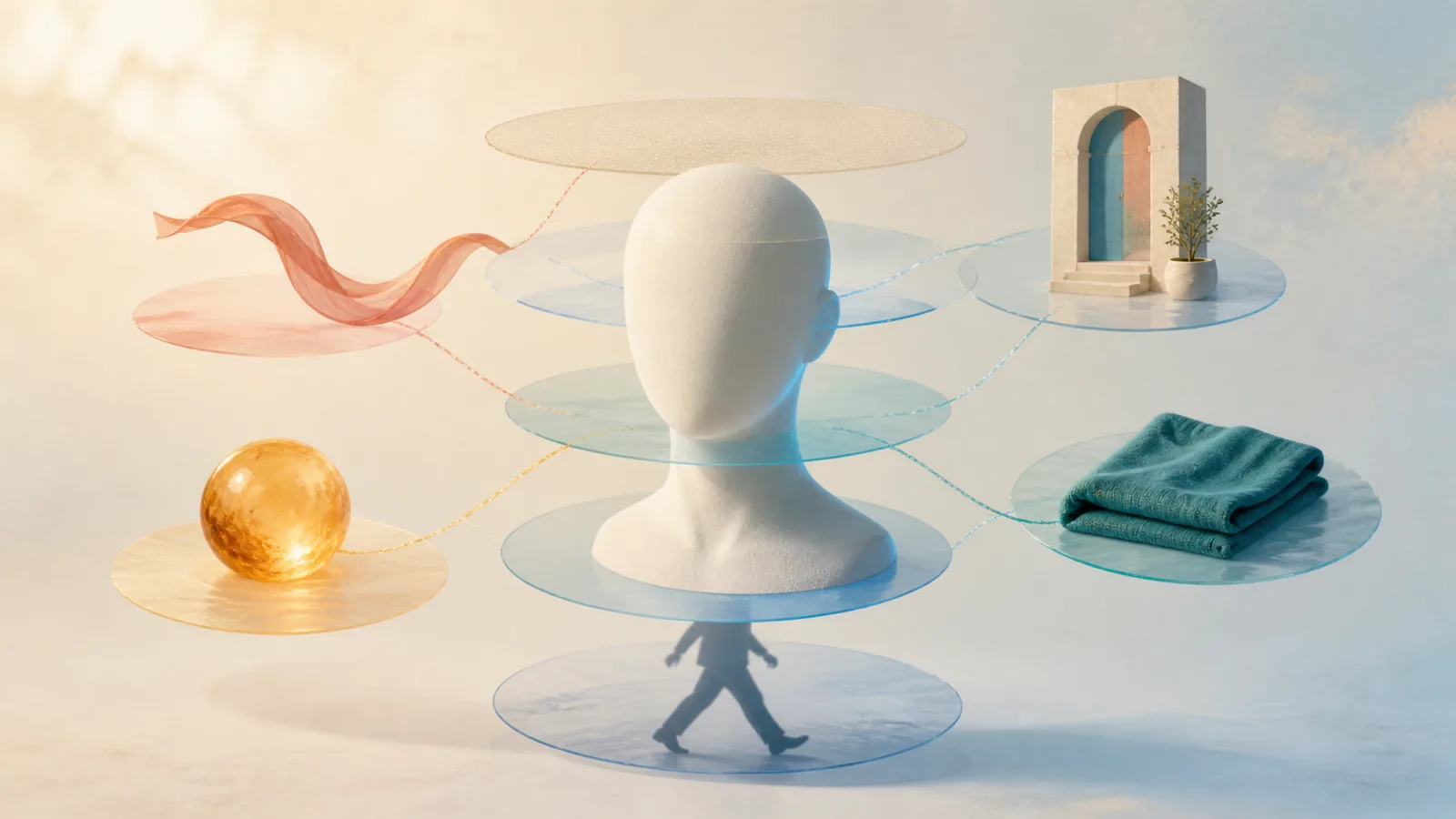
Recognition is not one image comparison. Shape, configuration, memory, voice, place, and name are cues joined with different strengths.
That is why performing poorly on a visual-search task—finding a sample shape hidden among many shapes—does not by itself establish weak face recognition. Conversely, someone can perform well on generic shape tasks and struggle specifically with faces. Without several tasks matched to the ability of interest, “poor vision” or “bad memory” becomes too broad a label.
3. Measuring Face Recognition: A 72-Trial Test Is Not a Diagnosis
One widely used research measure is the Cambridge Face Memory Test (CFMT), introduced by Duchaine and Nakayama in 2006. Participants learn unfamiliar faces, then select the same people from three-image arrays as viewpoint, lighting, and visual noise change. The standard test uses six identities and 72 trials; chance performance is 24 correct responses.[4]
That structure resembles daily life. A new acquaintance does not return in the same pose, illumination, and expression as at the first meeting. The CFMT attempts to measure retrieval of a learned face through variation, rather than simple side-by-side image matching.
But one CFMT score cannot diagnose developmental prosopagnosia. Results depend on the test version, age, the gender and ethnicity of stimulus faces, testing conditions, and the normative sample. In a 2025 study, two extended CFMT versions with similar structure but different face gender correlated at 0.72. That was substantial, yet approximately 49% of variance remained unshared, and relative performance in the average range moved considerably between tasks.[5]
Face recognition is therefore not a blood-type label. No biological wall separates a score of 68 from 69. Measurements contain error, tasks contain bias, and real-world recognition adds voices, gait, and context.
Tests are still useful. Subjective experience alone may not reveal whether the problem concerns faces, names, or simply meeting too many people. A clearer picture emerges by combining self-report, multiple objective tasks, developmental history, and consequences in daily life.
4. Prosopagnosia at One End, Super-Recognizers at the Other
At the low end of the distribution, severe lifelong difficulty is called developmental prosopagnosia (DP). It is distinguished from acquired prosopagnosia after events such as stroke or brain injury.
The figure “2–2.5% of the population” circulated for years, but a 2023 study of 3,116 adults showed how much prevalence depends on diagnostic rules. Applying historical criteria produced estimates from 0.64 to 5.42% using z-scores and 0.13 to 2.95% using percentile rules. Conservative criteria commonly used in research identified 0.93% by z-score and 0.45% by percentile. The investigators also failed to find a stable natural cluster composed only of poor recognizers.[6]
This does not make DP unreal. The difficulties are real; the result means that nature did not provide one obvious cliff, and that researchers or support systems must decide where to place a boundary for a particular purpose.
The impact of the same recognition weakness is not uniform. A study published in 2024 compared 88 people with DP and 58 controls. Mean Social Interaction Anxiety Scale scores were 30.25 and 17.19, and 44% versus 14% reached a suggested clinical cutoff. Crucially, more than half of the DP group did not reach that cutoff. Fear of mistakes, interactions with strangers, and other traits can compound recognition difficulty, but low face recognition does not automatically predict an anxiety disorder.[7]
At the opposite end are super-recognizers, people who retain unfamiliar faces and match them across photographs or video with unusually high accuracy. Their possible use in policing and forensics is under active study. Yet they are not infallible human face-recognition machines. In a 2023 international comparison, super-recognizers were fast but biased toward “same person,” sometimes expressing extreme confidence when misidentifying someone. Trained forensic facial examiners worked more slowly and used strategies designed to avoid false identification.[8]
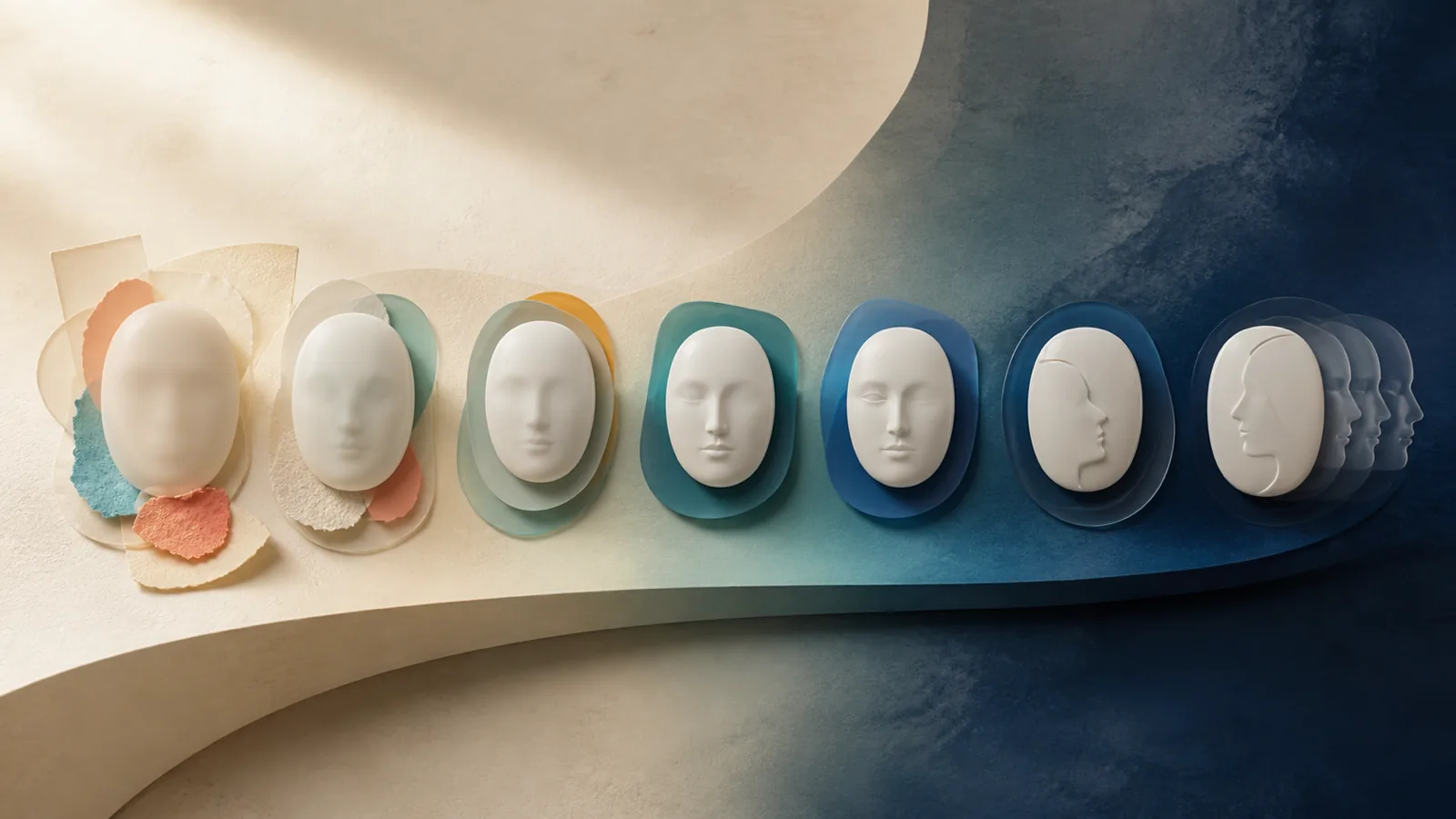
Naming the low and high ends does not erase the middle. Speed, accuracy, and the use of confidence are not the same dimension.
The distribution must not be read as “high means globally superior, low means globally inferior.” Associations with general intelligence are small. In a genetic analysis including 1,042 people, face recognition correlated 0.29 with object recognition and 0.16 with general intelligence. Another twin study found CFMT correlations of 0.70 for identical twins and 0.29 for fraternal twins, supporting a substantial, relatively specific genetic contribution. Heritability is not destiny, but the results resist the idea of one cognitive ladder on which clever people also remember every face.[9][2]
5. Why a Hairstyle Can Defeat a Brain—and How AI Groups Photographs
You recognize a colleague at work but not at a station on Sunday. You know an actor in a contemporary drama but lose the identity when period hair, costume, weight, makeup, and manner change together. This becomes understandable if the brain uses not an isolated face but a context-rich person package.
People with weak face recognition may compensate with voice, hair, glasses, clothing, gait, the expected place, or companions. A study involving 79 participants identified extra-facial information, identity prompts from others, and preparation for planned encounters as useful strategies. Hair changes, infrequent contact, unexpected settings, and uniforms that make everyone look similar could break those strategies.[10]
Google Photos' Face Groups detects faces, creates numerical face models, predicts similarity, and groups images likely to show the same person. Google's own documentation says suggestions are not perfect and that the system may also use nearby capture times or repeated clothing when a face is not visible.[11]
The classic FaceNet system mapped face images into a numerical space in which distance represented similarity, enabling verification and clustering. Its 2015 paper represented a face in 128 bytes and reported 99.63% accuracy on the then-standard Labeled Faces in the Wild dataset.[12] That is a helpful analogy for software grouping photographs from childhood through adulthood.
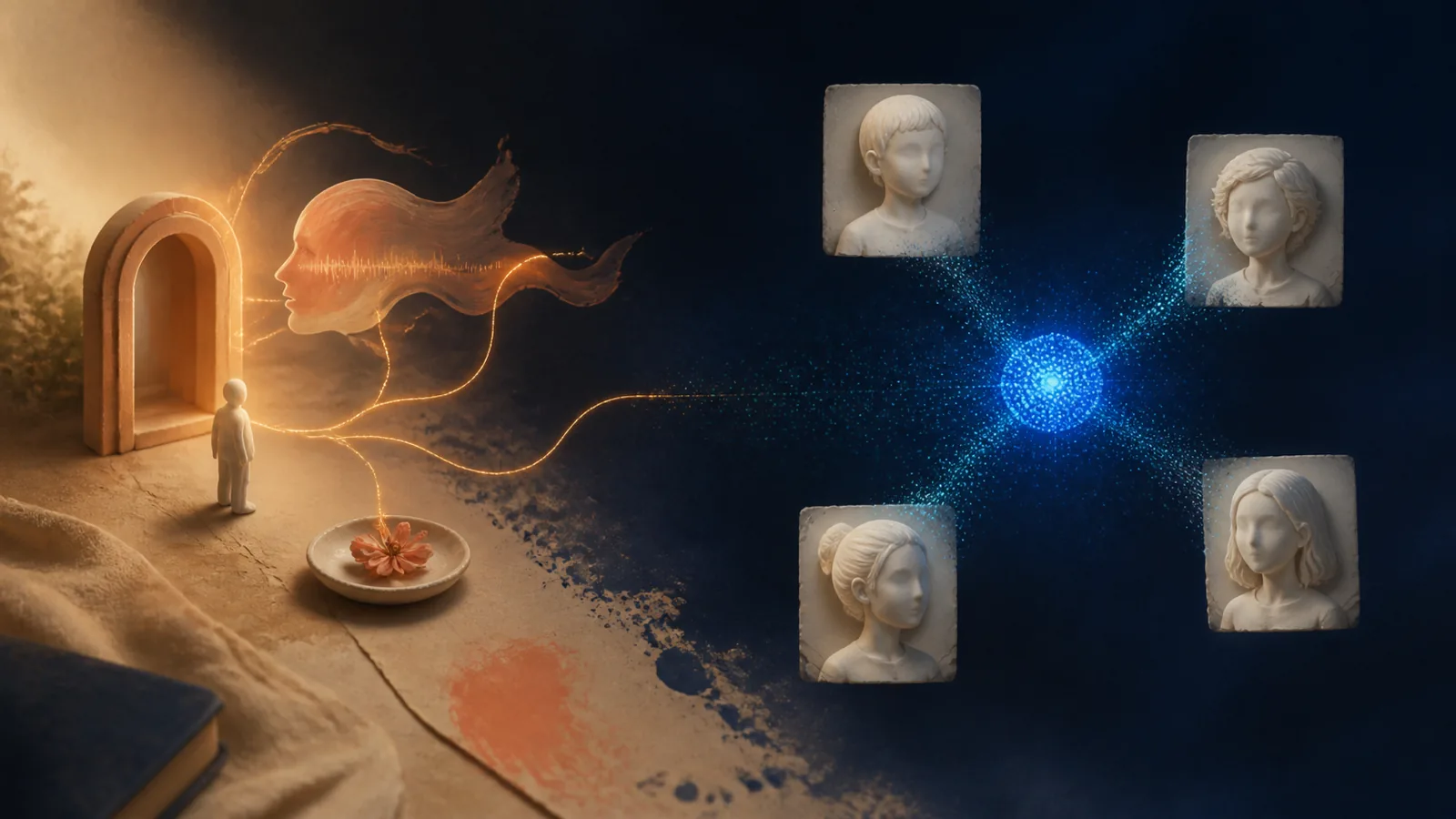
AI can map images into a space where similar identities lie near one another. Human memory also contains voice, relationship, emotion, place, and the social cost of being wrong.
Calling a never-forgetting person “FaceNet in a brain” should remain a metaphor. An algorithm learns from large image sets under an explicit objective; a human binds a limited number of encounters to emotion and social relationship. FaceNet's 99.63% was a result on one dataset, not universal performance across railway stations, aging, masks, biased training data, and the unequal consequences of mistakes. Both exceptional humans and machines can be confidently wrong.
6. Is “Just Short of a Disorder” a Disease? Separate Dimensional Traits from Diagnosis
Face recognition leads to a larger question. If abilities are continuous, is someone immediately above a diagnostic threshold “10% disordered”? Should a low mood be called “5% depression,” or mild malaise “5% of a cold”?
The intuition is appealing, but medicine cannot generalize it that way. Many symptoms vary continuously. Diagnoses, however, may also depend on symptom pattern, duration, onset, distress, functional impact, and exclusion of other causes. The WHO's ICD-11 clinical guide generally avoids artificial precision in counts and duration while explicitly considering significant impairment in personal, family, social, educational, occupational, or other important functioning and significant distress.[13]
Intellectual developmental disorder is likewise not “IQ 80 or below means disabled, 81 means normal.” Under DSM-5-TR, clinicians assess adaptive functioning in conceptual, social, and practical domains, and severity is not set by IQ alone. The American Psychiatric Association describes an IQ around 70–75 as an indicator of significantly limited intellectual functioning while requiring significant limitations in both intellectual functioning and adaptive behavior.[14] Borderline intellectual functioning can be an important support concept, but treating one number as if it were a complete diagnosis conflicts with current practice.
Statistical rarity and disease are also different. Extreme height, exceptional face recognition, or exact pitch may be unusual without being disorders. Conversely, a common symptom can be clinically important when it constricts life and creates a need for treatment or support.
Physician-philosopher Georges Canguilhem challenged the tendency to merge normal as statistically usual with normal as how a person ought to be. Distance from the mean must not be converted automatically into inferiority. The WHO's International Classification of Functioning, Disability and Health likewise places functioning in context, including environmental factors. Name badges at a conference, colleagues introducing themselves by voice, or stable classroom seating can reduce difficulty for the same cognitive profile.[15][16]
A more accurate statement is this: people possess many continuous traits. Weakness on one trait is not automatically disease. When multiple difficulties and environmental barriers combine to restrict participation, diagnosis or support may become important. A boundary is not a ranking of human value; it is a practical tool for identifying needs.
7. Unevenness Is Neither Proof of Talent nor Proof of Tragedy
Plotting abilities on a radar chart would usually produce an irregular shape. Face memory may be low while language is high. Processing speed may be slow while error detection is sharp. Spatial skill can coexist with weak name retrieval. An outgoing person may struggle with faces. A one-trial face learner may make premature same-person judgments.
It is dangerous to turn this into the comforting claim that every major weakness guarantees a genius-strength compensation. No law says a valley must create a peak elsewhere. A difficulty can simply make life harder, and nobody should have to purchase the right to support with an exceptional talent.
Still, documented lives show why one function cannot stand in for professional capacity. Neurologist and author Oliver Sacks wrote in detail about his own prosopagnosia and difficulty recognizing places. A clinician celebrated for observing people and turning minds into globally read prose struggled to recognize people and locations in ordinary life.[17]
The monumental portrait artist Chuck Close also discussed his prosopagnosia. In a PBS conversation he explained that when a real person moved their head half an inch, it could become a new face he had never seen. Fixing a face in a photograph and dividing it into a grid illustrates something stronger than a simple paradox: work can be designed around the way one's perception actually operates.[18]

Ability resembles terrain more than a perfect circle. A low region may be routed around, while a high ridge may become part of one's work.
Neither case proves that prosopagnosia caused achievement. A collection of famous exceptions would erase the majority who live with real difficulty and no celebrated output. The defensible conclusion is narrower and more important: weakness in one function cannot determine intelligence, creativity, vocational capacity, or human value as a whole.
8. Know Your Profile to Design a Life, Not to Rank People
If faces are difficult, specify the situations before pursuing a label:
- Do you recognize the person but fail only to retrieve the name?
- Does recognition arrive after several meetings, or are family members and your own face difficult?
- Does hearing a voice solve the problem?
- Are people recognizable at work but not in different clothing or places?
- Is the issue limited to confusing film characters, or does it cause avoidance of work and relationships?
- Has it existed since childhood, or did it begin suddenly?
Practical adjustments are modest but meaningful. Explain, “I have difficulty recognizing faces, so it helps if you say your name first.” Add the meeting place and topic to contacts. Keep display names visible in online meetings. Use name badges at large events. Share clothing details before meeting. Offer a broad greeting and use the response as context. These are not deceptions; they are environmental tools, like glasses or maps. Research on compensation also emphasizes preparation and external cues.[10]
If the difficulty is substantial, do not conclude from one online test. Seek a clinician or specialist familiar with visual cognition and neuropsychology. If recognition of familiar faces changes suddenly, do not assume a developmental difference: urgent medical evaluation is warranted because stroke and other neurological causes must be considered.[19]
Others can leave room for uncertainty too. A missed greeting does not immediately prove arrogance, coldness, or ingratitude. Conversely, remembering a face does not deserve uncritical trust. Face-recognition ability does not certify character.
A person whose every ability lies exactly at the average may be rare. Yet distance from average is not greatness, and proximity to average is not mediocrity. Radar-chart area cannot produce a total human score. Work, family, art, research, and friendship demand different axes and different combinations.
The difference between remembering someone after one meeting and after five meetings is real. It cannot decide which person is “above” the other. To see a person from multiple angles is not merely to search for a positive moral. It is the intellectual restraint not to infer a whole from one observation.
The next time someone fails to recognize us, we can leave a little interpretive space. They may not have dismissed us; they may store us somewhere other than the face.
Disclaimer: This article provides general information about cognitive science and diagnostic concepts. It does not diagnose prosopagnosia, intellectual developmental disorder, depression, or any other condition. Do not determine diagnosis or access to support from one test score. Consult an appropriate physician or psychologist when difficulties affect daily life. Sudden loss of familiar-face recognition requires urgent medical evaluation.
References
- [1]White & Burton, “Individual differences and the multidimensional nature of face perception,” Nature Reviews Psychology (2022). ↩
- [2]Wilmer et al., “Human face recognition ability is specific and highly heritable,” PNAS (2010). ↩
- [3]Leong et al., “Holistic and featural processing’s link to face recognition varies by individual and task,” Scientific Reports (2023). ↩
- [4]Duchaine & Nakayama, “The Cambridge Face Memory Test,” Neuropsychologia (2006). ↩
- [5]Engfors et al., “Investigating the stability of individual differences in face recognition behavior,” Scientific Reports (2025). ↩
- [6]DeGutis et al., “What is the prevalence of developmental prosopagnosia?” Cortex (2023). ↩
- [8]Towler et al., “Diverse types of expertise in facial recognition,” Scientific Reports (2023). ↩
- [9]Shakeshaft & Plomin, “Genetic specificity of face recognition,” PNAS (2015). ↩
- [10]Bate et al., “Coping strategies for developmental prosopagnosia,” Neuropsychological Rehabilitation (2019). ↩
- [11]Google Photos Help, “Set up & manage your face groups”. ↩
- [12]Schroff, Kalenichenko & Philbin, “FaceNet: A Unified Embedding for Face Recognition and Clustering,” CVPR (2015). ↩
- [13]WHO, Clinical Descriptions and Diagnostic Requirements for ICD-11 Mental, Behavioural and Neurodevelopmental Disorders (2024). ↩
- [14]American Psychiatric Association, “What is Intellectual Disability?”. ↩
- [15]Stanford Encyclopedia of Philosophy, “Concepts of Disease and Health”. ↩
- [16]WHO, International Classification of Functioning, Disability and Health (ICF). ↩
- [17]Oliver Sacks, “Face-Blind,” The New Yorker (2010). ↩
- [18]PBS NewsHour, “Conversation: Chuck Close, Christopher Finch” (2010). ↩
- [19]Cleveland Clinic, “Prosopagnosia (Face Blindness): What It Is & Symptoms”. ↩

NEW NOVEL 2026/08/01
Clouded Glass
Polishing is not about force.
Volume two of The World Became Slightly Farther Away.Five stories that can also be read as a starting point.
View on Amazon
Jijoden.com
Your life is worth writing.
There is a truer self you can tell only to AI.Gather fragments of memory into a single story.
Take a LookRelated Articles
What Is a Degree Really Worth? Earnings, Lifetime Pay, and Learning in the AI Era
University earnings estimates, Japanese and Western wage gaps, graduate school costs, hiring, family background, AI, and intuition: an evidence-based account of what education can—and cannot—buy.
How Many New Programming Languages Will the AI Era Create? A Three-Layer Forecast to 2035
AI is lowering the cost of prototyping languages, but not the cost of making one mainstream. Using 70 years of history, GitHub Linguist data, and recent developer research, this article forecasts language creation through 2035 and explains a five-step path to building one.
Deconstructing Gemini Spark: 24/7 Always-On AI Agent Architecture
What has Google officially announced about Gemini Spark, and who can use it? This guide covers its 24/7 agent model, region- and plan-dependent availability, bounded Workspace use cases, permissions, and privacy risks.
What I Learned from Trading FX with LLMs
A detailed log of building an AI-powered automated FX trading system and running it live for a month, revealing what LLMs are bad at and where they actually shine.
Why the Same AI Model Yields Different "Intelligence": The Hidden Prompt Transformations and Autonomous Loops Inside Modern IDEs
"Why do I get different results when using the exact same Claude Opus 5 model?" We dive deep into the "black magic" (context injection, prompt transformation, and hidden LGTM loops) that IDEs perform behind the scenes. Exploring the architectures of Cursor, Claude Code, Devin Desktop, and ChatGPT Codex.