
Table of Contents
Incidents Peak in August
Power bank fires are not evenly distributed through the year.
According to product incident reports submitted to Japan's National Institute of Technology and Evaluation (NITE), there were 2,140 incidents involving products containing lithium-ion batteries in the five years from 2021 to 2025. By product category, power banks account for the most. Incident numbers rise with the temperature from spring into summer and peak in August.
NITE calls this natsu-bate — a pun on summer fatigue and "summer battery" — and issues a warning each year before the season.
In the previous five-year tally, covering 2020 to 2024, there were 1,860 incidents, of which roughly 85% (1,587) developed into fires. What characterises this product group is how rarely things stop at smoke or heat.
This article works from the physics of why summer is worse, through NITE's recommended countermeasures, to the rules for air travel.
Why They Burn — Thermal Runaway
A lithium-ion cell holds a highly volatile electrolyte alongside a cathode material capable of releasing oxygen. That combination is what separates it decisively from other batteries.
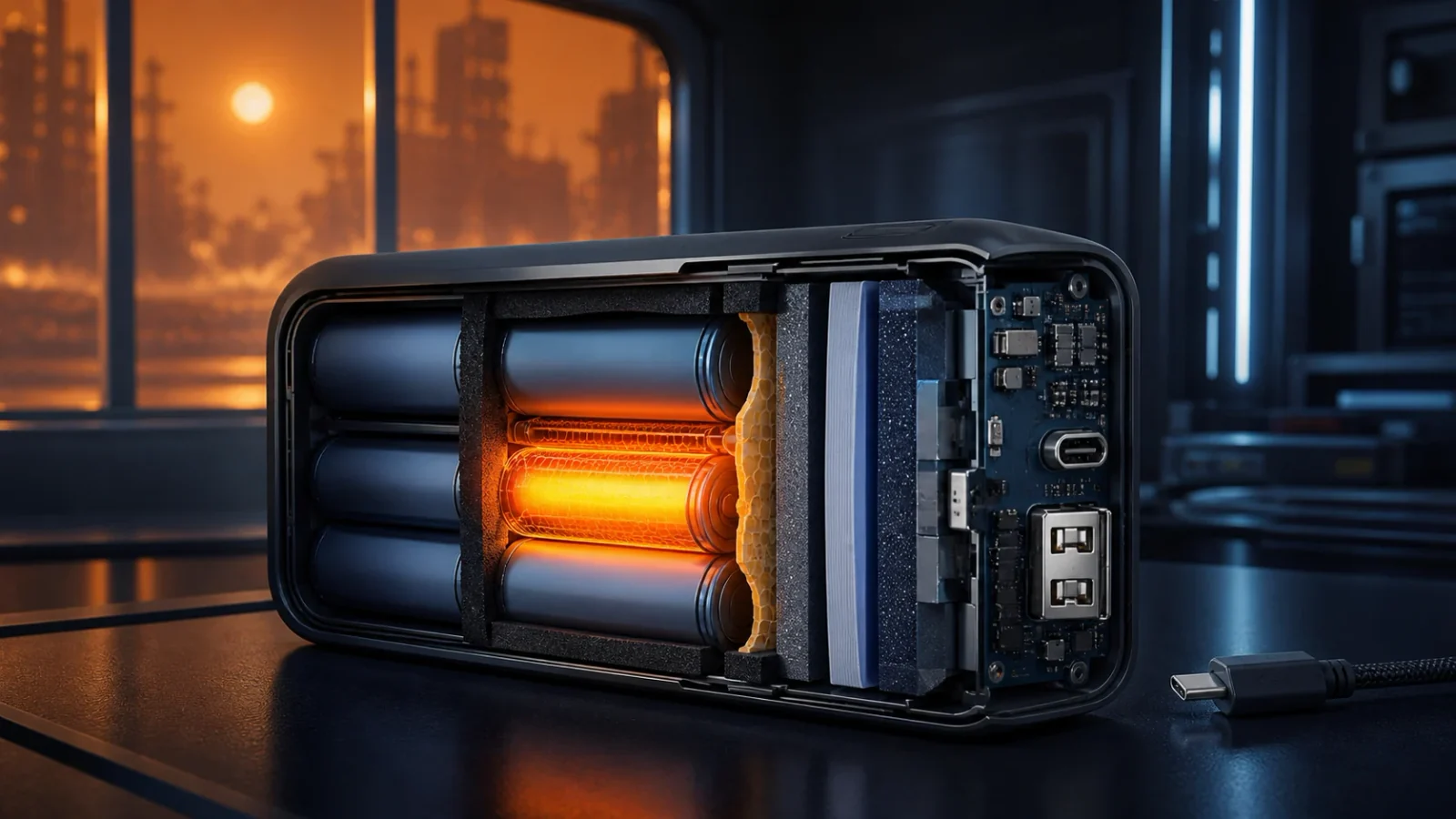
When something goes wrong internally — a short circuit, for instance — a rapid chemical reaction generates heat. Rising temperature accelerates the reaction further, and the cell enters thermal runaway. Once there, temperatures can reach 300–600°C within seconds.
The awkward part is that the cell supplies its own oxygen. Because the cathode material releases it, ordinary firefighting that works by cutting off external oxygen — smothering — is much less effective. Hence the behaviour people describe as "once it starts, it does not stop."
Gas generated inside raises the pressure, and the casing can rupture. Even a cell that has merely swollen can ignite if it takes a hard impact.
What sets it off
- Heat: direct sunlight, a car in summer, near a heater. This is the direct reason incidents cluster in summer.
- Physical damage: dropping, crushing, bending. Damaged electrodes become the starting point for a short.
- Overcharging or an unsuitable charger: charging with the protection circuit not doing its job.
- Age: batteries are consumables. Internal resistance rises over the years, and they run hotter.
- Cheap units with no protection circuit: some inexpensive third-party products have inadequate safety design and quality control.
Age is the one people overlook. A battery that was fine when new sits at a different risk level after a few years.
NITE's "Three Cs"
In its July 2026 warning, NITE organises the countermeasures as three Cs. They are easy to remember, so adopting them wholesale is the quickest route.
1. Cool Choice
- Check the seller's contact details. Do not buy from someone you cannot reach when something goes wrong.
- Check the product information. Capacity, ratings, and manufacturer clearly stated.
- Check the certification marks.
In Japan, power banks came under the Electrical Appliance and Material Safety Act (the PSE Act) in February 2019. Products meeting the safety standard carry the PSE mark. Which also means a power bank without one is not legitimately distributed in Japan.
Choosing on price alone is exactly how this step gets skipped. If a few hundred yen is the difference between having a protection circuit and not, it is an expensive saving.
2. Careful Use
- Do not use or store them anywhere hot. A car in summer passes 60°C within tens of minutes. The dashboard is the worst possible place.
- Do not subject them to impact or pressure. Being squashed under heavy items at the bottom of a bag counts as pressure. Stop using anything swollen or deformed immediately.
- Stop using it if anything is wrong. Unusual heat, swelling, a burnt smell, odd noises. Swelling in particular signals gas accumulating inside and is the clearest danger signal you get.
Beyond that, charge where you can see it. Leaving something charging while you sleep or go out raises the risk specifically because it delays noticing a fire. Avoid charging beside your pillow or on bedding.
3. Correct Disposal
The most overlooked of the three.
- Check whether the product you are discarding contains a lithium-ion battery.
- Use the manufacturer's take-back scheme, or follow your municipality's categories.
Put in with general waste, they are crushed inside the collection truck and ignite. Fires in refuse trucks and waste processing facilities mostly start this way. The incident happens even though it does not happen in your home.
Electronics retailers have collection boxes. A battery that has swollen past usability is precisely the one that needs to go through the proper route.
If One Does Catch Fire
- Secure the area first and move it away from anything flammable. People come before property.
- If you fight it, cool it with large amounts of water. Because smothering works poorly on lithium-ion fires, the approach is to cool the cell and break the thermal runaway chain.
- It can reignite even after appearing to settle. Isolate it somewhere safe and keep watching for a while.
- If it is beyond you, call the fire service without hesitating.
Rules for Air Travel
Power banks cannot go in checked baggage. Cabin baggage only, because a fire in the hold cannot be noticed.
There are also limits by capacity, measured in watt-hours (Wh):
- 100Wh or less: generally permitted (airlines may limit the number)
- Over 100Wh up to 160Wh: limited number permitted, typically two
- Over 160Wh: generally prohibited
Increasingly, airlines also require that power banks stay out of overhead lockers, and prohibit using them while charging. Check your airline's current rules before you fly; some countries and routes require additional certification marks.
Summary
- 2,140 incidents involving lithium-ion battery products in the five years from 2021 to 2025, with power banks the largest category. August is the peak.
- In the previous tally, around 85% developed into fires. Things rarely stop at smoke.
- The mechanism is thermal runaway. Because the cathode releases oxygen, smothering works poorly.
- The countermeasures are NITE's three Cs: choose well (the PSE mark, mandatory since February 2019), use carefully (heat, impact, abnormalities), dispose correctly (never with general waste).
- Swelling is the clearest danger signal. If it swells, stop using it, do not force it anywhere, and dispose of it properly.
- On aircraft, cabin baggage only. 100Wh and 160Wh are the thresholds.
That incidents cluster in summer also means changing where you keep it prevents a great many of them. Do not leave it in the car. That alone removes one of the main triggers.
References
- National Institute of Technology and Evaluation (NITE), "Beware of natsu-bate (the summer battery): prevent incidents with lithium-ion battery products using the three Cs" (15 July 2026)
- NITE Product Safety Information Magazine Vol.481, "Incidents involving products with lithium-ion batteries" (22 July 2025)
- Ministry of Economy, Trade and Industry, regulation of power banks under the Electrical Appliance and Material Safety Act (in force February 2019)

NEW NOVEL 2026/08/01
Clouded Glass
Polishing is not about force.
Volume two of The World Became Slightly Farther Away.Five stories that can also be read as a starting point.
View on Amazon
Jijoden.com
Your life is worth writing.
There is a truer self you can tell only to AI.Gather fragments of memory into a single story.
Take a LookRelated Articles
Silver Week Reshapes AI: GPT-6 Astra, Sol and Luna vs Claude Fable, Opus and Sonnet
A six-model comparison of launch strategy, intelligence, API prices, measured task costs, caching and access: GPT-6 Astra, Sol and Luna versus Claude Fable 5.1, Opus 5.5 and Sonnet 5.
What Can You Share with AI? Approval Criteria for Enterprise Code and Customer Logs
Authorize enterprise AI use with six repository acceptance criteria, log-sanitization examples, contract decisions and a reusable approval template. Primary sources checked September 19, 2026 distinguish permitted work, prohibited transfers and case-specific review.
GPT-6 Astra Arrives: What Changes When You Put It to Work in Codex?
Our first article produced with Astra examines GPT-6 in Codex, its differences from GPT-5.6, comparisons with Fable 5.1 and Opus 5, ARC-AGI-3 testing conditions, international reactions, and the AGI debate. Sources checked September 6, 2026.
Building nagara: A Voice Player for AI Replies, Articles, and Novels
I wanted long Claude Code replies to be easier to listen to. This engineering story follows nagara, an open-source macOS player built with Swift and AivisSpeech, through quiet collection, sentence navigation, and pitch-preserving playback speed.
You Don’t Have to Abandon Claude Desktop: The Practical Case for Claude Code CLI, Subagents, and Agent Teams
Subagents work in Claude Desktop's Code tab, so what still makes the CLI different? This practical guide explains CLI-only Agent Teams, Unix pipes, shell-environment continuity, which model and effort level each teammate and Subagent inherits, local-only configuration, Git exclusions, and copy-ready reviewer and log-watcher agents for ordinary Claude subscribers.