
Table of Contents
"Play Outside and the Myopia Will Go Away" Is Only Half Right
The most widely repeated advice about childhood myopia is to get children outdoors. That advice is correct — but how far it is correct does not get communicated accurately.
In June 2024, a group at Kyoto University reported a systematic review in the Cochrane Database, pooling randomised controlled trials. Its conclusion:
Increasing time spent outdoors is likely to help prevent the onset of myopia in children. Whether it slows progression in children who are already myopic remains unclear.
The effect of "making a child who is not yet myopic less likely to become so" and the effect of "stopping the prescription rising in a child who already is" are two different claims, backed by evidence of different strength. Telling the parent of a child who already wears glasses that playing outside will improve things goes beyond what the current evidence supports.
This article uses that distinction as its spine, and works through the mechanics of the eye, correction, surgery, and prevention.
⚠️ This is general information. Diagnosis and treatment decisions rest on an eye examination. If you have symptoms, see an ophthalmologist.
The Scale of Myopia, in Numbers
Myopia has moved past "common" into the territory of a public health problem.
- The world's myopic population is projected to reach about 4.76 billion people — 49.8% of the world population — by 2050. High myopia is projected at about 940 million (9.8%).
- Among children and adolescents, prevalence rose from 24% in 1990 to roughly 36% in 2023, and is expected to reach 39% by 2050.
- In Japan, the spread of smartphones from the 2010s onward is associated with onset at younger ages and a renewed rise in prevalence.
Pandemic data became a natural experiment in how environmental factors work. In the period when children's screen time rose from 2.1 to 5.6 hours a day and outdoor time fell, myopia progression accelerated noticeably.
High myopia matters less for the blurred vision itself than for future disease risk. The longer the eye's axial length, the higher the risk of retinal detachment, glaucoma, and myopic maculopathy. This is why "just wear glasses" is not the end of the story.
How the Eye Works, and What Refractive Error Is
The human eye refracts light through the cornea and the lens, forming an image on the retina. In an emmetropic eye, parallel light from a distance focuses on the retina. Refractive errors shift that focus.
- Myopia: the eye is too long axially, or refractive power is too strong, so the focus falls in front of the retina. Distance vision blurs.
- Hyperopia: the eye is too short, or refractive power too weak, so the focus falls behind the retina. Both near and distance work become tiring.
- Astigmatism: the cornea or lens is asymmetric, so focus scatters by meridian. Things can appear smeared or doubled.
- Presbyopia: with age the lens loses elasticity and accommodation declines. Near vision becomes difficult from around 40.
Most myopia arises from the eye growing longer axially. This is the crucial point: once elongated, the axis does not shrink back. That irreversibility is why myopia control treatments speak of slowing progression and never of curing it.
Genes and Environment — Both Matter
Genetic factors: predispositions such as axial length and corneal shape influence susceptibility to myopia and hyperopia. Where strong myopia runs in a family, children tend to progress faster.
Environmental factors: long hours of close work on phones and computers, less time outdoors, and inappropriate working distance or lighting all raise the risk of eye strain and myopia progression.
Among the environmental factors, outdoor time is the only one with interventional evidence for preventing onset. Restricting near work, or particular lighting conditions, do not have evidence of comparable strength.
The basics are distance, breaks, and outdoors: keep your working distance, look into the distance every 30 to 60 minutes, and secure daylight hours outside. If you have to rank them, outdoor time is the top priority for children who are not yet myopic.
What You Can Do for a Child Who Is Already Myopic
Since the effect of outdoor time on progression is unclear, slowing progression requires other means. The Japan Myopia Society has been putting guidelines for myopia control in place for fiscal 2025, and provision for myopia management spectacles is taking shape. The current guidelines list MiYOSMART and Stellest among the recommendations.
The options include:
- Myopia management spectacles: designed to alter how peripheral images focus, in order to slow axial elongation. The two products above appear in the recommendations.
- Orthokeratology (ortho-K): special lenses worn overnight temporarily reshape the cornea, so the day is spent without correction. It is also used in children for myopia control. Initial costs are relatively high and regular follow-up is a precondition.
- Low-dose atropine eye drops: used to slow progression. Indication and concentration are matters for the physician.
Which to choose depends on age, rate of progression, axial length, and lifestyle. Because measuring the rate of progression requires regular axial length measurement, the starting point is finding a clinic that measures it.
Correction — Glasses and Contact Lenses
Glasses: the safest and most adjustable option. A frame and lenses run to the order of tens of thousands of yen, varying with use, materials, and thinning treatments.
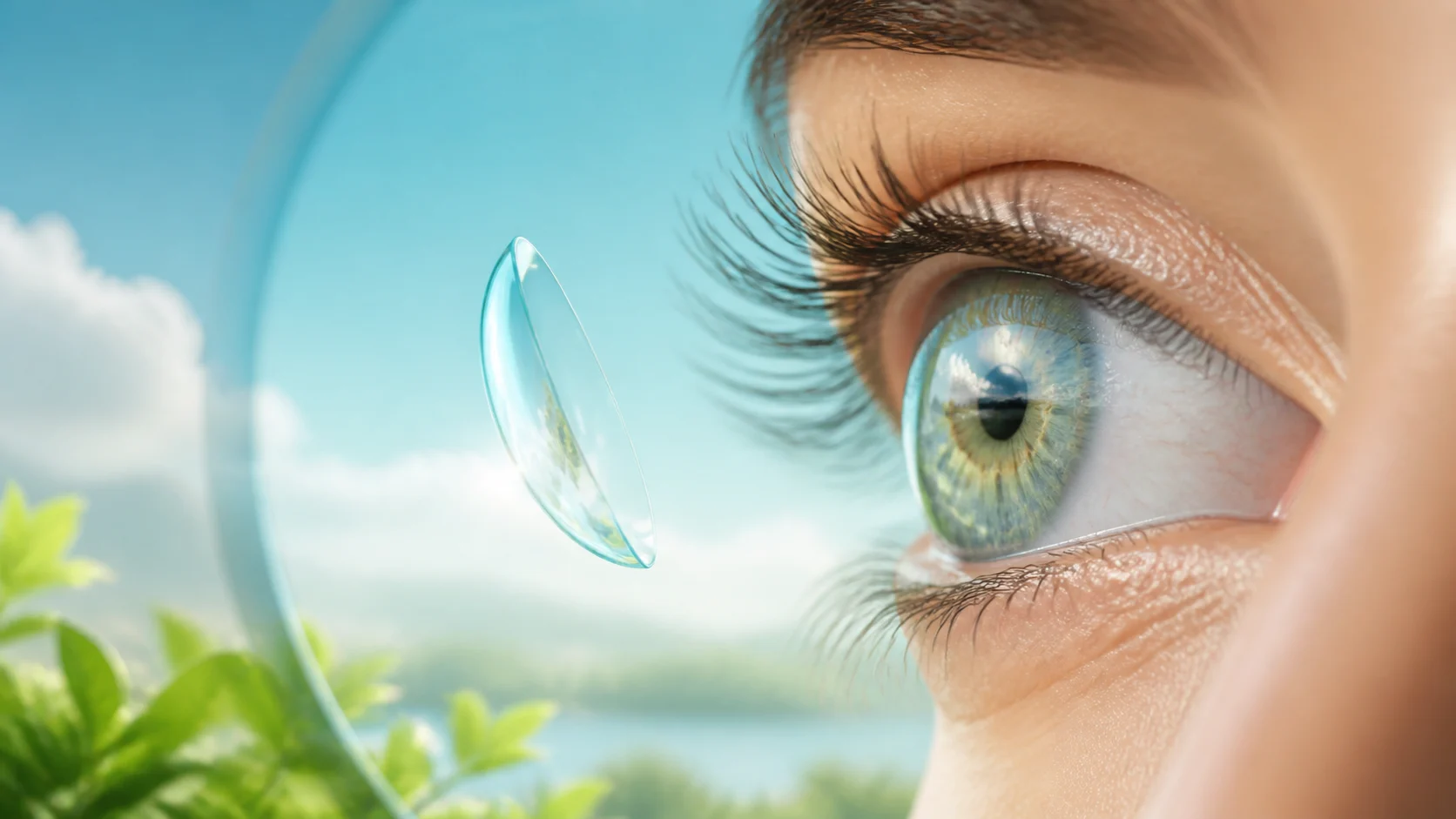
Soft contact lenses: offer a wide field of view and vision close to the uncorrected eye. Cost varies with replacement schedule — daily, two-weekly, and so on.
Under Japanese law, contact lenses are classified as highly controlled medical devices. Cosmetic coloured contact lenses that do not correct vision fall in the same class. Improper use can cause serious ocular damage, so examination and prescription by an ophthalmologist, plus regular check-ups, are a precondition. In surveys by the Japan Ophthalmologists Association, serious corneal infiltrates were reported in around 8% of cases; problems frequently affected both eyes, and more than half of cases required a break from wear of four days or more.
"I can buy them online, so I don't need an appointment" is, given that classification and the actual incident data, a high-risk conclusion.
Surgical Options (LASIK, ICL, and others)
Options that correct refraction fundamentally include LASIK, implantable collamer lenses (ICL), and intraocular lens implantation. Costs are generally in the order of several hundred thousand yen for both eyes.
Post-operative side effects can include dryness and night-time halo and glare, so assessment of suitability, choice of technique, and follow-up all matter. Whether surgery is possible depends on corneal thickness, prescription, the presence of eye disease, age, occupation, and living conditions. Getting explanations from more than one clinic and comparing them is the safer route.
Note that correcting refraction surgically does not return an elongated axial length to normal. The retinal and optic nerve risks associated with high myopia remain even after uncorrected visual acuity improves. That is why periodic fundus examination is still required after surgery.
What Habits Help
- Working distance and lighting: phones 30–40cm from the eyes, reading around 40cm, with adequate brightness.
- Frequent breaks: look at something distant for at least 20 seconds every 30 to 60 minutes (an application of the 20-20-20 rule).
- Outdoor activity: secure daylight hours outside. For children who are not yet myopic, this is currently the best-evidenced preventive measure.
- Screen settings: font, contrast, and brightness set kindly. Consider blue light's effect on falling asleep.
- Regular check-ups: review prescription and wearing patterns, check for side effects. For children, measure axial length too.
Eye Health in an Age of Long Life
The longer people live, the longer they live alongside cataract, glaucoma, and age-related macular degeneration. High myopia is one of the factors that raises the risk of these.
Slowing myopia progression in youth is better understood not as improving vision but as an investment in lowering future disease risk. Framed that way, the decisions get easier to make correctly.
Summary
- Outdoor time has evidence for preventing onset, but the evidence for slowing progression in children who are already myopic is unclear (Cochrane review, 2024). Do not merge the two claims.
- The world's myopic population is projected to reach 49.8% by 2050, with high myopia at 9.8%. Among children and adolescents: 24% in 1990, roughly 36% in 2023.
- Most myopia comes from axial elongation, and an elongated axis does not return. Surgery can improve vision without removing the disease risk.
- If a child is already myopic, options include myopia management spectacles (MiYOSMART and Stellest in the Japan Myopia Society guidelines), ortho-K, and low-dose atropine. Start by measuring axial length.
- Contact lenses, cosmetic ones included, are highly controlled medical devices. Examination, prescription, and regular check-ups are a precondition.
If in doubt, start with an eye examination. For children especially, there is nothing to be done until you know the rate of progression.
References
- Holden BA et al., "Global Prevalence of Myopia and High Myopia and Temporal Trends from 2000 through 2050," Ophthalmology, 2016
- Kyoto University, "Increasing time spent outdoors prevents the onset of myopia in children — results of a systematic review pooling randomised controlled trials" (21 June 2024)
- Japan Myopia Society, "Myopia control treatment"
- Japan Ophthalmologists Association, "Report on the survey of contact lens related ocular disorders"
- Consumer Affairs Agency, "On ocular damage from contact lenses — see an ophthalmologist even for coloured lenses, and stop use immediately if anything is wrong"
NEW NOVEL 2026/08/01
Clouded Glass
Polishing is not about force.
Volume two of The World Became Slightly Farther Away.Five stories that can also be read as a starting point.
View on Amazon
Jijoden.com
Your life is worth writing.
There is a truer self you can tell only to AI.Gather fragments of memory into a single story.
Take a LookRelated Articles
So, What Is Tobacco Really About? A Smoker’s Evidence-Based Guide to Its History, Health Risks, Taxes, and Politics
Why did tobacco spread worldwide, and why has smoking moved to society’s margins over the past two decades? A smoking author examines history, global prevalence, relative and absolute health risks, vaping, taxation, and competing interests without cheerleading or condemnation.
The Secret Behind the Sauna Boom and Future Predictions: Why Saunas Are Gaining Attention Now
We analyze the background behind the growing popularity of saunas and provide detailed insights into the future prospects of the sauna market in Japan and worldwide, exploring sauna's appeal from multiple perspectives including health consciousness, experiential value, and community building.
Is "Alcohol is the Best Medicine" Really True? A Comprehensive Review of Latest Evidence
A comprehensive analysis of alcohol and health relationships covering history, latest research, statistics, policies, and culture. Detailed explanation of modern scientific views where WHO states "no safe level of alcohol consumption."
Why Do Some People Gain Weight Easily While Others Don't? – Detailed Explanation from Body Type to Environment
A detailed explanation of differences in weight gain tendencies. We introduce various factors affecting weight in an easy-to-understand way for beginners, including basal metabolism, genetics and body type, gut bacteria, muscle mass, hormones, and lifestyle habits.
Moving Out of a Rental in Japan: A Practical Guide to a Fair Settlement
Separate renovation estimates from tenant liability. Check lease clauses, wallpaper depreciation, inspection signatures, AI-assisted review, certified mail, direct debits and Japan's updated small-claims procedure.