

Table of Contents
The Map to Read First
Business abbreviations become much easier when you separate them into four layers: English parts, division, ratios, and the business situation where the number is used.
Decode abbreviations through parts, denominator, and business scene
For terms such as CPA, ARPU, and KPI, decomposition beats rote memory. First expand the English, then treat Per as division and Rate as percentage, and finally ask what sits in the denominator.
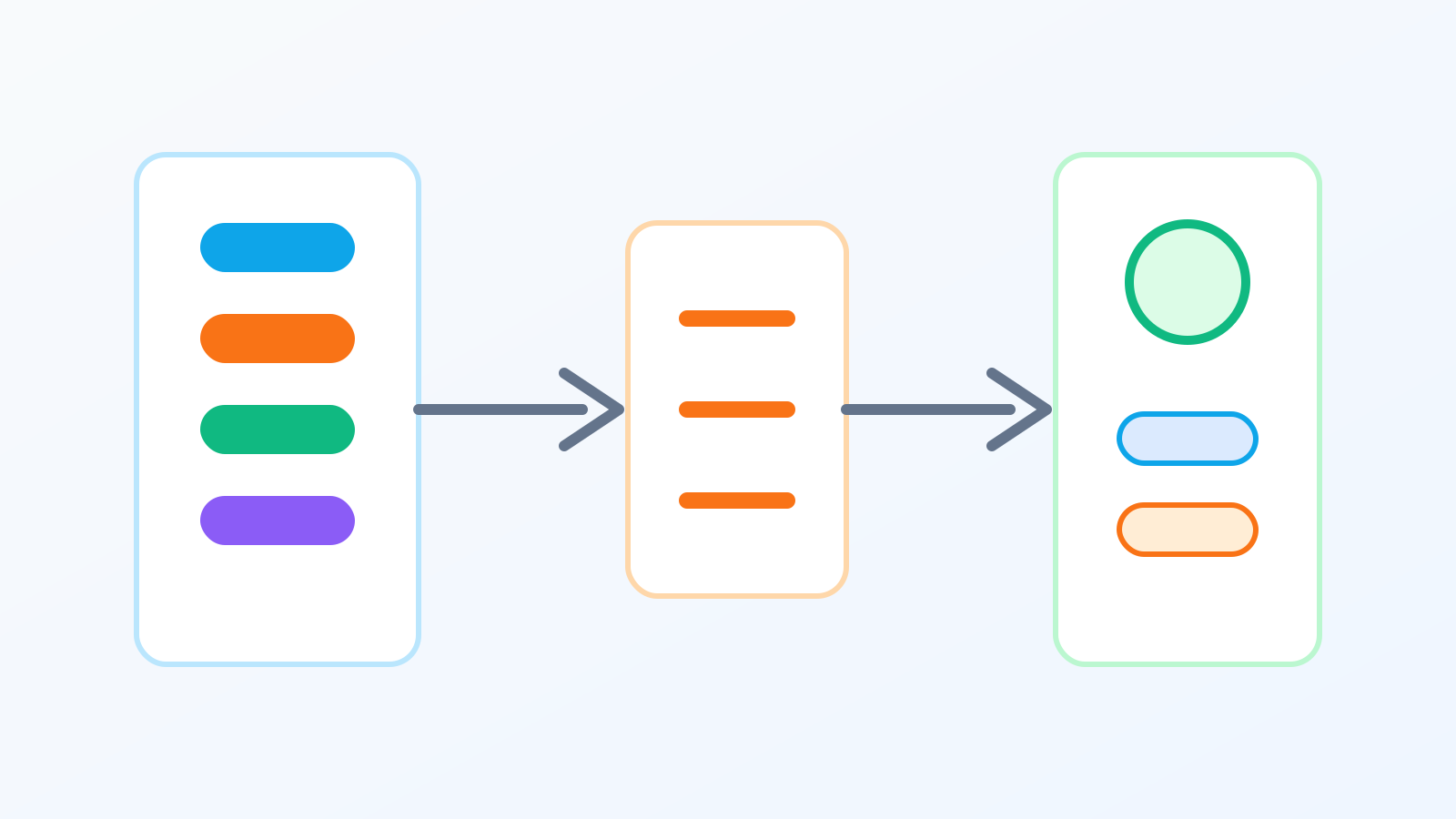
Abbreviations become easier to infer when you split them into English parts, calculation, and the business scene.
| What you see | What to think first | Examples |
|---|---|---|
| Per | Per means one unit, so expect division | CPC, CPA, CPV, ARPU |
| Rate | Rate means a percentage, so check the denominator | CTR, CVR, Retention, Churn |
| Average | Average means total divided by count | AOV, AVD, ARPU |
| Revenue | This is about sales | ROAS, MRR, ARR, ARPU |
| Cost | This is about expense | CPC, CPA, CAC, CAPEX, OPEX |
The best order is not alphabetical. Learn them by work situation: a page is viewed, an ad is shown, a video is watched, a customer is acquired, subscription revenue continues, a meeting produces a decision. In that order, the abbreviations stop looking like a code.
| Situation | First abbreviations to learn | What they help you judge |
|---|---|---|
| Websites and articles | PV, UU, Session, CTR, CVR | How often content was seen, who came, and where people converted |
| Video | Views, Watch Time, AVD, APV, VTR, CPV | Not only how often it was played, but how long viewers stayed |
| Advertising cost | CPC, CPA, CAC, ROAS, ROI | Click cost, conversion cost, customer acquisition, sales return, and profit return |
| E-commerce and SaaS | AOV, ARPU, MRR, ARR, Churn, NRR, LTV | Revenue per person, recurring revenue, churn, and future value |
| Management and sales | KGI, KPI, OKR, MQL, SQL, Pipeline | Goals, leading numbers, and deal progress |
| Accounting and finance | P/L, B/S, C/F, Margin, EBITDA, CAPEX, OPEX | Profit, cash, fixed cost, investment, and runway |
Learn Business Abbreviations in One Guide
Business terms are not secret codes for showing off intelligence. They are shared compression tools. When someone says PV, the team can immediately assume they are talking about the number of page views. When someone says CPA, the team can immediately assume they are talking about the cost to obtain one defined result. Many abbreviations look difficult, but most are just two or three English words joined together.
First, two corrections matter. CPA is not a video-only metric. It means the cost of one action or acquisition, such as a purchase, signup, inquiry, or application. Video-oriented metrics include CPV, VTR, watch time, average view duration, and audience retention. Also, the common abbreviation is usually ARPU, not ARUP. ARPU means Average Revenue Per User, or average revenue per user.
The Pochang Lab method is simple: do not memorize abbreviations as isolated strings. Break the English apart, connect it to a formula, and connect the formula to a business scene.
Learn the English Parts First
Start with about fifteen parts. View means seeing or playing. Impression means display. Click means click. Conversion means a valuable result. Cost means expense. Revenue means sales. Acquisition means acquiring. Retention means continuing. Churn means leaving or canceling. Average means mean value. Rate means percentage. Per means per one unit. User means user. Monthly means monthly. Annual means yearly.
The related terms in this table do not always contain the initial letter of the English part. Impression matters as the denominator of CPM, CTR, and VTR, even though the letter I does not appear in those abbreviations. Separate parts that appear as letters from parts that matter in the formula.
| English part | Plain meaning | Related terms and formulas |
|---|---|---|
| View | view, play, page view | PV, CPV, AVD |
| Impression | display | CPM; denominator of CTR and VTR |
| Click | click | CPC, CTR |
| Conversion | valuable result | CV, CVR, denominator of CPA |
| Cost | expense | CPC, CPA, CAC |
| Revenue | sales | ARPU, MRR, ARR, ROAS |
| Acquisition | acquiring | CAC, CPA |
| Retention | continuing | Retention, NRR |
| Churn | leaving or canceling | Churn Rate |
| Average | average | AOV, AVD, ARPU |
| Rate | percentage | CTR, CVR, VTR |
| Per | per one unit | CPC, CPA, CPV, ARPU |
| User | user | UU, DAU, MAU, ARPU |
| Monthly | monthly | MRR, MAU, MoM comparisons |
| Annual | yearly | ARR, YoY comparisons |
Use this order when a term appears in conversation
CPA becomes Cost / Per / Acquisition.
Per means division, Rate means percentage, Average means mean value.
Clicks, sessions, users, revenue, or something else?
When you see Per, think division. Cost Per Click means cost divided by clicks. Revenue Per User means revenue divided by users. When you see Rate, think percentage. When you see Average, think total divided by count. That one rule untangles CPC, CPA, CPV, ARPU, CTR, and CVR.
In 1973, William Chase and Herbert Simon of Carnegie Mellon University showed that skilled chess players remember meaningful board positions as larger chunks. Business terms also become easier when you learn them in chunks: cost metrics, rate metrics, revenue metrics, and retention metrics. [1]
Website and Article Terms
PV means Page View. It is the number of times a page was displayed. If the same person opens the same page three times, that normally counts as three page views. It is more accurate to say “10,000 views” than “10,000 people.”
UU means Unique User. It is a way to describe users after removing duplicates. Today, tools may use Users or Active Users instead. Because the value is inferred from devices, cookies, login information, and other signals, it is not a perfect count of real human beings.
A session is one visit bundle. If one person visits in the morning and again at night, that may be one user but two sessions. PV is like the number of shelves someone looked at in a store. Session is the number of visits. User is the number of people who came.
Impression means display count. Reach means the number of people reached. If one person sees the same ad five times, impressions are five and reach is one.
CTR means Click Through Rate. It is the percentage of impressions that became clicks. CTR = clicks divided by impressions times 100. If something is shown 10,000 times and clicked 500 times, the CTR is 5 percent.
CV means Conversion. It is the action the business defines as valuable, such as a purchase, request for materials, membership registration, or inquiry. CVR means Conversion Rate. If 500 clicks produce 25 purchases, the click-based CVR is 5 percent. But the denominator may also be sessions or users, so always confirm what the number is divided by.
Bounce Rate means the percentage of non-engaged visits, but the definition changes across analytics tool generations. In current Google Analytics, bounce rate is treated as the opposite of engagement rate, so comparing it directly with old reports can mislead. [2]
SEO means Search Engine Optimization, improving a site so people can find it through search. SEM means Search Engine Marketing, or marketing through search. In practice, some teams use SEM to mean search ads. LP means Landing Page, the first page a person lands on from an ad or search result.
| Term | Full name | Unit | Plain meaning |
|---|---|---|---|
| PV | Page View | count | Number of page displays |
| UU | Unique User | user-like estimate | Users after removing duplicates |
| Session | Session | visit | One visit bundle |
| Impression | Impression | count | Number of displays |
| Reach | Reach | user-like estimate | Number of people reached |
| CTR | Click Through Rate | percentage | Share of displays that became clicks |
| CVR | Conversion Rate | percentage | Share that became conversions |
Remember PV, Session, and User as shelf, visit, and person
If the same person opens a page three times, it normally counts three times.
Morning and night visits can be two sessions from one person.
It is inferred from devices and cookies, so it is not a perfect human count.
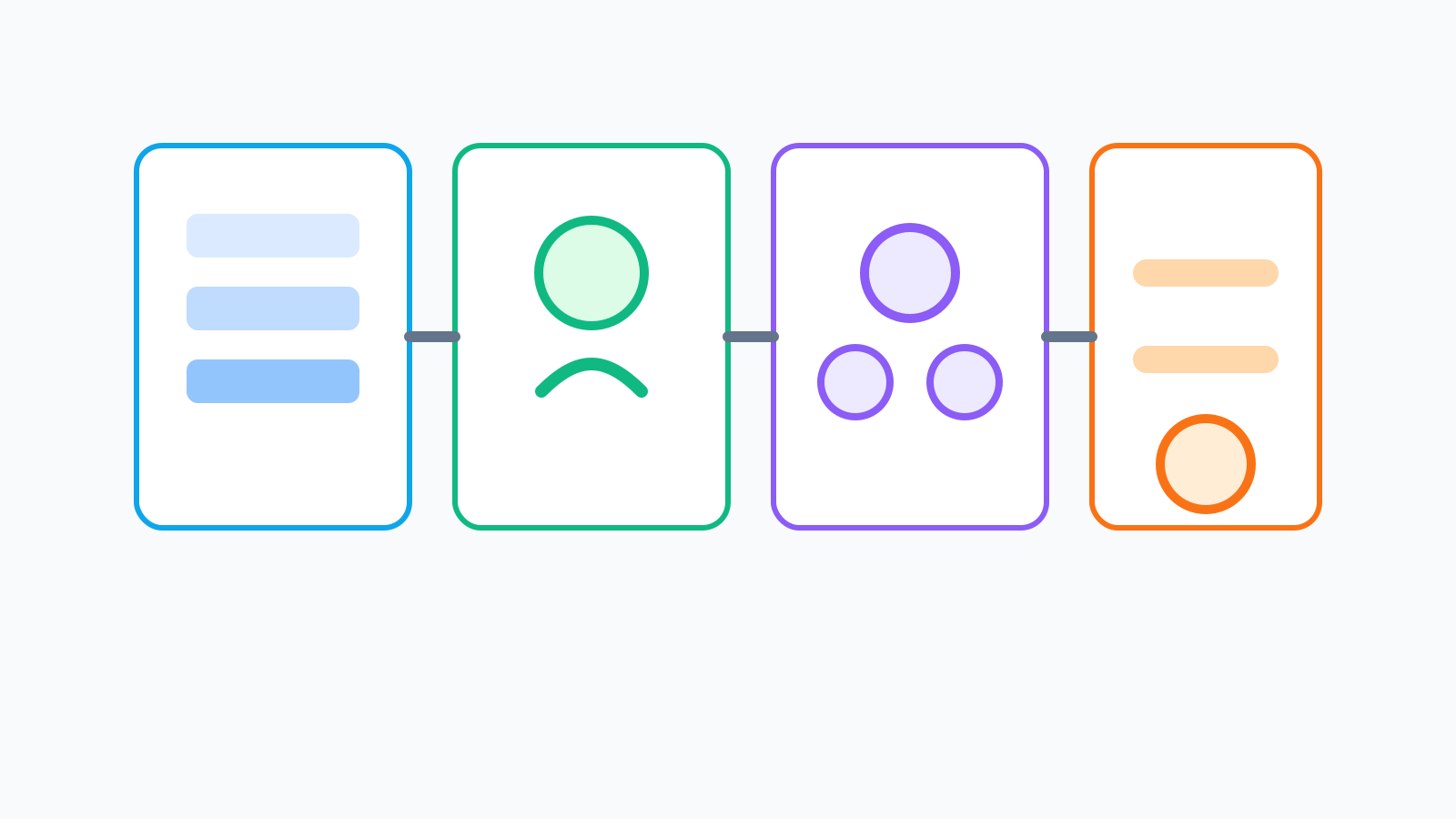
Read web metrics by separating views, visit bundles, de-duplicated users, clicks, and conversions.
Video and Video Advertising Terms
Views are play counts. However, the condition for one view differs by platform and format. When comparing views, align the platform, definition, and period.
Unique Viewers are estimated viewers after removing duplicates. If views are 100,000 and unique viewers are 20,000, the average viewer watched about five times.
Watch Time is total viewing time. AVD means Average View Duration. APV means Average Percentage Viewed. If a ten-minute video is watched for an average of three minutes, AVD is three minutes and APV is 30 percent. YouTube Analytics also uses watch time, average view duration, and audience retention to help creators understand engagement. [3]
Audience Retention shows how many viewers remain at each point in the video. A steep drop near the start or a rise at a specific point can become a useful improvement hypothesis.
In video advertising, CPV means Cost Per View, the cost per view. VTR means View Through Rate, the rate at which impressions become views. CPM means Cost Per Mille, the cost per thousand impressions. Mille means thousand, so M suddenly handles “thousand” here.
CPA means Cost Per Acquisition or Cost Per Action. It is the cost to obtain one acquisition or defined result: ad spend divided by acquisitions or actions. For video, read the funnel in order: display, click, view, result. CPA alone does not tell you where the funnel got stuck.
| Video flow | Metrics | What you learn |
|---|---|---|
| Shown | Impression, CPM | How much it appeared and cost per thousand displays |
| Started | Views, VTR, CPV | Whether display became viewing and the cost per view |
| Continued | Watch Time, AVD, APV, Audience Retention | How long viewers stayed |
| Acted | CV, CVR, CPA | Whether viewing or clicking produced results |
Read video in the order of display, view, retention, and result
Impression / CPM
Views / VTR / CPV
Watch Time / AVD / APV
CV / CVR / CPA

Video metrics become useful when you read the flow from display to view, retention, and result.
Advertising Cost and Customer Acquisition Terms
CPC means Cost Per Click. It is the cost per click. If ad spend is 100,000 yen and the ad receives 500 clicks, CPC is 200 yen. CPL means Cost Per Lead, the cost for one lead. CPO means Cost Per Order, the cost to obtain one order.
CAC means Customer Acquisition Cost. It is the total cost to acquire one new customer. CAC resembles CPA, but CAC may include not only ad spend but also sales labor, creative production, tooling, and other costs. It is possible for the ad dashboard CPA to be 3,000 yen while the company-wide CAC is 8,000 yen.
ROAS means Return On Ad Spend. It shows how much sales returned for ad spend. If 100,000 yen of ad spend produces 400,000 yen of sales, ROAS is 400 percent. But ROAS is a sales metric. After cost of goods, shipping, returns, and operations, the campaign can still lose money.
ROI means Return On Investment. It looks at profit or benefit relative to total investment. In a common formula, ROI is profit from the investment divided by the investment amount. ROAS is narrow, focused on advertising. ROI is broader, focused on investment overall. In 1914, Donaldson Brown at DuPont developed ROI into a management control tool by decomposing numbers to find improvement points. [4]
Attribution is the idea of assigning credit for a conversion across touchpoints. If a person sees a video and later clicks a search ad before purchasing, evaluation changes depending on whether all credit goes to search or some is assigned to video.
| Advertising metric | Denominator | Caution |
|---|---|---|
| CPC | clicks | Clicks do not guarantee conversions |
| CPV | views | The definition of a view differs by platform |
| CPA | acquisitions or actions | Confirm what counts as the acquisition or action |
| CAC | new customers | May include labor, production, and tools beyond ad spend |
| ROAS | ad spend | Sales return is not the same as profit |
| ROI | investment | Applies beyond advertising |
Do not stop at CPA; connect CPC, CAC, ROAS, and ROI
An entrance price. Cheap clicks are weak if they do not buy.
Divide by defined acquisitions or actions, such as purchases, signups, or inquiries.
May include sales labor, production, and tools beyond ad spend.
Looks at the investment return, not only sales.
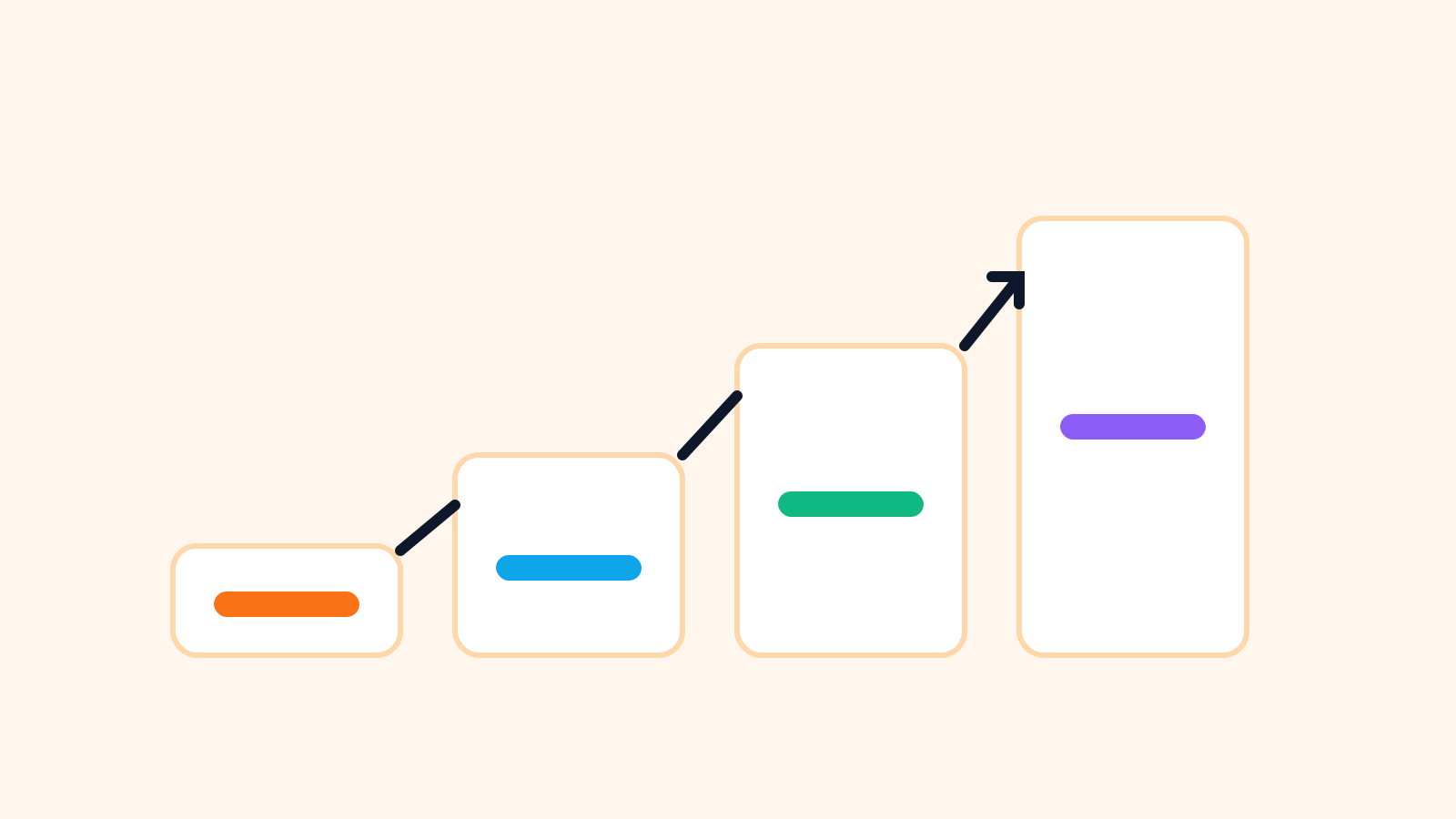
Read advertising cost from click cost to result cost, customer acquisition cost, and investment recovery.
E-commerce, Apps, and Subscription Terms
AOV means Average Order Value. It is average purchase amount per order. If revenue is 1,000,000 yen and there are 200 orders, AOV is 5,000 yen.
ARPU means Average Revenue Per User. It is average revenue per user. If monthly revenue is 600,000 yen and there are 200 users, ARPU is 3,000 yen. ARPPU means Average Revenue Per Paying User. Its denominator is paying users only. Do not mix ARPU, which includes free users, with ARPPU.
MRR means Monthly Recurring Revenue. It is recurring revenue normalized to a monthly amount. If there are 100 contracts at 3,000 yen per month, MRR is 300,000 yen. ARR means Annual Recurring Revenue, recurring revenue on an annual basis. In a simple business, ARR can be estimated as MRR times twelve, but one-time fees and usage-based billing require care.
DAU, WAU, and MAU mean Daily, Weekly, and Monthly Active Users. They are active users by day, week, and month. Each company defines what Active means. Login, posting, and purchasing have different meanings. DAU divided by MAU is often used as a rough measure of stickiness.
Activation means the state where a user has experienced the first value of the product. Retention means the continuation rate. Churn means the leaving or cancellation rate. If a month starts with 100 customers and 5 cancel, simple customer churn is 5 percent. Logo Churn, based on customer count, and Revenue Churn, based on lost revenue, are different.
Cohort means a group sharing a condition. If you separate April signups and May signups, you can see changes hidden by the overall average.
NRR means Net Revenue Retention. It shows how much recurring revenue from existing customers remains after cancellation, contraction, and expansion. If beginning revenue is 1,000,000 yen, expansion is 200,000 yen, contraction is 50,000 yen, and churn is 50,000 yen, ending revenue is 1,100,000 yen and NRR is 110 percent.
LTV or CLV means Lifetime Value. It is the value one customer brings over the entire relationship period. The value changes depending on whether you use revenue or gross profit and what period you assume. Comparing LTV with CAC shows whether acquisition cost can be recovered by future value.
Unit Economics means profitability at the smallest business unit, such as one customer or one order. Even if the company is growing overall, a structure that loses money on every unit sold is dangerous.
| Term | Denominator | Common mistake |
|---|---|---|
| AOV | orders | Not revenue per user |
| ARPU | all users | Includes free users |
| ARPPU | paying users | Usually looks higher than ARPU |
| MRR | monthly equivalent | One-time and usage-based revenue can distort it |
| ARR | annual equivalent | Confirm whether MRR times twelve is valid |
| Churn | customers or revenue | Do not mix Logo Churn and Revenue Churn |
| NRR | beginning revenue from existing customers | New customer revenue is separate |
For subscriptions, read whether customers are acquired, retained, and expanded
Cost to acquire one customer
First value experience
Whether users stay or leave
Whether existing-customer value grows

Subscription metrics connect acquisition, first value, retention, and expansion into one loop.
Goal Management and Management Numbers
KGI means Key Goal Indicator. It is the final result you want to achieve as a number. KPI means Key Performance Indicator. It is an important indicator on the way to that result. If annual revenue is the KGI, the number of sales meetings, win rate, and average deal size can be KPIs.
If KGI is the summit, KPIs are trail markers. When you decompose revenue into visitors times purchase rate times average order value, you can see where to intervene. That is the basic idea of a KPI tree.
OKR means Objectives and Key Results. The Objective is the desired state. Key Results are numerical outcomes used to judge whether it was achieved. OKRs are not task lists; they are result definitions. Management by objectives goes back to Peter Drucker’s MBO in 1954. In the 1970s, Andy Grove developed OKRs at Intel, John Doerr learned the system there, and later brought it to early Google. [5]
Leading Indicators move before future results, such as the number of sales meetings or product trials. Lagging Indicators are confirmed after the fact, such as revenue, profit, and churn. Good management combines both.
Target is the goal. Budget is the budget. Forecast is the current prediction. Actual is the result. If the target is 100 million yen but the forecast is 80 million yen, the gap needs action. Do not put wishful thinking into the forecast.
YoY means year over year. MoM means month over month. QoQ means quarter over quarter. In businesses with strong seasonality, do not judge only by MoM. Run Rate annualizes the current speed. Monthly sales of 10 million yen imply a simple annual run rate of 120 million yen, but multiplying a peak month by twelve creates an overly energetic future.
| Goal term | Role | Practical caution |
|---|---|---|
| KGI | Final result | Put it at the business goal level |
| KPI | Intermediate indicator | Choose numbers close to controllable action |
| OKR | Desired state and results | Do not reduce it to a task list |
| Forecast | Current prediction | Keep wishes out of it |
| Actual | Result | Compare it with the forecast |
| Leading Indicator | Moves early | Helps read future sales or churn |
| Lagging Indicator | Confirmed later | Good for results, but can be too late for action |
KGI is the summit; KPIs are trail markers
Annual revenue
Sales and Selling Terms
Lead means a contact with a potential customer. Prospect means someone who fits the conditions and is more concretely expected to become a customer. MQL means Marketing Qualified Lead, a lead judged promising by marketing. SQL means Sales Qualified Lead, a lead judged ready for sales follow-up. The criteria differ by company.
Opportunity means a concrete sales deal. Pipeline means the full set of ongoing deals. Funnel means the flow in which the number of people decreases from awareness to contract.
Win Rate means the deal closing rate. If 20 opportunities produce 5 wins, the win rate is 25 percent. Average Deal Size means average contract amount. Sales Cycle is the period from first contact to closing. Sales can be decomposed into number of opportunities times win rate times average deal size.
Upsell means moving a customer to a higher-tier product. Cross-sell means selling an additional related product. Forecast predicts future revenue from deal amount and probability. Do not call a salesperson’s enthusiasm probability; use historical results by sales stage.
| Sales term | Meaning | What to check |
|---|---|---|
| Lead | Contact with a potential customer | Conditions are still broad |
| MQL | Marketing-qualified lead | Criteria must be defined |
| SQL | Sales-qualified lead | Worth sales follow-up |
| Opportunity | Deal | Amount, probability, and timing |
| Pipeline | All ongoing deals | Where the flow is stuck |
| Win Rate | Closing rate | Deal count alone is not revenue |
From lead to win, count shrinks and probability rises
Strategy and Product Development Terms
B2B means business-to-business. B2C means business-to-consumer. D2C means the producer sells directly to consumers. C2C means consumer-to-consumer transactions.
TAM means Total Addressable Market, the theoretical total market. SAM means Serviceable Available Market, the market you can serve. SOM means Serviceable Obtainable Market, the realistic portion you can aim to obtain. Remember them as the giant circle, the reachable circle, and the circle you can realistically win.
USP means Unique Selling Proposition, the unique reason a customer chooses you. Value Proposition is the full proposal of whose problem you solve and with what value. Pain Point means the inconvenience or loss a customer feels.
3C looks at the market through Customer, Competitor, and Company. SWOT separates Strengths, Weaknesses, Opportunities, and Threats. The point is not filling a table; it is deciding what not to do.
As-Is means the current state. To-Be means the desired state. The difference is the Gap. Benchmark means comparison standard. Best Practice means a practice considered effective. When copying another company’s success, check the difference in conditions.
Hypothesis means a testable assumption. PoC means Proof of Concept, a small test of whether a mechanism works. MVP means Minimum Viable Product, the smallest product that can test customer value and business assumptions. It is not a sloppy version; it removes what is unnecessary for learning.
PMF means Product Market Fit, the state where a product fits strong market demand. Do not judge it only by sales. Look at retention, referrals, churn, and other signals. A/B Test compares two versions under aligned conditions. If you change many things at once, you cannot tell what worked.
| Strategy term | Use case | How to remember it |
|---|---|---|
| TAM | Total market | The theoretical largest circle |
| SAM | Serviceable market | The circle you can reach |
| SOM | Obtainable market | The circle you can realistically win |
| USP | Reason to choose you | Unique selling reason |
| MVP | Learn with a minimum product | Remove unnecessary learning cost, not quality |
| PMF | Product-market fit | Look at retention, referrals, and churn too |
TAM, SAM, and SOM narrow the market from huge to realistic
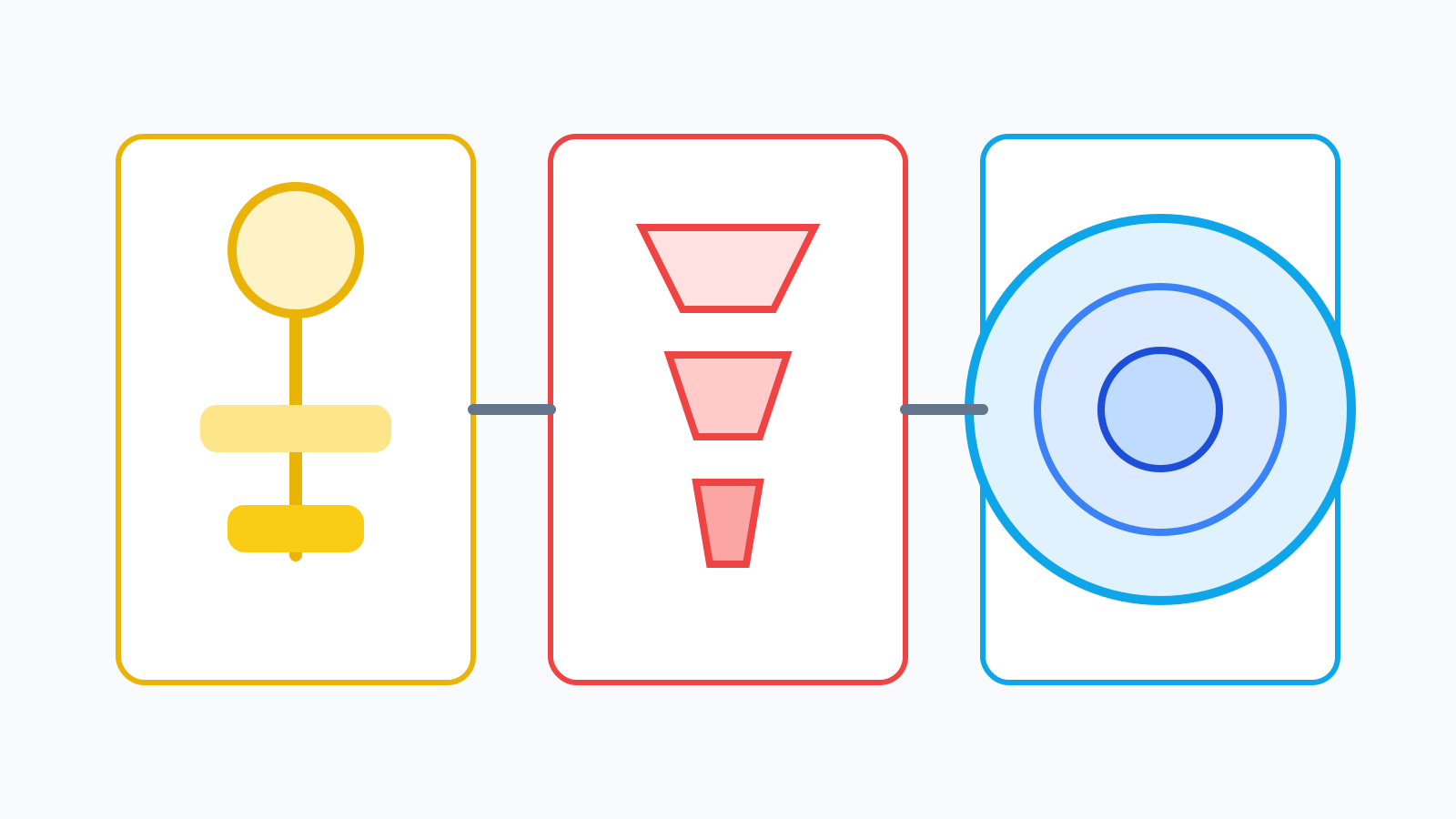
Goal, sales, and strategy terms become one map from the target to the funnel and the market you can win.
Project and Meeting Terms
Agenda means meeting items and order. Minutes means meeting notes. Decision means decision. Action Item means next action. Owner means responsible person. Due means deadline. After a meeting, leave who will do what by when.
Stakeholder means a person or group with an interest in the outcome. Consensus means agreement. Alignment means making direction and understanding consistent. Everyone does not need to have the same preference, but after a decision, people need to move in the same direction.
Scope is the range of work. Resource means people, time, budget, and other resources. Milestone is an important point on the way. Deliverable is the output. Dependency is a dependency. Bottleneck is the part stopping the whole flow.
Task is work to do. Issue is a problem that exists now. Risk is uncertainty that may happen in the future. When a risk becomes real, it becomes an issue. Escalation means raising a problem early to a manager or specialist team when it cannot be solved within your authority.
Assign means to allocate responsibility. Commit means to promise with responsibility. Pending means on hold. Buffer means margin. Reschedule means changing the date. Fix can mean either finalize or repair, so say which meaning you intend.
Feasibility means whether it can be done. Scalability means the ability to grow in scale. Leverage means using resources so a small force produces a large effect. ETA means estimated time of arrival or completion. EOD means end of business day. TBD means to be decided. TBA means to be announced. FYI means for your information.
| What to leave after a meeting | Meaning | Write it without ambiguity |
|---|---|---|
| Decision | Decision made | What was decided |
| Action Item | Next action | What will be done |
| Owner | Responsible person | Who owns it |
| Due | Deadline | By when |
| Risk | Future uncertainty | What will be bad if it happens |
| Issue | Current problem | What must be solved now |
After a meeting, at least leave decision, action, owner, and due date
Do not end with discussion only.
Bring it down to a work unit.
The whole team is not an owner.
Actions without deadlines drift.
Accounting, Cash, and Risk Terms
P/L means Profit and Loss Statement. B/S means Balance Sheet. C/F means Cash Flow Statement. P/L shows earnings over a period. B/S shows assets and liabilities at a point in time. C/F shows cash coming in and going out.
Revenue or Sales means sales and is also called the Top Line. Gross Profit is sales minus cost of goods sold. Gross Margin is gross profit divided by sales. Operating Profit is profit from operations. Net Income is final profit and is also called the Bottom Line.
Fixed Cost stays relatively fixed. Variable Cost changes with volume. Break-even Point is where profit becomes zero. In a simple single-product case, subtract variable cost from selling price and divide fixed cost by that contribution to estimate required sales volume.
A company can make profit and still run short of cash. If accounts receivable is collected after inventory purchases or payroll must be paid, P/L may be black while cash decreases. That is why cash flow must be read separately.
EBITDA means Earnings Before Interest, Taxes, Depreciation and Amortization. It looks at earnings before interest, taxes, depreciation, and amortization. It is useful for comparison, but it does not make capital expenditure or debt repayment disappear, and it is not cash itself.
CAPEX means Capital Expenditure, investment in equipment and similar assets. OPEX means Operating Expenditure, the cost of daily operations. Burn Rate is the speed at which cash decreases. Runway is how many months the company can continue with current cash. If cash is 60 million yen and net cash decreases by 10 million yen per month, runway is about six months.
Liquidity is the ability to convert assets to cash and meet payments when needed. Volatility is the size of price or number movements; it is not the same as loss.
Hedge means reducing loss on one side with another transaction or contract. Risk hedge is like carrying an umbrella; it does not stop the weather. Diversification means spreading investments or revenue sources.
Leverage can also mean using debt to move more than your own capital. It amplifies both profit and loss. Upside is the possibility of a better outcome. Downside is the danger of a worse outcome. Opportunity Cost is the value of the best option you did not choose. Sunk Cost is cost already paid and unrecoverable. Judge by the value of investing more from today, not by the amount already spent.
| Accounting and finance term | What it shows | Caution |
|---|---|---|
| P/L | Profit over a period | Profit does not always mean enough cash |
| B/S | Assets and liabilities at a point | It is a point-in-time view |
| C/F | Cash movement | Shows funding pressure |
| Gross Margin | Gross profit ratio | Sales scale alone does not show profitability |
| EBITDA | Earnings before several deductions | Not cash itself |
| CAPEX | Capital investment | Investment for the future |
| OPEX | Operating expense | Daily operating cost |
| Runway | Months the company can survive | Read it with burn rate and cash balance |
Profit and cash are different. Read P/L, B/S, and C/F separately
Revenue, gross profit, operating profit, and net income.
Assets, liabilities, and equity at a point in time.
Whether cash is enough even when profit exists.

Finance terms are easier when you separate profit, financial position, and cash movement.
The Fastest Way to Learn
First, do not look at an abbreviation and try to recall the Japanese meaning. Expand the English. CPA is Cost, Per, Acquisition. Cost, per one, acquisition. So it is the cost per acquisition. In some contexts, the A is Action, meaning the defined action such as a purchase or signup.
Next, place concrete numbers such as one hundred or one thousand. If impressions are 10,000, clicks are 500, purchases are 25, and ad spend is 100,000 yen, then CTR is 5 percent, CVR is 5 percent, CPC is 200 yen, and CPA is 4,000 yen. One story carries four terms.
| Number story | Calculation | Answer |
|---|---|---|
| 10,000 impressions and 500 clicks | 500 divided by 10,000 times 100 | CTR 5 percent |
| 500 clicks and 25 purchases | 25 divided by 500 times 100 | CVR 5 percent |
| 100,000 yen ad spend and 500 clicks | 100,000 divided by 500 | CPC 200 yen |
| 100,000 yen ad spend and 25 purchases | 100,000 divided by 25 | CPA 4,000 yen |
If you have five minutes a day, repeat these four moves
CPA = Cost Per Acquisition
Ad spend divided by acquisitions or actions
100,000 yen divided by 25 = 4,000 yen
Cost to obtain one acquisition or result

For memorization, expand the English, write the denominator, calculate once, and return the term to plain language.
On a term card, write the full English name, what it measures, the denominator of the formula, and what decision it supports. CVR, Churn, LTV, and ROI often differ by definition. If you know the abbreviation but not the denominator, you understand only half of it.
In 2006, Henry Roediger and Jeffrey Karpicke at Washington University in St. Louis compared rereading with repeated recall tests. After one week, retention was 61 percent in the testing group and 40 percent in the rereading group. Instead of staring at a glossary, writing the English and formula from memory is more likely to last. [6]
In 2008, Nicholas Cepeda and colleagues studied more than 1,350 participants, with gaps before review of up to three and a half months and final tests up to one year later. The longer you want to remember something, the longer the appropriate review interval becomes. In work practice, a short review the next day, three days later, one week later, and one month later is easy to use. [7]
Cost metrics include CPC, CPV, CPA, and CAC. Rate metrics include CTR, CVR, Retention, and Churn. Revenue metrics include AOV, ARPU, MRR, and ARR. Goal metrics include KGI, KPI, and OKR. Meaningful bundles make retrieval faster.
A 2019 study at Technische Universität Berlin found that 65 participants learned an eight-step procedure, and the acronym group learned it about five minutes faster on average. But not every aspect of execution improved after learning. Abbreviations can speed the entrance, but they do not replace understanding and practice. Learn the initials, expand the English, and use the term once in your own work. [8]
Finally, translate the term back into ordinary language in one sentence. NRR means how much existing-customer revenue remains after cancellations, downgrades, and expansions. Do not explain jargon with more jargon. If you cannot explain it simply, it is not yet usable knowledge.
The Real Purpose of Knowing Terms
Difficult wording is not necessary. If you understand the essence, you can explain it in simple language. In 2006, Daniel Oppenheimer of Princeton University showed experimentally that using unnecessarily difficult words does not make a writer seem more intelligent; readable writing is preferred. [9]
In a 2020 line of research involving Hillary Shulman and colleagues at Ohio State University, a 650-person experiment also found that jargon-heavy writing felt harder to process, and adding definitions did not remove the effect. Terms are not powerful because there are many of them. They are valuable when used accurately and briefly in the right situation. [10]
Still, common terms are worth learning. It is costly to stop at the entrance of a meeting just because you do not know a word, and it is unfair if your ability looks weaker than it is. Shared vocabulary shortens long explanations and lets the team move quickly to definitions, problem location, and next action.
Business terms are not tools for confusing people. They compress explanation, align understanding, and speed judgment. Break the English apart. Turn Per back into division. Turn Rate back into a percentage. Calculate once with your own numbers. When you can do that, the forest of abbreviations becomes an ordinary road.
References
- [1]William G. Chase and Herbert A. Simon, “Perception in Chess,” Cognitive Psychology, 1973. ↩
- [2]Google Analytics Help, “Engagement rate and bounce rate.” ↩
- [3]YouTube Help, “Understand your YouTube engagement” and “Measure key moments for audience retention.” ↩
- [4]Robert Bloom, “Donaldson Brown (1885-1965): The power of an individual and his ideas over time,” Accounting Historians Journal. ↩
- [5]What Matters, “The Origin Story of OKRs.” ↩
- [6]Henry L. Roediger III and Jeffrey D. Karpicke, “Test-Enhanced Learning: Taking Memory Tests Improves Long-Term Retention,” Psychological Science, 2006. ↩
- [7]Nicholas J. Cepeda et al., “Spacing effects in learning: a temporal ridgeline of optimal retention,” Psychological Science, 2008. ↩
- [8]Till Radovic and Dietrich Manzey, “The Impact of a Mnemonic Acronym on Learning and Performing a Procedural Task and Its Resilience Toward Interruptions,” Frontiers in Psychology, 2019. ↩
- [9]Daniel M. Oppenheimer, “Consequences of erudite vernacular utilized irrespective of necessity,” Applied Cognitive Psychology, 2006. ↩
- [10]Olivia M. Bullock, Daniel Colón Amill, Hillary C. Shulman and Graham N. Dixon, “Jargon as a barrier to effective science communication,” Public Understanding of Science, 2019. ↩

NEW NOVEL 2026/08/01
Clouded Glass
Polishing is not about force.
Volume two of The World Became Slightly Farther Away.Five stories that can also be read as a starting point.
View on Amazon
Jijoden.com
Your life is worth writing.
There is a truer self you can tell only to AI.Gather fragments of memory into a single story.
Take a LookRelated Articles
How Far Will AI Replace Traditional SEO Sales?
AI and API automation can replace routine SEO deliverables, while strategic value shifts toward business understanding, technical design, and discoverability architecture.
Your SaaS AI Interface Can Be Temporary: A Two-Track Strategy for the Software-for-Agents Era
Should SaaS companies invest in embedded AI or go all-in on APIs and MCP? A 2026 evidence-based two-track strategy for earning today's revenue while building an agent-native future.
What Is Claude Cowork, and Does It Accelerate “SaaS Is Dead”?
A practical analysis of Claude Cowork features, pricing, safety, and competitive positioning to evaluate whether it accelerates the “SaaS is dead” thesis.
Innovators Are Not 2.5% Because Anyone Measured It: Using Rogers's Diffusion Theory Correctly
The famous 2.5%, 13.5%, and 34% are not survey results but a normal distribution cut at standard deviations. Starting from that distinction: the five adopter categories, the five attributes that govern diffusion speed, critical mass, and why Moore's chasm is the part you actually use.
What Is a Degree Really Worth? Earnings, Lifetime Pay, and Learning in the AI Era
University earnings estimates, Japanese and Western wage gaps, graduate school costs, hiring, family background, AI, and intuition: an evidence-based account of what education can—and cannot—buy.