
Table of Contents
This article is organized based on published materials, news reports, and research materials that can be confirmed as of June 18, 2026. This is not individual advice on investing, borrowing, buying and selling, or refinancing.
Key Takeaways
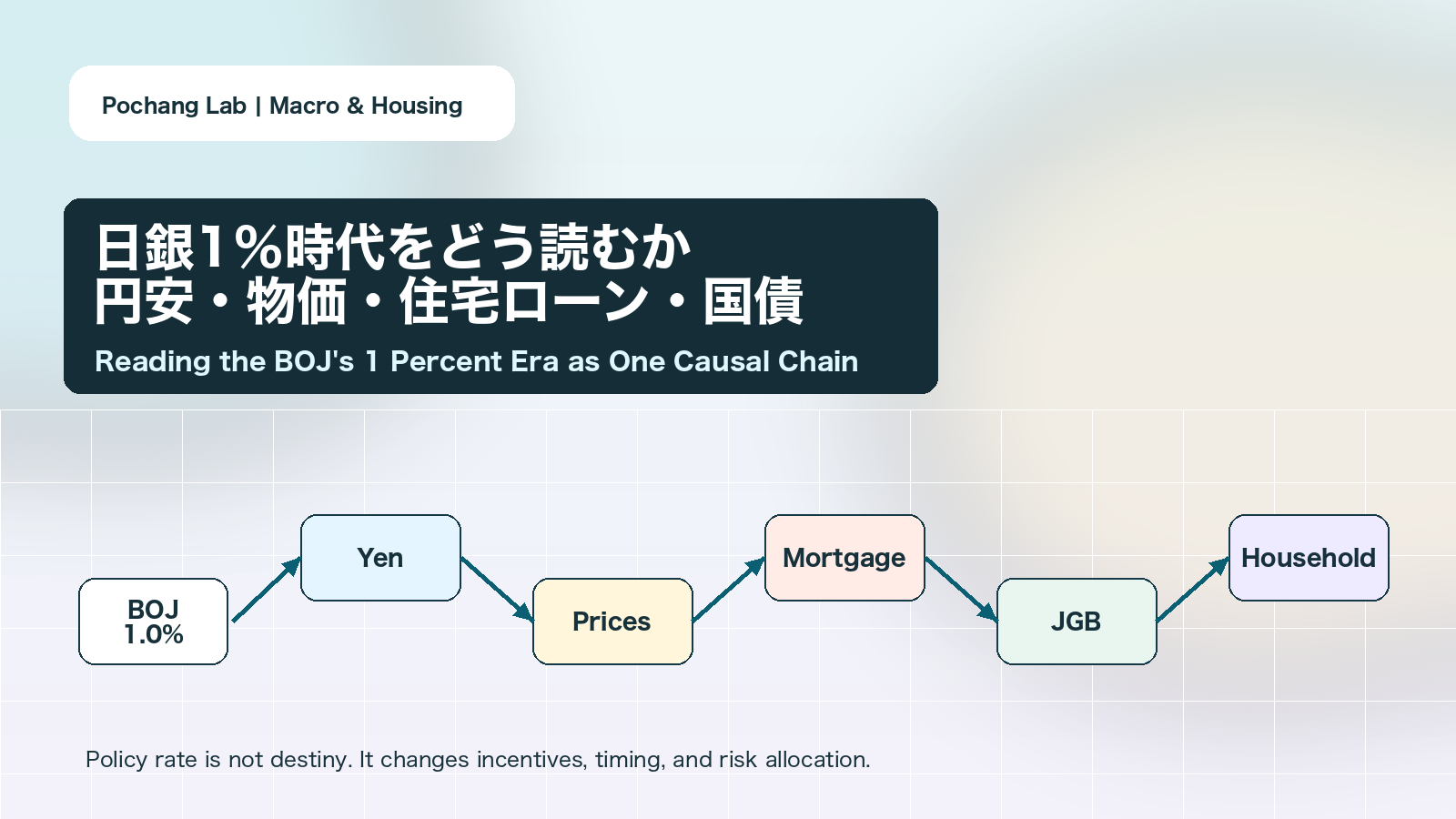
- The Bank of Japan's 1% interest rate hike is not a device to instantly reverse the yen's depreciation, but rather a normalization measure aimed at curbing inflation expectations and incentives to sell the yen.
- The rate of 75 yen to the dollar in 2011 shows that ``interest rate differences alone cannot explain exchange rates,'' but at that time interest rates in the United States were near zero, and the conditions are different from those in 2026.
- The representative level of Flat 35 is 3.21% as of June 2026, and existing long-term fixed contracts will not change across the board.
- The impact on mortgages, house prices, and government debt costs will not come all at once, but will spread over time through contract renewals, refinancing, maturities, and budgeting.
First, Fix the Numbers
At its monetary policy meeting on June 16, 2026, the Bank of Japan raised the target rate for overnight uncollateralized calls from around 0.75% to around 1.0%. The measure was effective from June 17, and the policy committee voted 7 to 1. The interest rate on the complementary deposit facility was also 1.0%, and the basic loan rate was 1.25%. [1] This is the first time the policy rate has reached 1% since 1995, and the highest level in approximately 31 years.
This 1% is not the mortgage interest rate itself. Policy interest rates are short-term market standards that guide overnight transactions between financial institutions, and they affect variable mortgages relatively quickly. On the other hand, Flat 35 does not move in the same range as the policy interest rate, as it is influenced by factors such as long-term government bonds, the procurement costs of mortgage-backed securities, and credit costs.
The Bank of Japan lifted negative interest rates in March 2024, and raised them in stages to 0.25% in July of the same year, 0.5% in January 2025, 0.75% in December of the same year, and 1.0% in June 2026. Still, the Bank of Japan itself explains that the real interest rate, which subtracts the inflation rate, is still negative, and that the financial environment is accommodative. If the expected inflation rate is 2%, the simple real interest rate subtracted from the nominal policy rate of 1% is -1%. It is more accurate to view interest rates, which have been abnormally low for a long time, as being on the way back to normal.
Why the Yen Did Not Strengthen After the Hike
Immediately after the decision was made, the market did not move according to the textbook. The yen exchange rate remained in the low 160 yen range to the dollar, and the Nikkei Stock Average briefly rose to the 70,000 yen range. Overseas media reported on the fact that the yen still did not appreciate by 1%, the first time since 1995. [3]
The first reason is that interest rate hikes were almost fully priced in. The foreign exchange market reacts not so much to the announced numbers themselves, but to the difference from prior expectations and the path of future interest rates. If market participants have been buying and selling the yen based on the assumption of a 1% exchange rate for several weeks, it is unlikely that new yen purchases will occur on the decision date. In fact, if it is perceived that there is no hurry to raise the next interest rate, the yen may even be sold after the announcement.
Second, the interest rate differential with the US is still large. As of June 18, the US Federal Reserve's policy interest rate was between 3.50% and 3.75%, leaving a gap of 2.50 to 2.75 points between Japan and the US. [2] A transaction that procures yen at a low interest rate and obtains a high yield on dollar assets can be attractive despite the risk of exchange rate fluctuations. Hideo Kumano of the Dai-ichi Life Economic Research Institute analyzed that it would be difficult to reverse the trend of a weak yen just by raising interest rates this time. On the other hand, the Japan Research Institute and others assess that raising interest rates to curb import inflation and overheating asset prices is rational. In other words, the opinions of domestic experts also discuss the necessity of raising interest rates and the magnitude of the yen's appreciation.
There is also the issue of counterfactuals here. We cannot immediately conclude that the interest rate hike was pointless because the yen did not rise. This is because if the interest rate had not been raised, it could have fallen to 161 yen or 163 yen. In reality, we can only observe the market after the hike; we cannot observe the market that would have existed without the hike. The effectiveness of monetary policy must be evaluated not only by whether it moved prices but also by whether it prevented larger fluctuations.
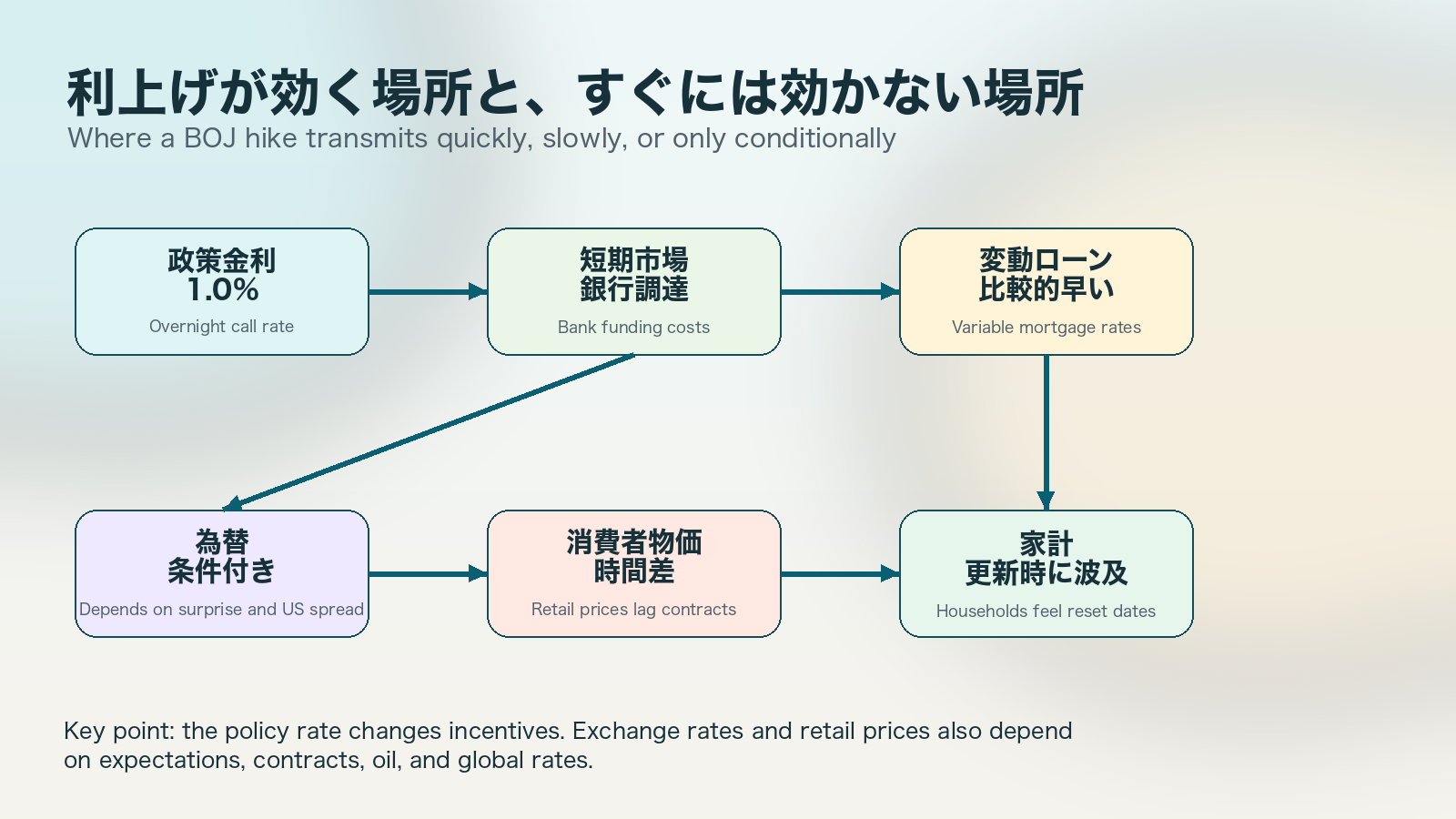
The policy rate is the starting point. Transmission to FX, prices, mortgages, and households is filtered through expectations, contracts, global rate spreads, and oil prices.
The 75-Yen Dollar in 2011 Is a Serious Counterexample to Interest-Rate Determinism
On October 31, 2011, the yen briefly reached 75.32 yen to the dollar, a new postwar high. [4] At that time, the Bank of Japan's policy interest rate was around 0% to 0.1%. If you just look at this, the yen will appreciate even if interest rates are zero, so it is correct to say that it is a mistake to explain foreign exchange rates by interest rate differences.
However, at the time, the US Federal Reserve also kept its policy interest rate unchanged at 0% to 0.25%. The difference in short-term interest rates between Japan and the United States was at most 0.25 points, and had virtually disappeared. The conditions are completely different from 2.50 to 2.75 points in 2026. In 2011, the yen was not the only case where Japan had zero interest rates and the United States had high interest rates, but the yen appreciated; both countries had interest rates close to zero, and another factor came to the fore.
Other factors are the European debt crisis, global risk aversion, the unwinding of the yen carry trade, Japan's current account surplus, and speculation about the return of funds after the earthquake. The yen has long been the funding currency for international financial markets. In normal times, they borrow low-interest yen and invest in high-interest assets, but in times of crisis they sell assets and return the borrowed yen to avoid losses. At that time, yen buying occurs. The Federal Reserve Bank of San Francisco also cited the unwinding of carry trades as a major explanation for the yen's strength as a safe-haven currency. [5]
Immediately after the earthquake, there was widespread speculation that Japanese companies and insurance companies would sell large amounts of overseas assets and bring funds back into Japan, but market participants at the time pointed out that such predictions and stop-loss orders had more to do with moving the market than actual capital repatriation. On March 18th, seven major countries coordinated to intervene by selling the yen, and on October 31st, the Japanese government and the Bank of Japan launched a large-scale intervention by selling the yen. The appreciation of the yen was a complex phenomenon that could not be explained by policy interest rates alone.
The theory of foreign exchange overshooting, developed by Rudiger Dornbusch in 1976, states that financial market prices adjust faster than commodity prices, so that foreign exchange rates can move beyond their long-term equilibrium following policy changes. Research by Richard Meese and Kenneth Rogoff in 1983 demonstrated how difficult it is for exchange-rate models based on economic theory to consistently outperform simple random walks in short-term forecasting. What half a century of research has taught us is not that interest rate differentials are meaningless, but that it is dangerous to determine daily exchange rates based solely on interest rate differentials.
Is Yen Weakness the Same Thing as National Decline?
The view that treats the yen exchange rate as a scorecard of Japan's national strength has some points that are correct and some that are wrong. If Japan's potential growth rate, labor productivity, demographic structure, public confidence in public finances, and corporate return on domestic investment decline relatively, the attractiveness of owning yen assets will weaken. The relocation of manufacturing bases overseas, dependence on energy imports, and deficits in digital services will also change the balance between real demand for buying and selling yen. In this sense, it is important to point out that behind the yen's depreciation are structural changes in the Japanese economy.
However, to go so far as to say that Japan has lost its appeal and the yen has lost its value does not match the statistics. According to the Ministry of Finance, the current account balance in 2025 was a surplus of 31,879.9 billion yen, and the primary income balance was a surplus of 41,590.3 billion yen. At the end of 2025, Japan's external net assets amounted to 561,750.4 billion yen, and external assets amounted to 1,805,634.2 billion yen. [6] [7] Japan remains one of the world's largest net creditors, with the ability to receive interest, dividends, and business profits from overseas.
The problem is the content of that surplus. In 2025, the balance of trade and services was in the red at 4,241.5 billion yen, with a trade balance of 848.7 billion yen and a deficit in services of 3,392.8 billion yen. Rather than generating surpluses by exporting products from domestic factories and returning the proceeds to yen, as in the past, they now earn a large proportion of their income from overseas subsidiaries and securities investments. If a company reinvests its profits overseas, even if it has a current account surplus, it will not immediately buy the same amount of yen. The simple relationship that the yen appreciates as Japan's external assets increase also breaks down.
The term safe currency does not just mean moral trust in a country or brand power. This is due to a combination of low-interest funding currencies, large amounts of overseas assets held by domestic investors, high market liquidity, and the ease with which positions can be undone in times of crisis. In the Middle East tensions in 2026, high crude oil prices worsened Japan's terms of trade, which is an importing country, and also worked to keep U.S. interest rates high. In that case, just because a war has broken out does not necessarily mean that the yen will appreciate. Rather than saying that the safe currency status of the yen has completely disappeared, it is more reasonable to think that the types of crises that cause the yen to be bought and the power relationship between interest rates and resource prices that cause the yen to sell have changed.
Will a Rate Hike Really Lower Import Prices and Living Costs?
There is certainly a path through which interest rate hikes can lower import prices through the appreciation of the yen. If the yen appreciates by 10%, the amount of yen needed to buy goods at the same dollar price will theoretically decrease by nearly 10%, putting downward pressure on procurement costs for things like energy, food, and building materials. The Bank of Japan also analyzes that in recent years, the degree to which exchange rate fluctuations are transmitted from import prices to domestic prices has become stronger than before. [1]
However, the store price will not drop immediately. Companies make foreign exchange contracts up to several months in advance, hold inventory, and purchase through long-term contracts. Transportation costs, personnel costs, rent, electricity costs, and domestic distribution costs cannot be eliminated by the strong yen alone. Even if purchasing costs fall due to the strong yen, companies may decide to postpone lowering prices in order to restore profit margins that have been damaged by past cost increases. There is a time lag in the order of imports, corporate prices, and consumer prices, and exchange rate changes are not passed on to retail prices on a one-to-one basis.
Furthermore, interest rate hikes will affect corporate borrowing rates, financing costs for housing development, store rents, and the profitability of capital investments. Not all products will be cheaper because raw materials will be cheaper due to the strong yen and financial costs will increase due to higher interest rates. This may have the effect of weakening demand, making it difficult to raise prices, or there may be a move to pass on capital costs to prices.
The Bank of Japan's focus this time was not just on import prices. Wage increases and price revisions have become entrenched, the underlying price increase rate is approaching 2%, and there is a danger that the weak yen and high crude oil prices will once again strengthen the ability to pass on prices between companies. Raising interest rates has the role of cooling demand a little, preventing inflation expectations from rising above expectations, and reducing the profits from selling the yen, rather than being a device that will definitely raise the currency. 1% is not a magic that will immediately lower prices, but is more like an insurance policy that reduces the probability of an upward movement.
What Global Cases Show About the Conditional Link Between Rates and Currencies
Mexico is a relatively clear example of the relationship between raising interest rates and strengthening the currency. According to an analysis of the Bank of Mexico compiled by the Bank for International Settlements, the Mexican peso appreciated by 13.2% in 2023, due to the large interest rate differential with the United States and relatively small market fluctuations. [8] The strong currency suppressed the production costs of imported goods, and the goods inflation rate fell from 11.09% in December 2022 to 4.89% in December 2023 and 2.39% in November 2024. When there are sufficient real interest rates, confidence in the central bank, and relatively stable fiscal and market conditions, interest rate differentials tend to have an effect on currencies and prices.
Türkiye provides the opposite lesson. Türkiye's central bank has raised its policy interest rate from 8.5% in May 2023 to 50% in March 2024. Still, the currency and prices did not stabilize immediately. According to the International Monetary Fund, the inflation rate has fallen from 49.4% in September 2024 to 30.9% in December 2025, but is still very high. [9] Even if nominal interest rates are significantly raised, it will take time for the currency to appreciate and prices to stabilize, given the combination of long-standing distrust in policy, fiscal and wage policies, foreign currency demand, and inflation expectations.
Comparing the two countries, we find that policy interest rates alone do not determine the wealth of the people. While high interest rates provide interest to savers, they are a burden to home buyers and capital investment. What determines long-term living standards are productivity, real wages, employment, public finances, and energy structures, and raising interest rates is only one way to do so.
Flat 35 Is Not Uniformly 3.5 Percent; the Representative June Level Is 3.21 Percent
Regarding Flat 35 in June 2026, 3.21% should be treated as the nationally representative figure. [10] The most common rate offered by participating financial institutions was 3.21% under the standard conditions of a 21- to 35-year borrowing period, a loan-to-value ratio of 90% or less, and the new JHF group credit life insurance. This was an increase of 0.50 points in one month from 2.71% in May. There may be cases where the rate is around 3.5% depending on the product, loan-to-value ratio, credit life insurance riders, and the financial institution's fee structure, but this does not mean that Flat 35 as a whole became uniformly 3.5%.
Flat 35 is a partnership product between private financial institutions and the Japan Housing Finance Agency, which began handling it in October 2003. The basic structure is that financial institutions originate the loans, while JHF purchases and securitizes the claims; it is neither a purely private product nor a program in which the government directly lends all funds. Public institutions create the supply base for long-term fixed rates, and the private sector handles the customer-facing lending channel. Since the interest rate and repayment amount through final repayment are determined when the loan is executed, the rate for existing borrowers will not change to 3.21% in June 2026.
Historically, the lowest interest rate was 3.05% in June 2008, 2.49% in June 2011, 1.10% in June 2016, and 0.90% in August of the same year. Back in 2011, there was a system that lowered the interest rate by 1.0 points for the first 10 years for flat 35S that met certain housing performance standards. If the June 2011 standard is 2.49%, the rate for the first 10 years will be 1.49%. It would not be unnatural for contracts to initially be in the 1.3% range and then in the 2.3% range, depending on the timing, financial institution, and group credit handling.
The difference between interest rates in the 1% range and the 3% range is larger than it appears. A simple calculation of borrowing 40 million yen for 35 years, with equal principal and interest and no bonus repayments, means that the monthly repayment amount at 1.49% per year is approximately 122,278 yen, and total interest is approximately 11.36 million yen. At 3.21% per year, the monthly repayment is approximately 158,666 yen, and total interest is approximately 26.64 million yen. The monthly difference is approximately 36,388 yen, and the interest difference over 35 years reaches approximately 15.28 million yen. The interest rate may look like a decimal number, but in a mortgage loan, it is the price of time over more than 30 years.
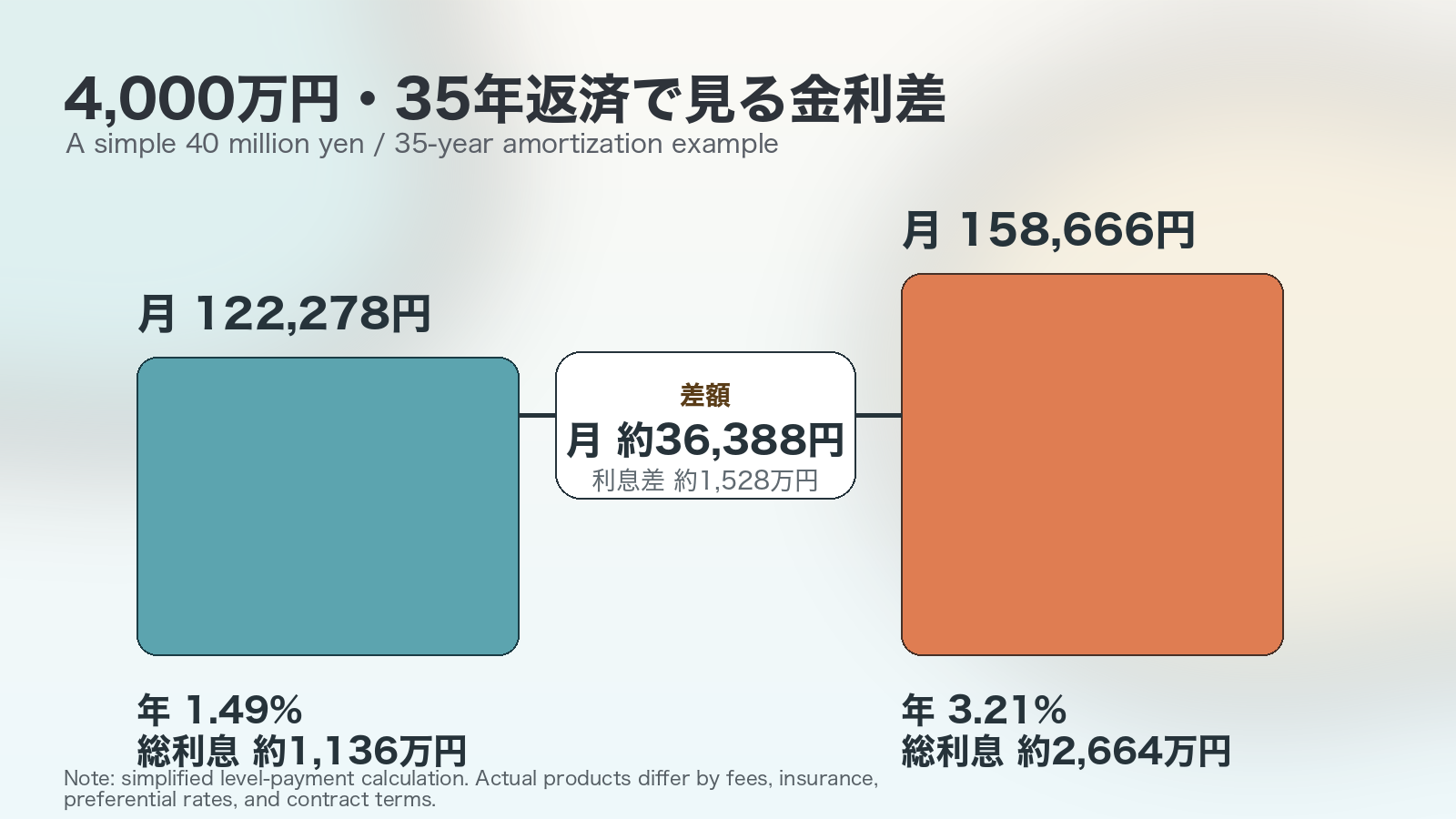
In a mortgage, an interest-rate difference is not just a decimal point. Over 35 years, it becomes a large difference in monthly payments and total interest.
Do Not Read 75 Percent Variable-Rate Usage as a 75 Percent Default Rate
According to a survey conducted by Japan Housing Finance Agency in January 2026, of the 1,237 people who took out a home loan between April and September 2025, 75.0% chose the variable type. [11] Fixed period selection type accounts for 14.9%, and all period fixed type accounts for 10.1%. This 75% is the proportion of product selection among recent borrowers, not 75% of all existing borrowing households, nor the proportion of those who will be unable to repay in the future.
Certainly, vulnerabilities are increasing. In the survey, 24.1% of people had a financing rate of more than 90% to less than 100% of the house price, and 38.7% used a paired loan or combined income. Younger people tend to buy expensive properties based on the income of two people, and the burden suddenly increases when interest rates rise, childcare leave, job loss, illness, or divorce occur. The number of people who expected mortgage interest rates to rise in the next year reached 73.7%.
Still, there is currently no data to suggest that a wave of defaults has begun. According to the Bank of Japan's Financial System Report for April 2026, despite changes in the interest-rate environment, there have been no major changes in mortgage delinquency rates. The spread of repayment burdens depends on the timing of contract renewals and repayment amount revisions. [12] Delinquency rates remain low and flat. For loans with a five-year rule, not all repayment amounts are revised every year, and only about 20% of loans are actually revised each year. In contracts with the 125% rule, the increase in the repayment amount can be kept within 1.25 times the previous amount.
However, these rules do not exempt interest. By reducing monthly repayments, the reduction in principal will be delayed and the burden will be passed on to later years. There are no rules for some financial institutions or products. In an attitude survey conducted by the Japan Housing Finance Agency, 58.8% of people answered that they would continue making repayments if their monthly repayments increased by 10,000 yen, but this dropped to 24.2% if their monthly repayments increased by 30,000 yen. The impact of rising interest rates is not a cliff that suddenly hits everyone, but rather a wave that spreads over time depending on contract renewals and household financial conditions.
How Far Does Personal Responsibility Go?
The principle is clear that those who choose variable interest rates bear the risk of interest-rate increases. Those who chose a fixed rate paid an insurance premium in the form of higher interest from the beginning in order to avoid future rate increases. If only variable-rate borrowers were subsidized across the board with taxes, or contract interest rates were forcibly fixed at a low level, this would undermine fairness with fixed-rate borrowers who continued to pay that premium, and create a moral hazard that would encourage the next borrower to take excessive risks. A system that transfers all the consequences of choices to society is difficult to justify.
On the other hand, it is also inappropriate to consider a mortgage loan to be the exact same bet as short-term buying and selling of stocks or foreign exchange. Housing is the foundation of life, and the loan period is 30 to 40 years, and it is provided through screening by financial institutions. According to a survey conducted by the agency, approximately 40% to 50% of respondents did not fully understand or were concerned about how interest rates are determined, repayments, and the range of preferential treatment. There is room for examination not only of the responsibility of the borrower, but also of financial institutions' explanations, suitability examinations, and sales practices that encourage excessive borrowing.
Additionally, if many households sell their homes at the same time, housing prices will fall sharply, the value of bank collateral will decline, and consumption will weaken, resulting in losses for people outside the original contract. In economics, this is called an externality. Therefore, instead of broadly waiving principal and interest just because borrowers chose a variable-rate loan, policy should extend repayment periods, provide temporary grace periods, change loan conditions, and offer limited income-based support to households facing unemployment, illness, disasters, sudden income declines, and similar shocks. This is not compensation for investment losses, but crisis management to prevent cascading foreclosures and social losses.
Borrowers who have been repaying for a longer period will have lower outstanding balances and are more likely to be able to settle the debt by selling. However, in households with high loan-to-value ratios immediately after purchase or in areas where prices have fallen, sale proceeds after expenses may be less than the outstanding balance. Policy needs to prevent cascading defaults while respecting the insurance premium already paid by fixed-rate borrowers.
Do Higher Rates Necessarily Lower Home Prices?
In theory, if mortgage interest rates rise, the amount that can be borrowed for the same income will decrease, and the rate at which future rents on real estate are discounted to present value will also rise, putting downward pressure on housing prices. Financing costs for developers will also increase, and expected yields will no longer match when purchasing for investment purposes. Therefore, there is basis for the argument that interest rate hikes will dampen speculative demand.
But that doesn't mean prices will fall immediately. If new supply is low due to a lack of construction personnel, material costs, land supply, and population concentration in urban areas, the number of transactions will decrease and prices will remain high. A study by the Federal Housing Finance Agency found that for every point increase in the difference between existing loan interest rates and market interest rates, the probability of selling a home decreased by 18.1%. [13] In the United States, it was estimated that approximately 1.72 million sales were lost due to the interest rate lock-in effect from mid-2022 to mid-2024, and the reduced supply pushed up prices by about 7%, while the direct effect of high interest rates pushed prices down by about 5.6%. A rise in interest rates may result in a market freeze rather than a price crash.
Japan's long-term fixed loan market is not the same as the U.S. long-term fixed loan market because there are many variable loans, but three forces are common: sellers are reluctant to part with low fixed interest rates, buyers' budgets are shrinking, and developers are tightening supply. If the number of second-hand properties for sale decreases and the supply of new buildings in the city center decreases, the prices of rare properties will be difficult to fall even if interest rates rise. Rather than looking uniformly across the country, we need to look at investment properties in urban centers, real demand housing in the suburbs, and areas with declining populations.
Can Foreign Speculation Alone Explain Housing Inflation?
The Ministry of Land, Infrastructure, Transport and Tourism analyzed approximately 550,000 new condominium units registered in the three major metropolitan areas between January 2018 and June 2025. [14] In the first half of 2025, acquisitions from overseas addresses accounted for 3.5% in Tokyo's 23 wards and 7.5% in the 6 central wards. Of the newly built condominiums registered during the same period, the percentage of sales within a year was 9.3% in the 23 wards and 12.2% in the 6 central wards. In the 23 wards in the first half of 2024, the short-term sales ratio of large-scale condominiums with 100 or more units was 9.9%, far exceeding the 3.3% for other areas.
It is true that short-term sales are increasing in urban areas, but the registration information does not include nationality, so it is not possible to know the nationality of those who have acquired foreign addresses or the number of foreign national buyers who have domestic addresses. There is also no confirmed tendency for people with foreign addresses to actively resell properties worth 200 million yen or more in the six central wards of Tokyo, so it cannot be concluded that foreigners are the only cause of the nationwide price hike.
It is more precise to focus on behavior rather than nationality. These include taxation on short-term resales, disclosure of beneficial ownership, ownership costs for vacant and idle housing, regulations on loan rates and repayment burden rates, restrictions on resale of rights to unfinished properties, and expansion of the housing supply. If policy interest rates are raised more than necessary to curb speculation, young households with real demand and healthy small and medium-sized enterprises will also be hurt. Lars Svensson, former deputy governor of Sweden's central bank, has shown that playing against the wind with monetary policy to keep asset prices down can mean that the costs of higher unemployment and lower inflation can outweigh the benefits of lowering the probability of a crisis. The basic idea is to use housing finance regulations, taxation, and supply policies to combat housing bubbles, and to adjust policy interest rates to prices and the overall economy.
Can the BOJ Not Raise Rates Because JGB Debt Is So Large?
The outstanding balance of Japan's ordinary government bonds is expected to be 1,145 trillion yen at the end of fiscal 2026. Interest payments in the FY2026 budget are also at a level that takes into account the rise in interest rates. [15] The interest rate on 10-year government bonds used for budget estimation has been raised to 3.0%. The Ministry of Finance's estimates for later years show that when assumptions about interest rates and growth rates change, the outlook for national debt expenses and tax revenues will also change significantly. If market interest rates remain 1 percentage point higher than the standard, national debt costs will increase gradually in subsequent years. [16]
It is incorrect to calculate that if the policy interest rate goes up by 1 point, 1% of 1,145 trillion yen, or more than 11 trillion yen, will become an additional burden starting the next day. Most outstanding government bonds have fixed interest rates, meaning the interest rate does not change until maturity. The burden increases over several years, as each new issue and refinance replaces it with a higher interest rate. The fact that the average remaining term of government bonds is approximately nine years also delays the spread of the crisis. Slower does not mean safer, but it does mean that finances have time to adjust.
Raising interest rates will also affect the Bank of Japan's own profits. While the Bank of Japan holds a large amount of government bonds as assets, it also earns interest on financial institutions' current account deposits at the Bank. Raising the policy interest rate will increase the interest paid on current accounts, narrowing the gap with the interest earned on low-yielding government bonds. Although the Bank of Japan's ordinary profit in fiscal 2025 decreased by 450.1 billion yen from the previous year, it still paid 1.83 trillion yen to the national treasury. If interest rates are raised further in the future, there is a possibility that payments to the national treasury will decrease, and the interest burden on the government as a whole cannot be measured solely by interest payments on national bonds.
A situation in which high debt puts pressure on the central bank to maintain low interest rates is called fiscal domination. However, because the country's national debt is denominated in its own currency, it has large domestic financial assets, and its external net assets are huge, it does not mean that it will immediately go bankrupt in the same way as debtor countries denominated in foreign currencies. The dangers are that rising interest rates will put pressure on budgets, that raising interest rates to curb inflation will become politically difficult, and that investors will demand higher interest rates on long-term government bonds.
On the other hand, if the nominal growth rate exceeds interest rates and wages, corporate profits, and tax revenues increase, the debt burden will become relatively lighter. According to the same calculations by the Ministry of Finance, if the nominal growth rate were 1 percentage point higher than the standard, tax revenue would increase by 1.0 trillion yen in fiscal 2027, 2.1 trillion yen in fiscal 2028, and 3.4 trillion yen in fiscal 2029. Rather than just fixing interest rates low, the main goal is to increase productivity and nominal income and create a situation in which the increase in tax revenue due to growth exceeds the increase in interest payments.
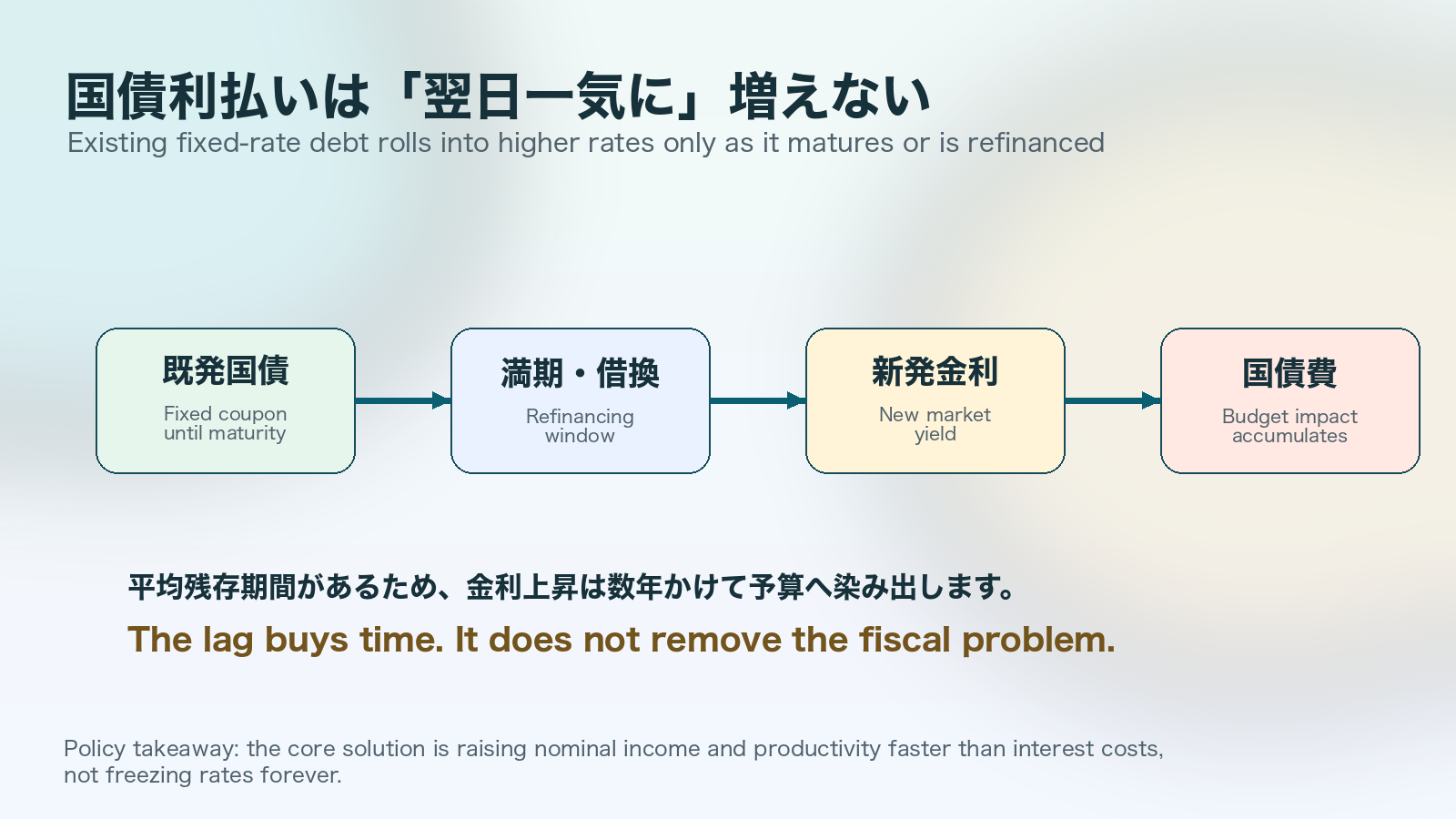
JGB interest costs do not jump all at once the next day. They spread through maturities and refinancing, so the question is whether Japan uses that time for growth and fiscal adjustment.
The Conclusion to Draw From the 1 Percent Hike
The current 1% rate is not a policy that will reverse the yen's depreciation in a single blow. As expected, the interest rate differential with the US was large, and high crude oil prices also contributed to the yen's selling. Still, if interest rates had not been raised, the yen would have weakened and inflation expectations would have worsened, and the effect cannot be denied based on the exchange rate alone on the day.
The 75 yen to the dollar in 2011 is a counterexample to the theory that interest rate differentials are universal, but at that time, the difference in interest rates between Japan and the United States was between 0% and 0.25%, with almost no difference. The current weak yen is the result of a combination of relative interest rates, crude oil, trade and service deficits, reinvestment of overseas profits, growth expectations, fiscal assessments, and investor positions.
For home loans, the representative interest rate for Flat 35 in June 2026 is 3.21%, and the fixed interest rate of existing contracts will remain unchanged. Borrowers who choose variable rates have contractual responsibilities, and a blanket remedy that ignores the premiums paid by fixed-rate borrowers is unfair. However, it is also a mistake to replace the selection rate of 75% with a default rate of 75%, as the current delinquency rate is low. What is needed is not full compensation for losses, but limited changes to conditions for households that are truly unable to repay, and prevention of spillover throughout the financial system.
Housing prices do not necessarily fall if interest rates rise. Declining purchasing power is a downward factor, but supply shortages, construction costs, urban concentration, and lock-in of low-interest loans are supporting prices. Foreign speculation is a factor that should be examined in some parts of the city, but it is not a figure that can alone explain the rise in prices nationwide. Rather than crushing speculation in general with policy interest rates, we need to combine lending regulations, taxation, information disclosure, and housing supply.
If Pochang Lab were to tackle this problem, the conclusion would not be to declare one side right or wrong, but to break down who bears the interest-rate risk, who benefits from yen depreciation, who suffers the losses, and which policies produce which side effects. One percent is neither a number that will save nor destroy the Japanese economy. It is a number that returns to prices the risks of currency, prices, housing, and public finance that were hidden during the long era of zero interest rates. The ultimate force that can revive confidence in the yen will depend not only on additional interest-rate hikes, but also on simultaneous improvements in domestic investment profitability, productivity, energy security, the services balance, real wages, and confidence in fiscal management.
References
- [1]Bank of Japan, Change in the Guideline for Money Market Operations, June 16, 2026. ↩
- [2]Federal Reserve, Federal Reserve issues FOMC statement, June 17, 2026. ↩
- [3]Mainichi Japan/AP, Nikkei index briefly tops 70,000 for 1st time after BOJ's rate hike, June 16, 2026. ↩
- [4]AFPBB News, Yen briefly reaches 75.32 per dollar as Japan intervenes, October 31, 2011. ↩
- [5]Federal Reserve Bank of San Francisco, Japan's Complicated Role as a Global Safe Haven. ↩
- [6]Ministry of Finance Japan, Balance of Payments for Calendar Year 2025. ↩
- [7]Ministry of Finance Japan, International Investment Position at Year-End 2025. ↩
- [8]BIS Papers, Monetary policy transmission in Mexico, 2025. ↩
- [9]IMF, Executive Board Concludes 2025 Article IV Consultation with Türkiye, February 13, 2026. ↩
- [10]Japan Housing Finance Agency / Flat 35, June 2026 borrowing rates. ↩
- [11]Japan Housing Finance Agency, Survey of Mortgage Users, January 2026. ↩
- [12]Bank of Japan, Financial System Report, April 2026. ↩
- [13]Federal Housing Finance Agency, The Lock-In Effect of Rising Mortgage Rates, Working Paper 24-03. ↩
- [14]Ministry of Land, Infrastructure, Transport and Tourism, Survey results on new condominium transactions using real estate registration data, November 25, 2025. ↩
- [15]Ministry of Finance Japan, Fiscal Conditions in the FY2026 Draft Budget. ↩
- [16]Ministry of Finance Japan, Projection of the effects of the FY2026 budget on future expenditures and revenues. ↩

NEW NOVEL 2026/08/01
Clouded Glass
Polishing is not about force.
Volume two of The World Became Slightly Farther Away.Five stories that can also be read as a starting point.
View on Amazon
Jijoden.com
Your life is worth writing.
There is a truer self you can tell only to AI.Gather fragments of memory into a single story.
Take a LookRelated Articles
Why Do Japanese People Buy Expensive iPhones Despite Being a "Poor Country"?
Analysis of why Japan maintains 60-70% iPhone market share despite economic stagnation, examining economic, psychological, and cultural factors including installment sales strategies and social conformity.
What the Strait of Hormuz Is: A Zero-Base Refresher in 2026
A structured 2026 refresher on the Strait of Hormuz, covering geography, shipping mechanics, global and Japanese exposure, bypass limits, crisis history, and why electrification only partly reduces the risk.
What Is a Degree Really Worth? Earnings, Lifetime Pay, and Learning in the AI Era
University earnings estimates, Japanese and Western wage gaps, graduate school costs, hiring, family background, AI, and intuition: an evidence-based account of what education can—and cannot—buy.
The Richest People in the World and Japan 2026: Top 100, Japan Top 30, and 22 Celebrity Billionaires
A data-led comparison of the world's top 100 fortunes, Japan's top 30 and 22 celebrity billionaires, with cautious Japanese celebrity estimates, cross-country after-tax models, yen conversions at ¥160 per dollar, and intuitive scale comparisons.
How to Choose a Job-Hunting Service in 2026: Comparing Major Portals, Scout Platforms, Agents, and PitaCareer
A fact-based guide to the differences among major job portals, scout platforms, career agents, doda, Geekly, and PitaCareer—a new service launched on July 16, 2026—including its strengths and best uses.