
Table of Contents
Could Anywhere Doors Become Real?
Introduction: Aligning Fiction with Science
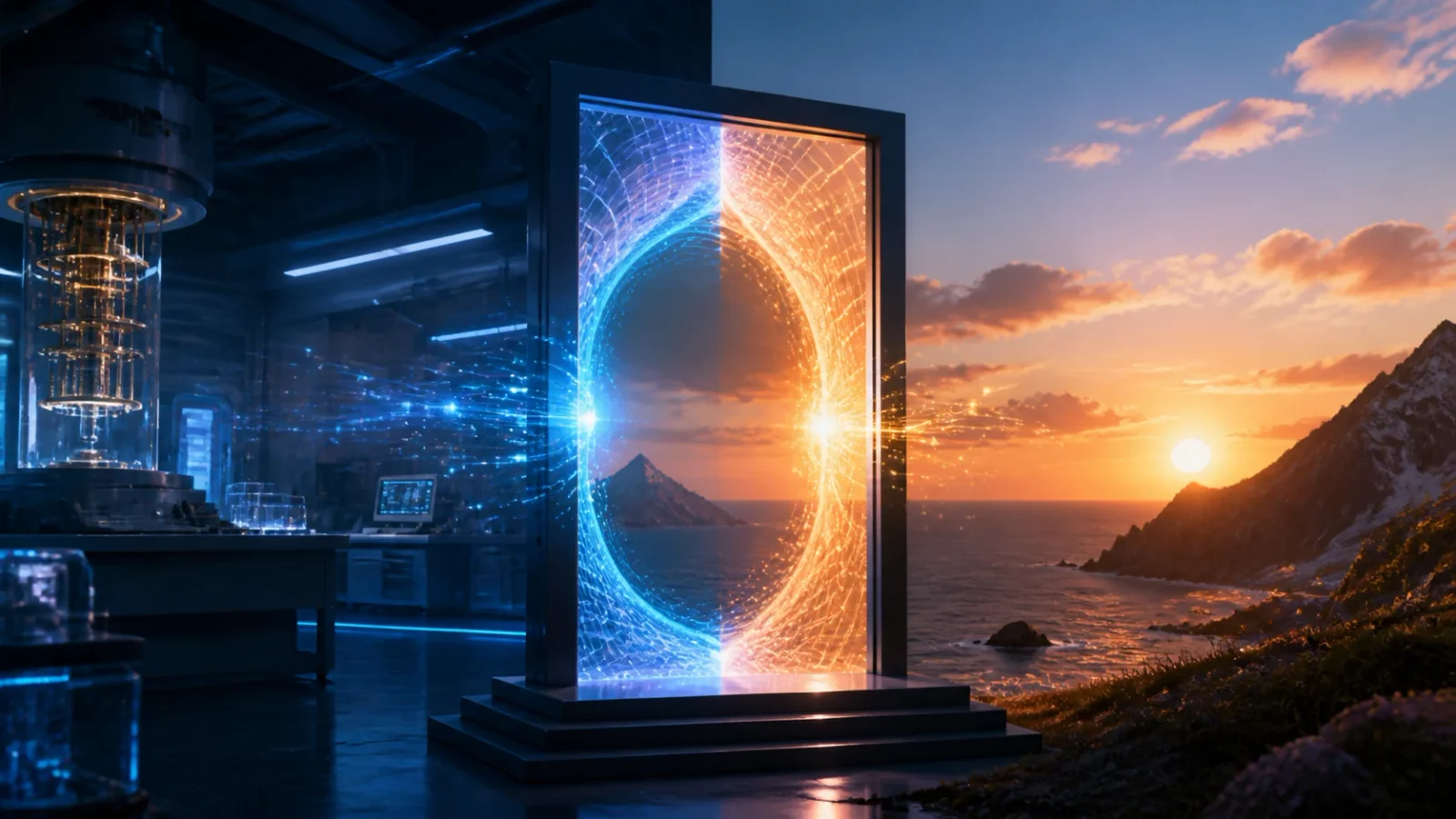
The "Anywhere Door" folds space to connect distant places in an instant. Real-world quantum teleportation, however, transfers quantum states (information) rather than matter. It always relies on a classical channel, so nothing travels faster than light. Keeping that distinction clear helps us see what science can actually deliver.
💡 Quantum teleportation moves information without cloning; the original state is destroyed, so it is closer to relocation than duplication.
1. How Quantum Teleportation Emerged
The theory of quantum teleportation matured in the 1990s, and the first photonic experiment succeeded in 1997. Subsequent demonstrations with atoms, ions, superconducting circuits, and optical fibers refined the protocol.
- In 2017, China's "Micius" quantum-science satellite delivered entanglement and teleportation over roughly 1,200 km between ground stations and orbit.
- In 2025, researchers reported 254 km quantum-state messaging over standard optical fiber, suggesting that intercity networks are coming within reach.
Every one of these achievements moved quantum states, not physical objects.
2. Where Are We Now? Current Research Themes
Building practical quantum networks
Quantum repeaters, quantum memories, and entanglement swapping are steadily improving. The European Union and several Asian countries now treat quantum internet test beds as strategic infrastructure, aiming to offer metropolitan services in the 2030s.
Re-examining wormholes and warp drives
Hollywood-style warp concepts still attract theorists. A 2022 quantum-computing experiment simulated wormhole dynamics via holographic duality, but it remained a model on a processor—not a tunnel carved into spacetime. Alcubierre-style warp drives are mathematically consistent solutions, yet they require vast amounts of negative energy, so their engineering feasibility is vanishingly small.
3. Engineering Obstacles to an Anywhere Door
- Measurement resolution: No technology can read a living body at atomic detail without destroying it.
- No-cloning theorem: Unknown quantum states cannot be copied perfectly; teleportation destroys the original, raising ethical and legal questions about identity.
- Long-distance loss: Photons attenuate and entanglement decays, demanding complex networks of repeaters and error correction.
- Classical speed limit: Because a classical message is required, teleportation inherits the speed of light; trips between Earth and Mars would still suffer hour-scale delays.
- Negative-energy scarcity: Wormholes and warp drives would need controllable negative energy, yet observed effects such as the Casimir phenomenon provide only tiny amounts.
4. Looking Ahead: 10, 100, and 1,000 Years
10–30 years
- Metropolitan quantum communication grids support finance, government, and healthcare with entanglement-based services.
- Teleportation becomes a built-in capability for research instruments and distributed sensing.
100 years
- "Information transfer + local synthesis" workflows serve medicine and space industry use cases.
- Remote molecular fabrication and immersive telepresence mature, yet full human teleportation remains implausible because of measurement, ethical, and resource barriers.
1,000 years
- If a future theory unifies gravity and quantum mechanics in a practical form, spacetime engineering might become conceivable.
- For now, Anywhere Door concepts stay speculative: not impossible in principle, but unsupported by experimental evidence.
5. Balancing Benefits and Risks
Potential benefits
- Ultrasecure communications: Entanglement allows eavesdropping detection, strengthening national-scale security systems.
- Remote science and manufacturing: Hazardous or distant environments could fabricate components on demand using locally available materials.
- Medical breakthroughs: Molecular-level state transfer could transform drug discovery and diagnostics.
Risks and open questions
- Identity and personhood: Destroying the original state challenges existing legal and ethical frameworks.
- Massive infrastructure costs: Cryogenics, stable lasers, and dense repeater networks are expensive to build and maintain.
- Speed-limit reality: Classical signaling still throttles interplanetary communications to tens of minutes or more.
Conclusion: Information Doors Are Near, Spatial Doors Are Distant
Science is steadily opening an "information door"—combining quantum teleportation with classical channels to reconstruct data elsewhere. That roadmap looks actionable within a few decades. Folding space itself, by contrast, demands breakthroughs in negative-energy control and spacetime engineering, so it remains an ultra-long-term dream. Understanding where we stand today lets us pursue bold visions without losing touch with feasible technology roadmaps.
Key References Consulted
- Science coverage of the "Micius" quantum-science satellite experiments
- Phys.org reporting on the 254 km quantum messaging experiment published in 2025
- European Commission, "Strategic Agenda for Quantum Technologies 2030" (2025 edition)
- NASA JPL and Caltech joint press release on wormhole-simulation work
- Standard references on quantum teleportation, the no-cloning theorem, and the Alcubierre drive

NEW NOVEL 2026/08/01
Clouded Glass
Polishing is not about force.
Volume two of The World Became Slightly Farther Away.Five stories that can also be read as a starting point.
View on Amazon
Jijoden.com
Your life is worth writing.
There is a truer self you can tell only to AI.Gather fragments of memory into a single story.
Take a LookRelated Articles
Silver Week Reshapes AI: GPT-6 Astra, Sol and Luna vs Claude Fable, Opus and Sonnet
A six-model comparison of launch strategy, intelligence, API prices, measured task costs, caching and access: GPT-6 Astra, Sol and Luna versus Claude Fable 5.1, Opus 5.5 and Sonnet 5.
What Can You Share with AI? Approval Criteria for Enterprise Code and Customer Logs
Authorize enterprise AI use with six repository acceptance criteria, log-sanitization examples, contract decisions and a reusable approval template. Primary sources checked September 19, 2026 distinguish permitted work, prohibited transfers and case-specific review.
GPT-6 Astra Arrives: What Changes When You Put It to Work in Codex?
Our first article produced with Astra examines GPT-6 in Codex, its differences from GPT-5.6, comparisons with Fable 5.1 and Opus 5, ARC-AGI-3 testing conditions, international reactions, and the AGI debate. Sources checked September 6, 2026.
Building nagara: A Voice Player for AI Replies, Articles, and Novels
I wanted long Claude Code replies to be easier to listen to. This engineering story follows nagara, an open-source macOS player built with Swift and AivisSpeech, through quiet collection, sentence navigation, and pitch-preserving playback speed.
You Don’t Have to Abandon Claude Desktop: The Practical Case for Claude Code CLI, Subagents, and Agent Teams
Subagents work in Claude Desktop's Code tab, so what still makes the CLI different? This practical guide explains CLI-only Agent Teams, Unix pipes, shell-environment continuity, which model and effort level each teammate and Subagent inherits, local-only configuration, Git exclusions, and copy-ready reviewer and log-watcher agents for ordinary Claude subscribers.