
Table of Contents
October 12, 2026 was a Monday and a national holiday in Japan, Sports Day. The Japan Racing Association (JRA) held meetings at Tokyo and Kyoto, with 24 races across the two courses.
I am not a horse-racing expert. I know almost none of the horses' names, and watching the paddock tells me nothing. Even so, that day I finished buying tickets for all 24 races in the morning and spent the rest of the day in front of a screen with a cup of tea, simply cheering. The picks, the ticket entry, and the cheering screen were all worked out in conversation with an AI agent.
To put the result first: on a ¥15,000 budget, I got back ¥4,090. I lost more than ¥10,000. Yet the first thing I said at the end of the day was that it had been fun. This article is a record of that day. It is not advice on how to bet.
1. The verdict: deciding everything in the morning and then just cheering was fun, even with a loss
The day had only three rules.
- Set the budget at ¥15,000 in the morning and never top it up.
- Buy every ticket at ¥100 per combination, for all 24 races, in one go in the morning.
- Buy nothing more during the races; just cheer and check the results.
| Item | The day's numbers |
|---|---|
| Scope | All 24 races at Tokyo and Kyoto (Races 1 to 12) |
| Purchase | 150 combinations × ¥100 = ¥15,000 (49 entries) |
| Payout | ¥4,090 (8 wide hits, 0 trifecta hits) |
| Result | −¥10,910 (27.3% return) |
On the numbers alone, it was a clear loss. But the size of the loss was fixed from the start. I deposited only an amount I was willing to lose, so I could not lose more. Within that limit I watched 24 races, celebrated eight hits, and groaned at many near misses. It cost more than a film, but I was not bored from morning to evening.
2. Why horse racing: a game where the budget is set in the morning and spent within the day
There are many ways to spend a day off: films, walks, games, books. Games of chance range from horse racing, keirin cycling, pachinko and slot machines to stocks and foreign exchange trading.
To me, stocks and FX do not work as a single day's entertainment. Gains and losses carry over into the following days, and even with small amounts the shape of the risk is hard to see. Pachinko and slots can fill a whole day, but I hear it is easy to go over budget once you get heated, and I find it hard to see how much is draining away each hour. These are only my personal impressions, not a judgment on any of them.
Horse racing suited me for the following reasons.
- Bets start at ¥100. A ¥10,000 budget buys exactly one hundred ¥100 tickets.
- Tickets can be bought online. With the JRA's Soku-PAT service, you can only bet up to the amount you have deposited in advance, so the deposit becomes the ceiling.
- The races can be watched for free. Since March 14, 2026, Green Channel's race coverage has been streamed free of charge, including on the JRA's official YouTube channel.[2] I could watch at home with a cup of coffee.
- The share returned to bettors is published. The payout rate for each bet type is public: 80% for win and place, 77.5% for quinella and wide, and 72.5% for trifecta.[1]
| Bet type | Payout rate | How I used it that day |
|---|---|---|
| Win and place | 80.0% | Not used |
| Quinella and wide | 77.5% | Wide as insurance; quinella in the main races |
| Trifecta | 72.5% | In every race, as the dream ticket |
Because the payout rate is below 100%, betting over time loses between roughly 20% and 28% on average. Put the other way, you can picture in advance roughly how much a ¥10,000 day will cost on average. I found that reassuring.
On the other hand, on a two-course day a new race starts about every 15 minutes. Predicting all 24 races on your own is hard work for someone without knowledge. You could bet only on the graded races, but then most of the day goes unused. So I asked an AI agent to help with the picks and the planning.
3. Morning preparation: three years of favourite rankings, then a choice of how to bet
The first step was to have the AI agent (Claude Code) study past results. It downloaded the JRA's official annual result PDFs[3] for 2023 to 2025, 864 files in all, and tallied 10,299 races. It ignored ability and pedigree entirely and compared only fixed rules of the form "bet on the horse ranked N in popularity, using bet type X."
The conclusion was something of an anticlimax.
- No fixed rule based only on popularity rankings stayed profitable from one year to the next.
- Typical approaches returned roughly 56% to 92% depending on the year.
- When the best-performing rule from earlier years was applied to the following year, every one of them lost money that year.
| Approach (24 races a day at two courses, 2023 to 2025) | Return |
|---|---|
| Win, favourite | 79.4% |
| Place, favourite | 85.9% |
| Quinella, 1st and 2nd favourites | 85.2% |
| Trifecta, favourite → 2nd → 3rd favourite | 75.1% |
The same popularity-based rule swung considerably from year to year. In other words, at least across these three years, I could not find a way to bet mechanically and keep making money.
So I changed the goal. If I was going to lose on average anyway, I would choose a format that made the day enjoyable. The conditions were that every race should have some chance of a hit, and that there should be a dream of a big payout.
The final choice was one wide ticket plus five trifecta tickets per race.
- The wide ticket paired the morning's favourite and second favourite. It wins if both finish in the top three, so it served as insurance.
- The trifecta put the second favourite first, the favourite second, and the third- to seventh-favourites third.
- For the two main races, Tokyo Race 11 and Kyoto Race 11, the AI read the horses' records and picked ten combinations for each.
Among the approaches compared, the trifecta part had the most profitable days over the previous three years. Applied to those three years, the combination with the wide ticket finished in profit on about one day in three, and there was never a day without a single hit. Its average return was still only about 83%, so it was still a losing format. I chose it for enjoyment, not as a way to win.
4. What the AI agent did, and what I did
Buying tickets online takes effort until you get used to it. You choose the race, the bet type and the method, tick the horse numbers, enter the amount, and add it to the cart. Doing that 49 times means a great many clicks, and a real risk of buying the wrong thing.
That day, the roles were split as follows.
| Step | Who did it |
|---|---|
| Deciding the budget (¥15,000) and the betting approach | Me, in discussion with the AI |
| Logging in to Soku-PAT | Me |
| Adding every race's tickets to the cart | The AI agent |
| Checking entries, combinations and the total | The AI agent (49 entries, 150 combinations, ¥15,000) |
| The final "Purchase" click | Me |
The AI neither typed my password nor confirmed the purchase. I logged in, the AI used the browser to put every ticket in the cart and check it against the plan, and I pressed only the final confirmation button.
This made the biggest difference. There was no rush to buy before each post time; everything was finished in the morning. It is the opposite of studying the paddock and deciding at the last minute, but it allows another way to spend the day: watching the results unfold like a drama.
5. A cheering screen that grew through conversation
Once the tickets were bought, a new problem appeared: I could no longer tell at a glance what to cheer for in each race. With so many combinations, I could not remember which horses had to finish where.
So I had the AI build a cheering screen in HTML, just for that day.
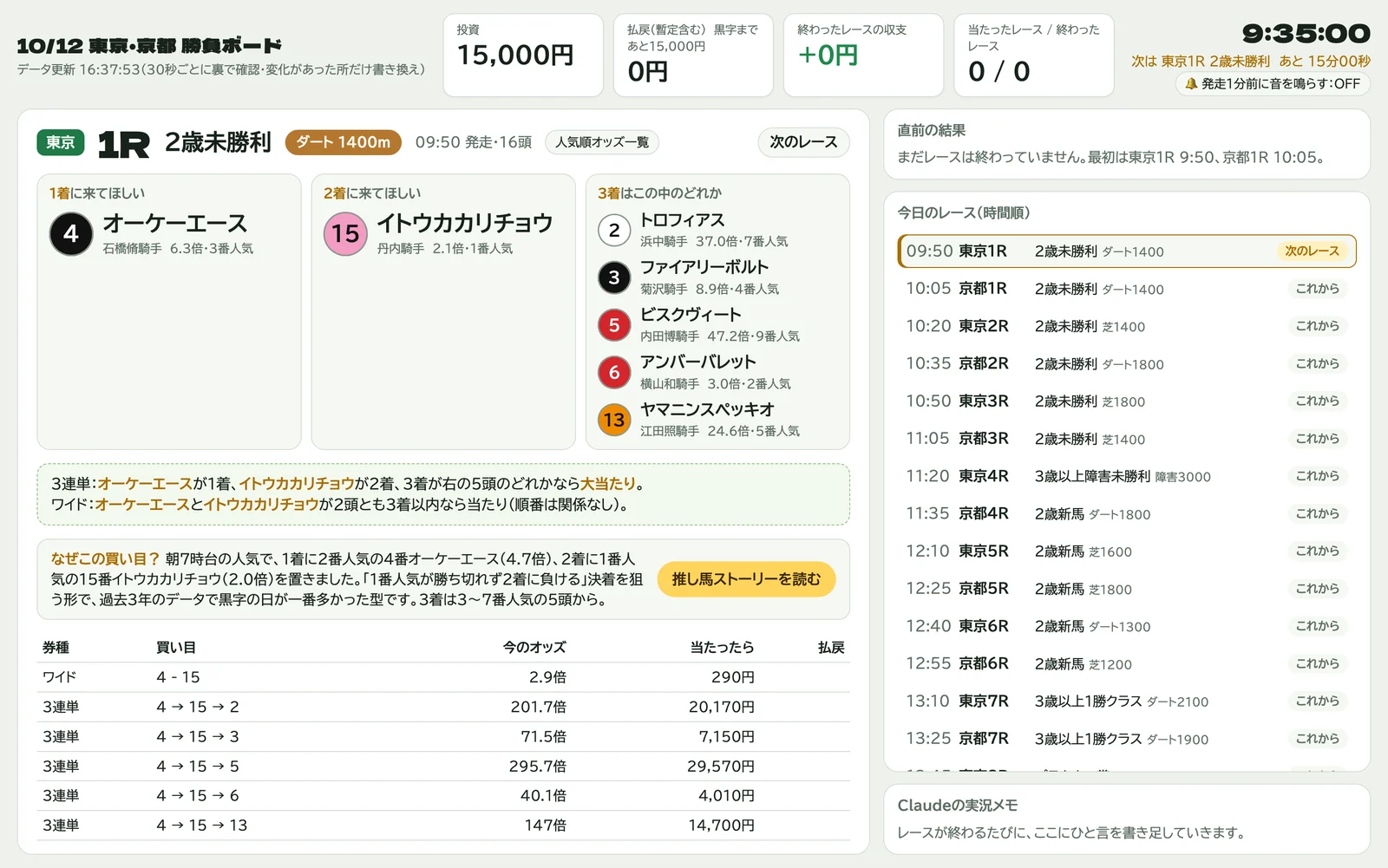
The screen in the morning. For the next race it shows, in large type and by name, the horse I wanted to win, the horse I wanted second, and the third-place candidates. All 24 races are listed by post time on the right.
The first version included the following.
- The next race's course, name, turf or dirt, distance and post time.
- The horses to cheer for, shown large by name rather than number. Commentators call out names, so knowing them makes cheering easier.
- The winning condition written out in a sentence, such as "a hit if this horse wins and that horse is second."
- The current odds for each ticket and an estimate of the payout if it hits.
- The total stake, payout, profit and a countdown to the next race.
After that, the screen changed each time I mentioned something between races.
- The dark screen was hard to read in daylight, so it switched to light mode.
- When I said the periodic reload made the screen flicker, it changed to reloading only the data instead of the whole page.
- When I said I wanted to know the pedigree and recent form of the horses I had picked, a "favourite horse story" pop-up appeared.
- When I asked to see every runner sorted by popularity, an odds pop-up appeared.
- I had a short trumpet-like fanfare play one minute before each start, then had the volume turned down twice.
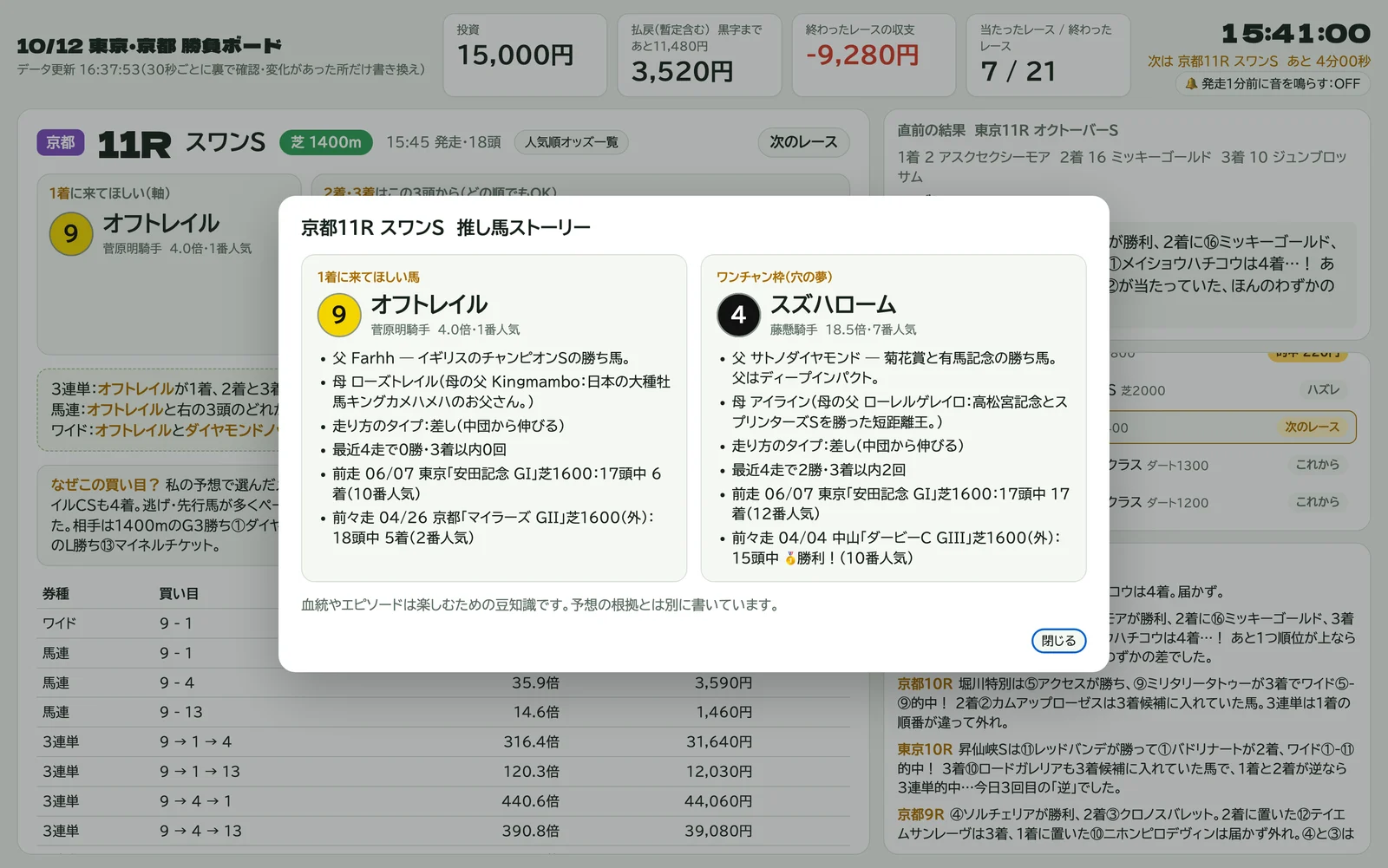
The "favourite horse story." For the horse I placed first and the long-shot "one-chance" horse, it shows the sire and maternal grandsire, running style, and the last two races. It is trivia for enjoyment, separate from the reasoning behind the picks.
The story pop-up had almost nothing to do with the predictions. Still, knowing what kind of champion a horse's sire was, or where it finished last time, changes how a race looks. When the AI does all the predicting, I never learn the horses' names, but with a screen like this some of them start to stick.
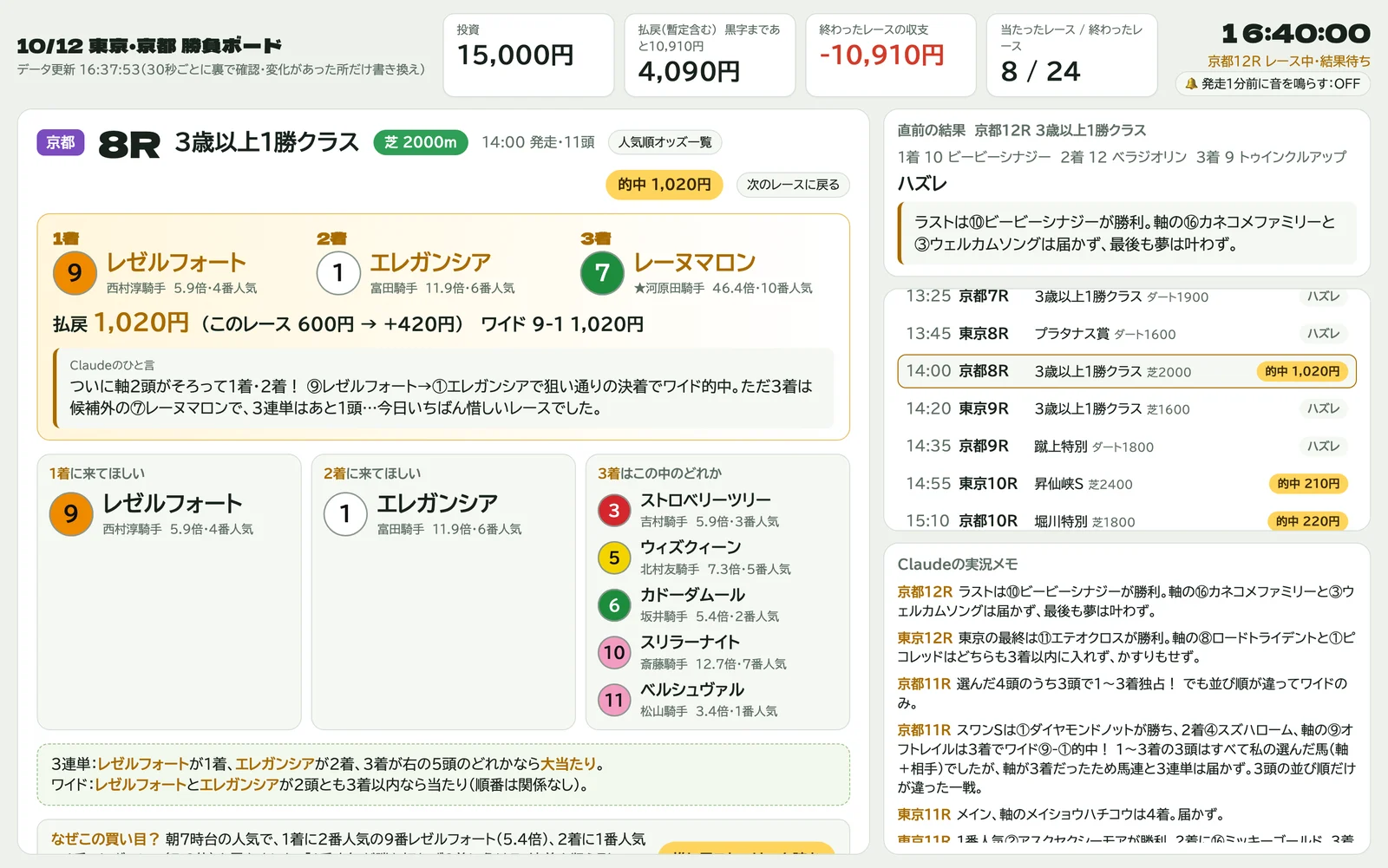
I did not write a single line of code all day. I asked in words, and a few minutes later the screen changed. Results were gathered automatically too: once official payouts were announced, an update every three minutes replaced the numbers on screen with the confirmed amounts. Before the official announcement, I would tell the AI in the chat what the first three finishers were, and it would calculate a provisional payout from the latest odds and put it on screen.
Note: "AI" here means an AI agent that can create files, operate a browser, fetch data and keep updating it, not an AI you only talk to in a chat window. Claude Code, Codex, Google Antigravity and Cursor are examples. With chat alone, it is hard to build this kind of screen and keep it running for a whole day.
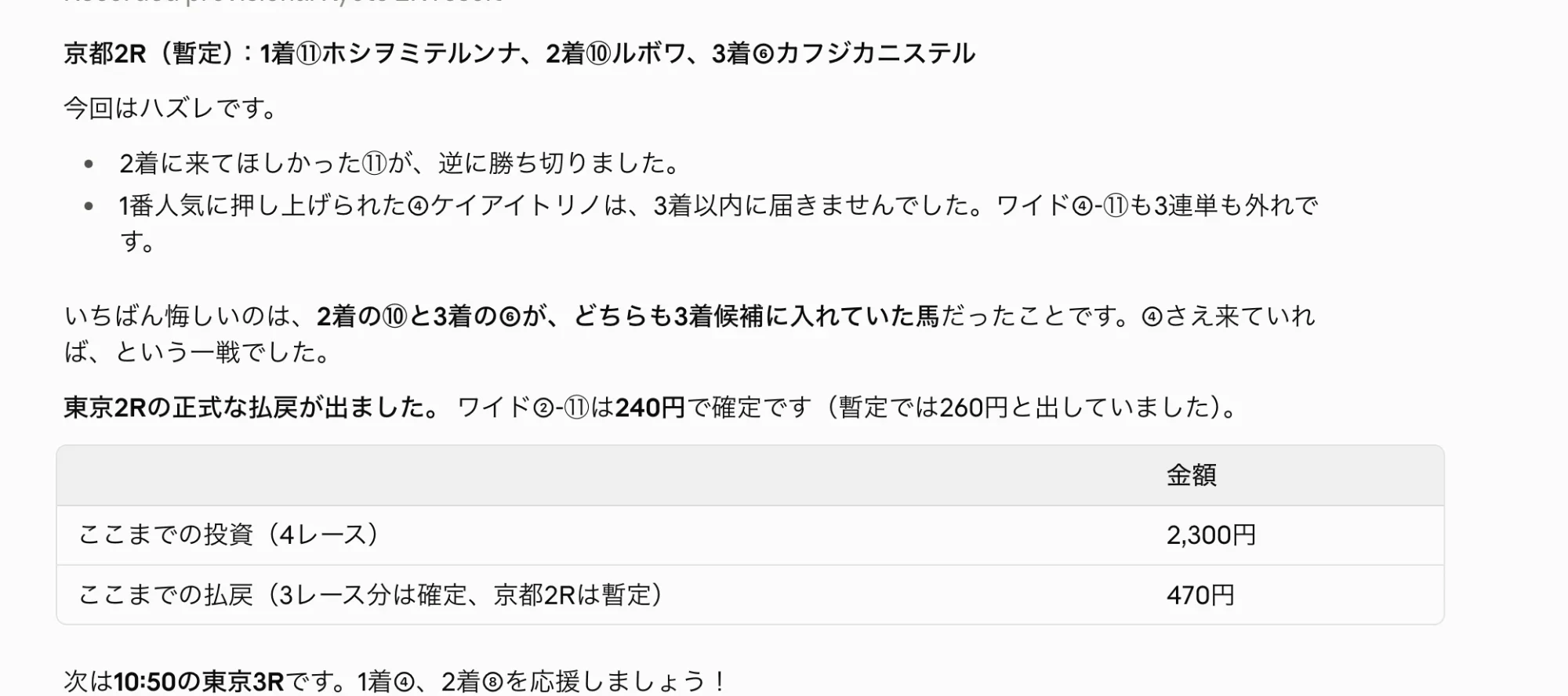
After each race I typed in the finishing order and got back a provisional result and a short comment. When the previous race's official payout came out, it also told me the difference.
6. Results: eight wide hits and no trifecta hits in 24 races
The official results for every race were as follows. The numbers are saddle-cloth numbers, and the payout is the total for my ¥100 tickets.
| Race | 1st–3rd (horse numbers) | Payout |
|---|---|---|
| Tokyo 1 | 15-6-4 | ¥230 (wide) |
| Kyoto 1 | 14-8-10 | ¥0 |
| Tokyo 2 | 2-11-12 | ¥240 (wide) |
| Kyoto 2 | 11-10-6 | ¥0 |
| Tokyo 3 | 4-11-6 | ¥0 |
| Kyoto 3 | 5-11-6 | ¥0 |
| Tokyo 4 | 3-10-8 | ¥1,440 (wide) |
| Kyoto 4 | 12-5-13 | ¥0 |
| Tokyo 5 | 12-6-10 | ¥160 (wide) |
| Kyoto 5 | 6-2-4 | ¥0 |
| Tokyo 6 | 16-14-10 | ¥0 |
| Kyoto 6 | 3-7-11 | ¥0 |
| Tokyo 7 | 13-10-11 | ¥0 |
| Kyoto 7 | 2-15-9 | ¥0 |
| Tokyo 8 | 5-2-1 | ¥0 |
| Kyoto 8 | 9-1-7 | ¥1,020 (wide) |
| Tokyo 9 | 8-13-4 | ¥0 |
| Kyoto 9 | 4-3-12 | ¥0 |
| Tokyo 10 | 11-1-10 | ¥210 (wide) |
| Kyoto 10 | 5-2-9 | ¥220 (wide) |
| Tokyo 11 | 2-16-10 | ¥0 |
| Kyoto 11 | 1-4-9 | ¥570 (wide) |
| Tokyo 12 | 11-9-13 | ¥0 |
| Kyoto 12 | 10-12-9 | ¥0 |
Three races stood out.
In Kyoto Race 8, the two horses chosen in the morning finished first and second. Horses No. 9 and No. 1 had slipped to fourth and sixth favourite before the start. When the two of them crossed the line one-two, I got goosebumps. But third place went to a tenth-favourite horse I had not included, so the trifecta missed by one horse. At that moment, my trifecta combinations were priced between 250 and 709 times the stake.
In Tokyo Race 4, No. 3, Gereru, was the second favourite in the morning but had dropped to eighth favourite by the start. It still cleared every jump and won. The provisional wide payout showed ¥1,100, but the official figure was confirmed at ¥1,440. Perhaps tickets involving a horse that had fallen out of favour were not bought much toward the close.
In Kyoto Race 11, the Swan Stakes, all three placed horses were among the four the AI had chosen. But No. 9 Off Trail, fixed in first place, finished third, so the quinella and trifecta missed. The read was right; only the order was wrong.
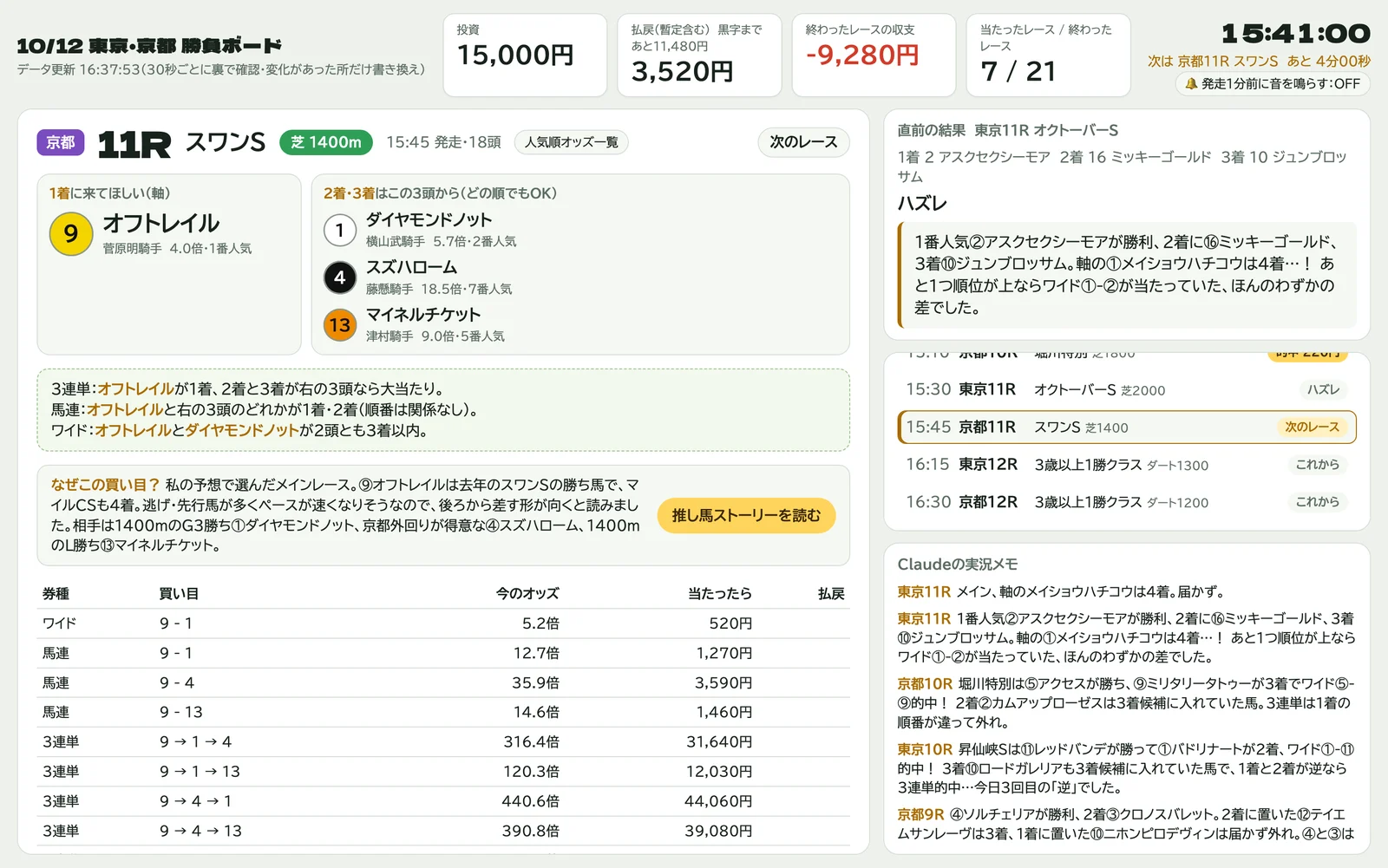
Before the Swan Stakes. With ten combinations in the main race, it felt as if something would hit whatever happened, and it was the most enjoyable race of the day. All three placed horses were picks; only the order was wrong.
Several races also ended with "if only first and second had been reversed, the trifecta would have hit": Tokyo Races 1, 2 and 10. In Tokyo Race 2 the winning trifecta (2→11→12) paid 32.5 times the stake, while my ticket was 11→2→12.
7. What I took away
In races with one dominant favourite, putting the favourite first may hit more often
That day, the morning favourite often simply won. When there is a favourite at around 1.5 to 1, placing it second makes the trifecta hard to hit.
Looking back at the three years of data afterwards, there were 531 races where the favourite was under 2.0 to 1 and the second favourite was 6 to 1 or longer. In those races, the day's format (second favourite → favourite → third to seventh favourite) hit the trifecta in 3.2% of races, while putting the favourite first (favourite → second favourite → third to seventh favourite) hit in 9.2%. The return was about 70% either way, so more hits did not mean more money. If I do this again, I would like to put the favourite first in those one-horse races. More hits alone make it more fun to watch.
Combination bets are a contest among the people who bought each combination
Quinella and trifecta payouts are not the product of win odds. Each bet type has its own pool, and the payout depends on how much money went on that particular combination. Comparing a few combinations in Tokyo Race 2, "2→11→12," with the favourite winning, was priced at 32.5 against 40.9 implied by the win odds. "11→2→12," with the favourite beaten into second, was priced at 89.6 against an implied 76.3. Orders that everyone buys seem to pay less, and orders that few people buy pay a little more.
The morning favourites were only provisional
One horse that was second favourite in the morning had fallen to eighth favourite by the start. Apparently only a small amount is wagered the day before and early in the morning, and most of the money arrives close to the deadline. Many bettors wait for the horses' weights or the day's track bias. Buying everything in the morning means giving up that last-minute information.
Ten ¥100 variations were the most fun
I bought ten combinations for each main race. With ten, I could not remember them all, so I ended up cheering hard for the horse I had placed first and checking the hits after the finish. Spreading ¥100 across ten combinations, rather than putting ¥300 on one, kept several paths to a hit open until the very end. For me, that was the most enjoyable part.
You do not have to bet every race
A ¥10,000 budget buys one hundred ¥100 tickets. Five combinations in each of 24 races already comes to ¥12,000. Cutting to two or three combinations makes hits rarer, and sometimes the only combination that comes in is the one you left out. In that case, betting on fewer races might be more enjoyable: only the 12 races at Tokyo, only the afternoon, or about one race an hour, with reading or anime in between. In the data I looked at that morning, concentrating on fewer races produced more profitable days and more big days, but also more days with no hits at all. The average return was almost the same either way.
8. HTML is just right for a tool that lives for one day
The screen was a disposable HTML page made for that day only. You could build a full system that goes from prediction to purchase, but the layout changes with each bet type and betting method. It is quicker to make the screen you need on the day itself. If you like a format, you can save it as a skill, and next time the same preparation starts with a single sentence such as "I want to do horse racing today."
I think this also works beyond leisure. For a one-off meeting or presentation, you could build an HTML page instead of slides: a working mock-up whose display changes when you press a button, ready for the next meeting. AI agents handle HTML and JavaScript very well, and what you describe in words takes shape. The habit of turning what you want to see into a screen right away seems useful at work, too.
9. A caution: this is not a way to make money
Finally, a few points to be clear about.
- Betting is for adults only. Under Article 28 of Japan's Horse Racing Act, people under 20 cannot buy betting tickets.[1]
- The payout rate is below 100%, so betting loses on average over time. This article does not describe a way to make money. Please do not use living expenses or bet in order to earn.
- Decide the budget the day before or that morning, and do not top it up. For me, this was the most effective brake.
- If you are worried about getting too absorbed, the JRA provides information on where to seek advice.[4]
It was a day that cost me more than ¥10,000, but I was not bored from morning to evening. The screen changed little by little as I talked with the AI, and after each race we shared the near misses. I am leaving this as a record that such a holiday is possible.
References
- [1]JRA, "Types of betting tickets." Lists the payout rate for each bet type (80% for win and place, 77.5% for quinella and wide, 72.5% for trifecta, among others) and the ban on betting by people under 20 (Horse Racing Act, Article 28). JRA official site (Japanese) ↩
- [2]JRA, announcement of free streaming of Green Channel's race coverage. From March 14, 2026, streamed free on Green Channel Web's free tier, the JRA's official YouTube channel and the JRA app. JRA news (Japanese) ↩
- [3]JRA, "Annual results." Official PDFs listing the finishing order, popularity, odds and payouts for every race on each race day. The figures in this article are my own tally of the 2023–2025 files, made with an AI agent. They use final odds and do not show that the same popularity order could have been bought before the deadline. 2025 results (Japanese) ↩
- [4]JRA, "Measures against gambling disorder." Provides information on where people worried about becoming too absorbed in betting can seek advice. JRA official site (Japanese) ↩
NEW NOVEL 2026/08/01
Clouded Glass
Polishing is not about force.
Volume two of The World Became Slightly Farther Away.Five stories that can also be read as a starting point.
View on Amazon
Jijoden.com
Your life is worth writing.
There is a truer self you can tell only to AI.Gather fragments of memory into a single story.
Take a LookRelated Articles
Making Jev’s Speed and Cost Playable: Two Hours of Conversation, Zero Handwritten Lines
Trying Jev turned into a buzzword game through conversations with Claude Code. A real demo, roughly 400ms responses, about ¥5 in API usage, and the mistakes that moved decisions back into code.
Your Home PC Is Becoming a Remote AI Agent Workstation
Using Claude Code Remote Control and Codex mobile access as reference points, this article explains how local development machines are becoming remotely supervised AI agent workstations.
What Changed from Claude Opus 4.6 to Claude Opus 4.7?
A practical comparison of Claude Opus 4.7 and 4.6 across coding, agentic work, vision, instruction following, cost, and the broader GPT-5.5 context.
How Well Can Claude Fable 5 Predict Horse Races? I Let the Latest AI Bet ¥10,000 Over Two Real Races
An honest experiment: I asked Anthropic's latest model, Claude Fable 5, to predict two real horse races at Fukushima Racecourse with a ¥10,000 budget. Here's what it got right, what it got wrong, and what this reveals about AI and prediction.
GitHub Projects in Practice: AI Agents Read, Update, and Share Project Context
Make GitHub Projects shared context for people and AI agents: setup, search, reporting, startup reads, automatic status updates, AGENTS.md and CLAUDE.md instructions, reusable skills, and human oversight.