

Table of Contents
Introduction: Why "Household Detection" Still Matters
Netflix rolled out a global crackdown on account sharing in 2023, and by 2026 the underlying system remains central to the company's revenue structure. Complaints like "I keep getting verification codes" or "my parents' TV got locked out" are still common.
The clearest signal of how central this has become: starting with Q1 2025, Netflix stopped reporting quarterly subscriber counts. The company explained that revenue and growth could no longer be measured by membership alone, and it explicitly named its extra member feature — alongside advertising — as a new growth driver. In other words, the household detection algorithm is no longer just an anti-fraud mechanism; it is now the foundation of an actual revenue line.
This article uses Netflix's Q2 2026 earnings, its official help center, and patent filings to explain the algorithm's structure and its role in the business.
Key Takeaways
- 💡 What kinds of data signal that devices belong to the same household
- 🔍 Why smartphones are treated differently from living-room devices
- 🧠 How machine-learning models score household confidence
- 💰 Why the "extra member" option became a formal revenue stream rather than a tolerated workaround
1. Why Household Detection Is a Top Management Priority
1-1. The Core Revenue Principle: One Household, One Contract
Subscription services rely on one household signing one contract and sharing it among family members. If that assumption breaks, viewership quickly outpaces paying subscribers and the model collapses. In Q2 2026, Netflix reported quarterly revenue of $12.56 billion (up 13.4% year over year), with full-year 2026 guidance narrowed to $51.0–51.4 billion. Management attributed the growth to membership gains, pricing, and advertising revenue — not subscriber growth alone.
1-2. Dropping Subscriber Counts for a "New Yardstick"
As noted above, Netflix stopped disclosing membership figures and average revenue per membership (ARM) starting with its Q1 2025 report. The company's stated reason: having reached a stage of substantial profit and free cash flow, with new revenue streams like advertising and the extra member feature maturing, membership had become just one component of growth rather than the primary indicator. In other words, controlling account sharing through household detection is now explicitly positioned alongside advertising and extra memberships as a revenue driver in its own right.
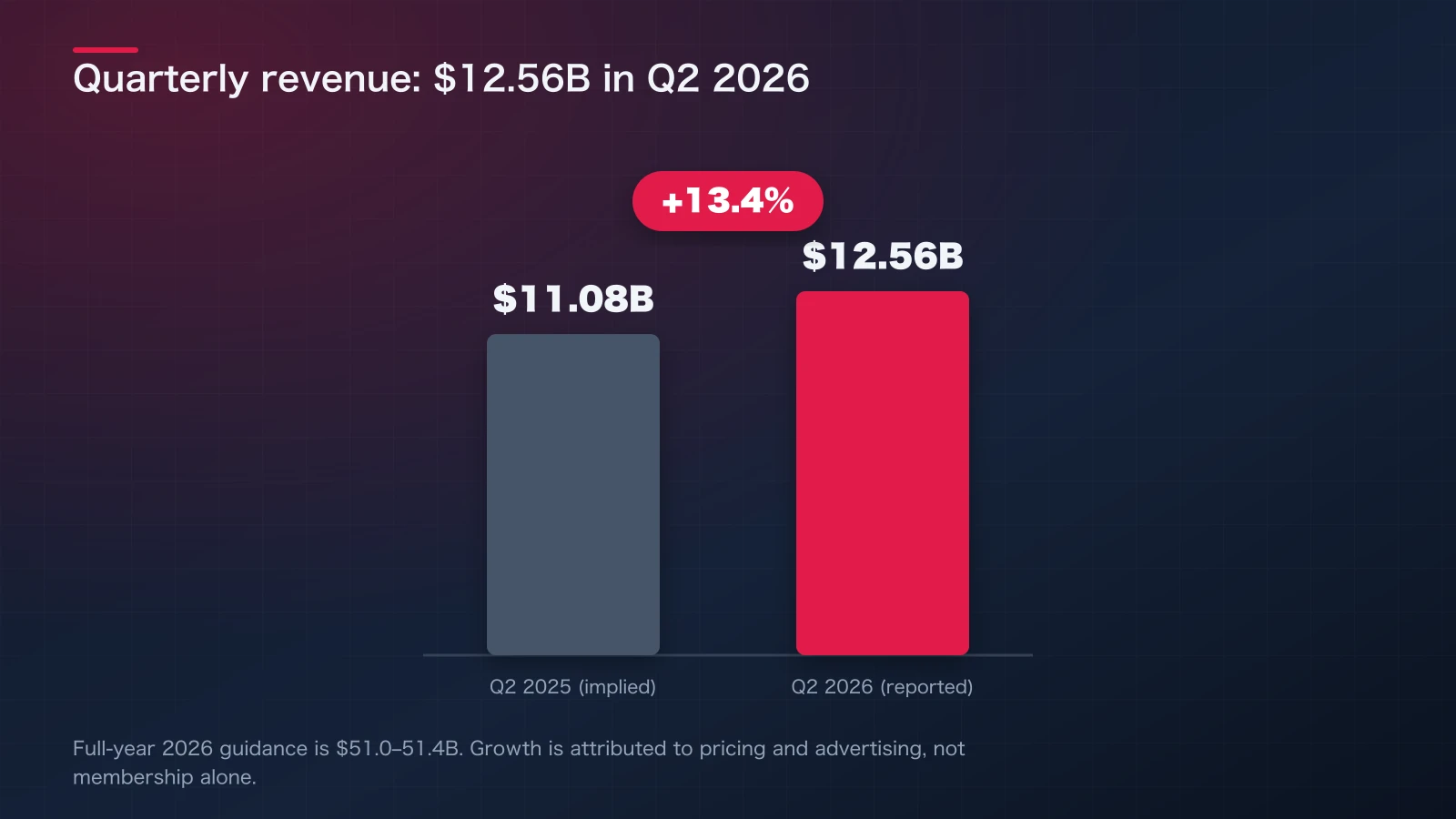
Figure 1: Q2 2026 revenue reached $12.56B, up 13.4% year over year. Revenue metrics, not subscriber counts, are now the central yardstick.
2. How Netflix Defines a Household
Netflix's official Help Center defines a household as follows:
"A Netflix Household is a collection of devices connected to the internet at your primary place of residence where you access Netflix." — Netflix Help Center, "What is a Netflix Household?"[1]
When you sign in from a device on the same network, Netflix automatically establishes your household based on IP address, device IDs, and account activity. For privacy reasons, the company states explicitly that it does not use device GPS data. In other words, you are not being tracked by location — the network environment is the primary signal.
When updating your household, Netflix sends a confirmation email, and the link expires after 15 minutes. That short window discourages abuse while also nudging legitimate users to complete the process promptly rather than putting it off.
3. The Three Layers of the Household Detection Algorithm
Patent filings and community analyses suggest Netflix combines three layers to judge whether devices belong to the same household.
Layer 1: Network Information (IP Address)
- Home broadband is treated as the "center" of the household with a high confidence score.
- Office or public Wi-Fi carries limited penalties because variability is expected.
- Mobile networks change daily and therefore incur no baseline penalty.
- Fixed lines at distant locations are heavily penalized as likely separate households.
Layer 2: Device Classification (Expected Usage Patterns)
Netflix classifies devices by purpose and movement range, applying different thresholds to each category.
| Device Type | Assumed Usage | Strictness |
|---|---|---|
| Smartphones (iOS / Android) | Designed for mobility with constantly changing IPs | Most permissive |
| PCs (browser playback) | Move between home and office | Moderate |
| Fire TV / Apple TV / Smart TV | Expected to stay plugged into a single living room | Most stringent |
This framework explains why smartphones face few hurdles even when used far from home, whereas Fire TV units at a vacation house quickly trigger alerts.
Layer 3: Machine-Learning Models That Score Usage Patterns
Netflix describes a "Household Confidence Score" in several patents (including US Patent 11,594,843). The score likely draws on features such as:
- Consistency of viewing time slots and days of the week
- Alignment of content genres and user preferences
- Frequency and distance of device movement
- Combinations of simultaneous streams and their locations
- Coherence with each account's historical usage
If the score dips below a threshold, Netflix prompts a verification code, and repeated anomalies can escalate to a block.
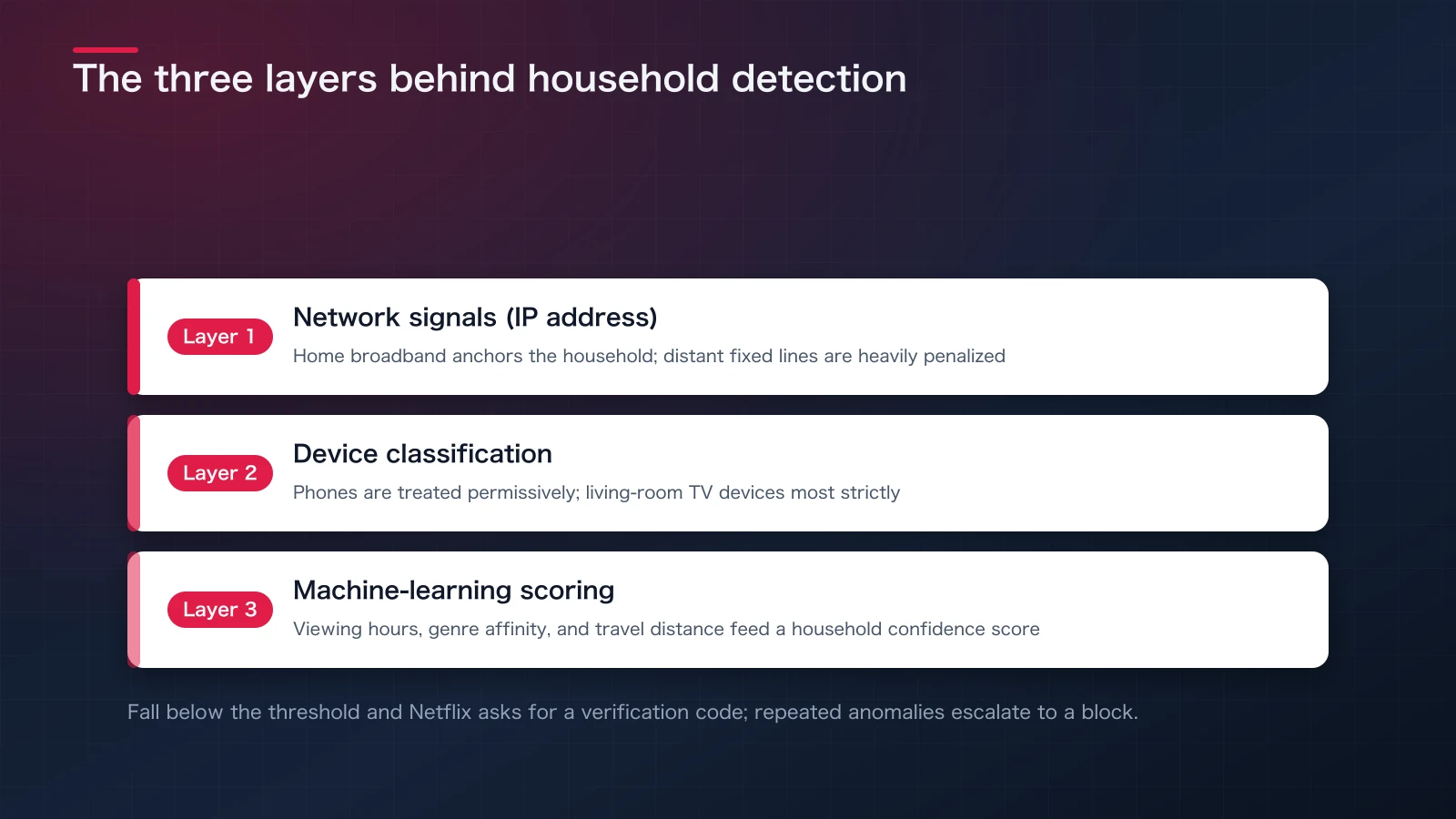
Figure 2: Network signals form the base layer, with device classification and ML scoring layered on top.
4. Case Studies of Typical Behavior
Case 1: Why Smartphones Rarely Get Flagged
Smartphones are treated as personal devices that travel with their owners. Because constant IP changes are expected, they incur little to no penalty. Whether the device connects via home Wi-Fi, mobile data, or the office network, the behavior matches the assumed profile.
Case 2: Why a Second-Home Fire TV Raises Red Flags
Living-room devices such as Fire TV are evaluated under the assumption that they stay in one household. Connecting one to a Wi-Fi network 20 kilometers away and using it only once a month diverges sharply from that expectation, causing the confidence score to plummet.
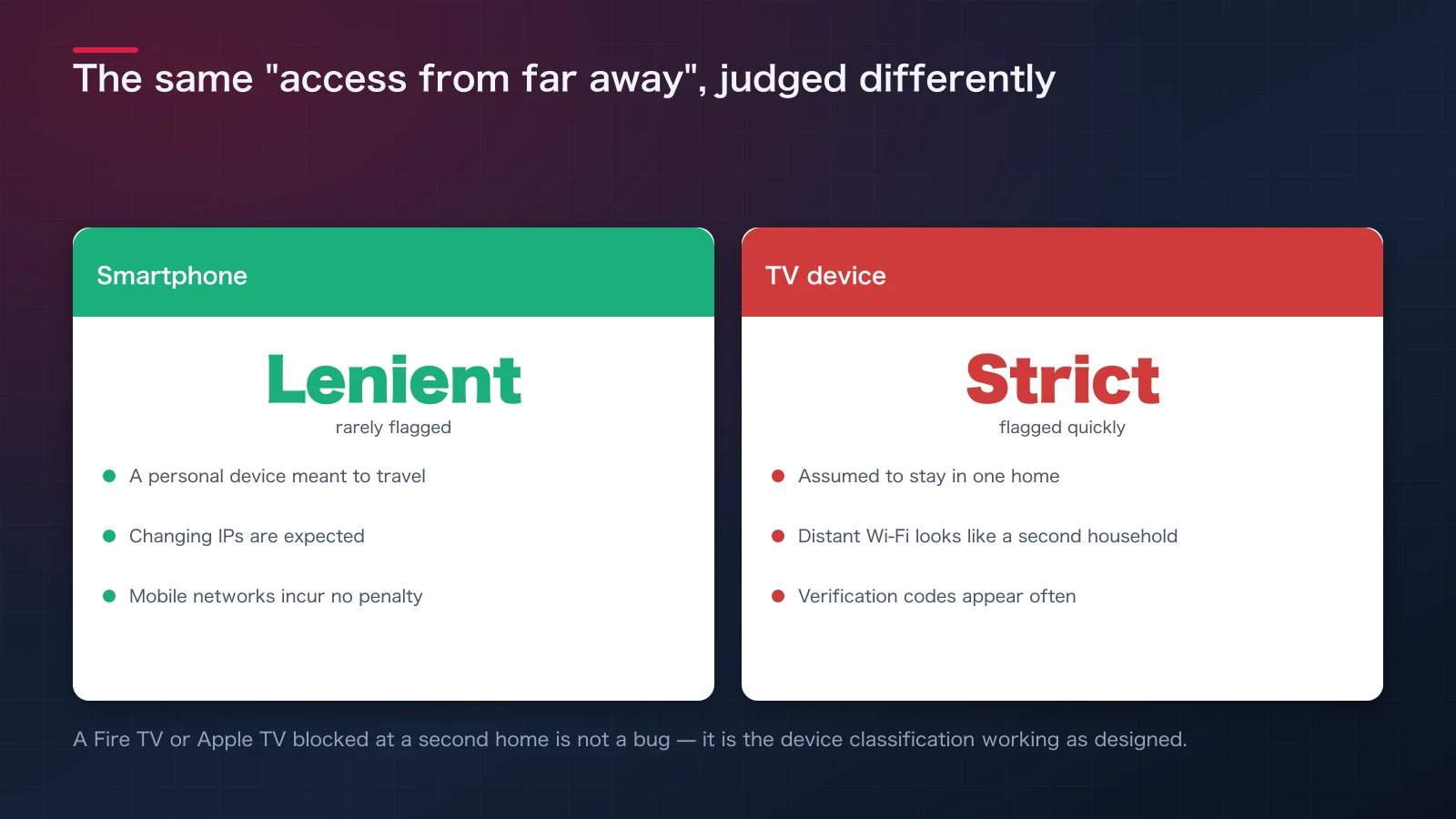
Figure 3: A smartphone that always travels with its owner and a television fixed in a living room are judged by entirely different criteria, even for the same "access from far away."
5. Where Things Stand in 2026: The "Extra Member" as an Official Workaround
While tightening household detection, Netflix has also built a legitimate sharing path for family members who live apart: the Extra Member option.
- In Japan, Standard-tier subscribers and above can invite someone outside the household for an extra ¥790 per month[3].
- An extra member gets their own account, password, and profile, so viewing history and recommendations never mix with the owner's. The account owner pays for the slot and manages adding or removing extra members[3].
- Extra members must be in the same country where the account owner signed up, and cannot be added to ad-supported plans[3].
- Some regions have piloted a "guest member" style feature, but as of mid-2026 it is not available in Japan.
In short, 2026-era Netflix runs a two-tier design: detect and block sharing outside the household for free, but explicitly permit it for a fee. By closing the free loophole while opening a paid one, Netflix monetizes the underlying sharing demand without eroding ARPU (average revenue per member).
| Plan (Japan) | Approx. monthly price | Extra member |
|---|---|---|
| Standard with Ads | ¥890 | Not available |
| Standard | ¥1,590 | ¥790/month per person |
| Premium | ¥2,290 | ¥790/month per person (multiple allowed) |
⚠️ Plan and extra-member prices change over time. Always confirm current pricing on Netflix's official site before subscribing.
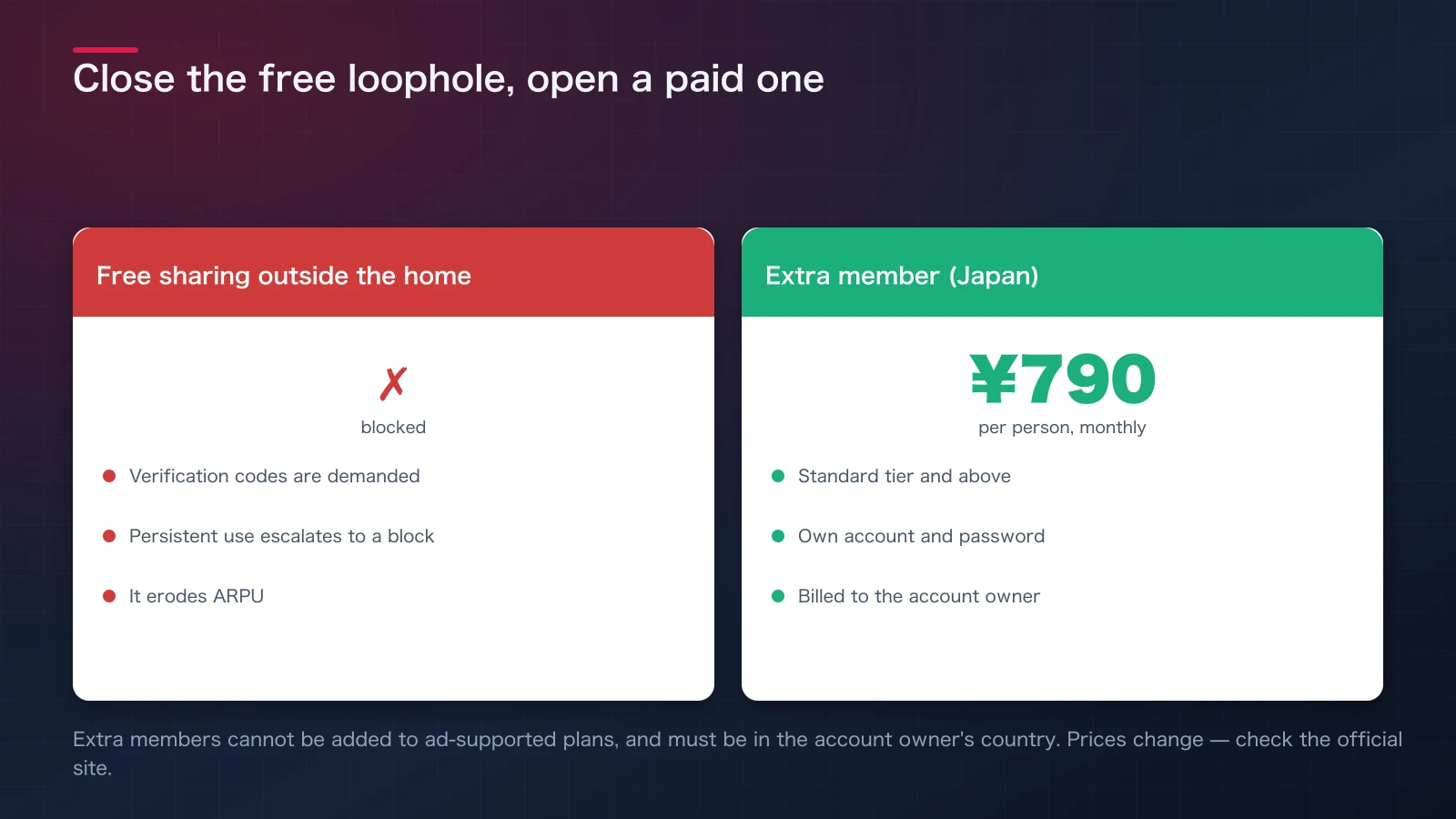
Figure 4: Netflix closes the free loophole while opening a paid one — the extra-member feature protects ARPU.
6. Patent Strategy and the Ripple Effect Across the Industry
Netflix holds multiple patents related to household detection and anti-sharing measures, including US Patent 11,594,843 and US20220238867A1, which describe techniques for inferring households from viewing histories and contextual data. The rationale for patenting includes deterring competitors from replicating the same techniques, protecting machine-learning models and large-scale datasets as intellectual property, and demonstrating tangible assets in corporate valuations.
Major competitors including Disney+ and Max (HBO Max) have followed Netflix's lead in tightening account-sharing policies. It's reasonable to expect other streaming services to adopt a similar two-tier strategy — detection-based enforcement paired with paid legitimization. Understanding Netflix's approach offers a useful lens for reading pricing strategy across the broader subscription industry.
Conclusion: What the Algorithm Reveals About Netflix's Strategy
The household detection stack spans IP signals, device classification, behavioral scoring, and intellectual property management — together forming infrastructure that underpins Netflix's revenue and brand. By 2026, that infrastructure has grown a clear, legitimate revenue line on top of it in the form of extra memberships, reinforcing a shift away from any single subscriber-count metric. Although the mechanisms operate behind the scenes, they illustrate how technology, legal strategy, and business model design can be tightly aligned.
(This article incorporates reasoned interpretations based on public information, technical analysis, and patent documents, and remains consistent with Netflix's officially disclosed specifications.)
References
- [1]Netflix Help Center, What is a Netflix Household?. ↩
- [2]Netflix Help Center, Sharing your Netflix account. ↩
- [3]Netflix Help Center, Extra Members. ↩

NEW NOVEL 2026/08/01
Clouded Glass
Polishing is not about force.
Volume two of The World Became Slightly Farther Away.Five stories that can also be read as a starting point.
View on Amazon
Jijoden.com
Your life is worth writing.
There is a truer self you can tell only to AI.Gather fragments of memory into a single story.
Take a LookRelated Articles
GPT-5.2 Explained: New Features, Performance, and Pricing Guide
A comprehensive guide to GPT-5.2 released by OpenAI on December 11, 2025, covering Instant/Thinking/Pro modes, improvements from GPT-5.1, API pricing, and competitive analysis.
Why AI Struggles with Japanese: Structural Barriers, English-Centric Bias, and the Future of Perfect Translation
Explore why AI struggles with Japanese through two key barriers: linguistic structural complexity and English-centric training data. Learn about the causes of misreading and misrecognition, and predict when perfect Japanese AI will emerge.
Amazon Titan Explained: Strengths and Use Cases (2025 Edition)
A comprehensive guide to Amazon Titan models on Amazon Bedrock, covering overview, competitive comparison, and practical use cases. Explores Titan family's strengths in security and governance features.
The New Coding Frontier: Cursor's Composer and the Era of Agent Speed
Cursor Composer 1 and Cursor 2.0, announced in October 2025, open a new era of AI coding assistance. A deep dive into fast models that preserve developers' "flow state" and multi-agent workflows.
Silver Week Reshapes AI: GPT-6 Astra, Sol and Luna vs Claude Fable, Opus and Sonnet
A six-model comparison of launch strategy, intelligence, API prices, measured task costs, caching and access: GPT-6 Astra, Sol and Luna versus Claude Fable 5.1, Opus 5.5 and Sonnet 5.