
Table of Contents
1. Conclusion: insect aversion is not a shortage of courage; it is a problem of threat prediction and perceived control
A single cicada lies outside the front door. For some people, that is enough to make entering home feel impossible.
It may not sting. It may never fly. Yet the mind rehearses a future in which it suddenly thrashes about, launches toward the face, or disappears into clothing. It is not even clear whether the motionless cicada is alive. In Japanese slang, this uncertainty has produced the jokes “semi-final” and “cicada bomb.”
Other people can pick up a cicada bare-handed. Some can dispatch a cockroach with a rolled newspaper; others leave the room at the first sight of one and cannot return until a friend or relative arrives.
That difference is not simply courage or personality.
Responses to insects combine vigilance toward real harm, pathogen-avoidance disgust, unpredictable movement, childhood experience, parental reactions, urbanization, identification knowledge, gendered roles, and the feeling that the situation can—or cannot—be controlled.
This article reaches three conclusions:
- Disliking insects, being unable to deal with one, and having a clinical phobia are different things.
- Adult aversion is not explained by “growing wiser” or by instinct alone. Gaps in contact and knowledge, intrusion into living space, and vivid predictions of failure can amplify it.
- The goal need not be to love insects. Distance, tools, procedures, and help can let a person act safely while still disliking them.
Insect aversion is not a trivial preference. It reveals how people classify danger and contamination, what conditions enable action, and how housing, products, emergency services, and education might be designed.
2. “I dislike it,” “I cannot handle it,” and “I have a phobia” are not the same statistic
There is no reliable count of everyone in the world who dislikes insects. International surveys do not consistently separate mild dislike, an inability to look, and clinically impairing fear.
In a 2021 commercial survey of 314 Japanese adults living alone, 74.2% said they disliked or did not much like insects. Yet 61.5% said they could deal with a cockroach themselves. Some people therefore act despite dislike. This was a small private online survey, not a national prevalence study.[1]
In psychiatry, a specific phobia involves marked fear of a particular object or situation, a response disproportionate to the actual danger, persistent avoidance, and meaningful disruption to life or work.
A study combining 25 World Mental Health surveys in 22 countries—124,902 respondents—estimated lifetime prevalence for all specific phobias at 7.4% and 12-month prevalence at 5.5%. Lifetime prevalence was 9.8% among women and 4.9% among men. Median age of onset was eight. Among 12-month cases, 18.7% reported severe role impairment, while 23.1% reported receiving any treatment. These figures cover many objects and situations, not insects alone.[2]
| Measure | Population | Result | What it measures |
|---|---|---|---|
| Dislike or relative dislike of insects | 314 Japanese adults living alone; commercial survey | 74.2% | Preference and aversion |
| Able to deal with a cockroach | The same 314 adults | 61.5% | Capacity for action |
| Lifetime prevalence of specific phobia | 124,902 people in 22 countries; academic study | 7.4% | Clinically defined disorder, including non-insect fears |
Conflating these measures inflates or minimizes the issue. A person who dislikes insects but lives normally does not automatically need treatment. Someone who cannot leave home, approach lower floors, sleep through summer, or live alone because of possible insects may benefit from professional help.
3. Four components of the response: danger, disgust, unpredictability, and lack of control
Breaking the response into four parts makes it easier to address.
| Component | The brain’s appraisal | A practical response |
|---|---|---|
| Danger | It may sting, contain venom, or transmit disease | Identify it from a safe distance; do not approach genuinely hazardous species |
| Disgust | It suggests contamination, decay, waste, or pathogens | Use no-touch tools, protective equipment, and a predefined cleaning procedure |
| Unpredictability | It may fly, change direction, or disappear | Limit its movement with a net or container |
| Lack of control | I do not know how to catch it; failure may send it toward me | Pre-plan the steps, maintain distance, and establish whom to call |
Avoiding a venomous or stinging species is rational. Disgust toward cockroaches and flies can be understood partly as a behavioral defense against pathogens. Someone may tolerate a cicada model yet fear the living animal because movement is the decisive variable.
As an explanatory model, one can think of response intensity this way:
response intensity = expected harm + disgust + unpredictability + proximity − perceived control
Fear reduction is therefore not only about manufacturing courage. Increase distance, restrict movement, open the exit in advance, and keep tools accessible. These are control-system changes, not moral tests.
4. Instinct is a readiness to notice—not a fully formed, immutable fear
In a 2017 experiment, six-month-old infants viewed spiders versus flowers and snakes versus fish while researchers measured pupil dilation. Infants showed stronger arousal responses to spiders and snakes. They did not run away or verbally report fear. The result supports an evolved preparedness to attend to potentially ancestral threats, not the claim that humans are born with a complete fear of all insects.[3]
Mistaking a branch for a snake costs seconds; mistaking a snake for a branch can be costly. Where misses are more dangerous than false alarms, a bias toward warning can be adaptive.
Evolution alone, however, cannot explain why a firefly and a cockroach evoke different reactions, why families and regions differ, or why training changes fear. Instinct is not an alarm with permanently fixed volume. Experience and culture help decide what gets classified as dangerous, how loudly the alarm sounds, and what happens after it rings.
5. What a 13,000-person study found about urbanization and the “extinction of experience”
In 2021, Yuya Fukano and Masashi Soga at the University of Tokyo reported a large online survey and experiment involving 13,000 Japanese adults aged 20 to 79. It measured childhood and current residential environments, whether 13 kinds of insects were usually encountered indoors or outdoors, identification knowledge, and disgust.[4]
The findings supported two pathways:
- Urbanization increases the proportion of encounters occurring indoors, and insects commonly seen indoors tend to evoke stronger disgust.
- Urbanization reduces natural-history knowledge, and lower ability to distinguish species broadens disgust across more kinds of insects.
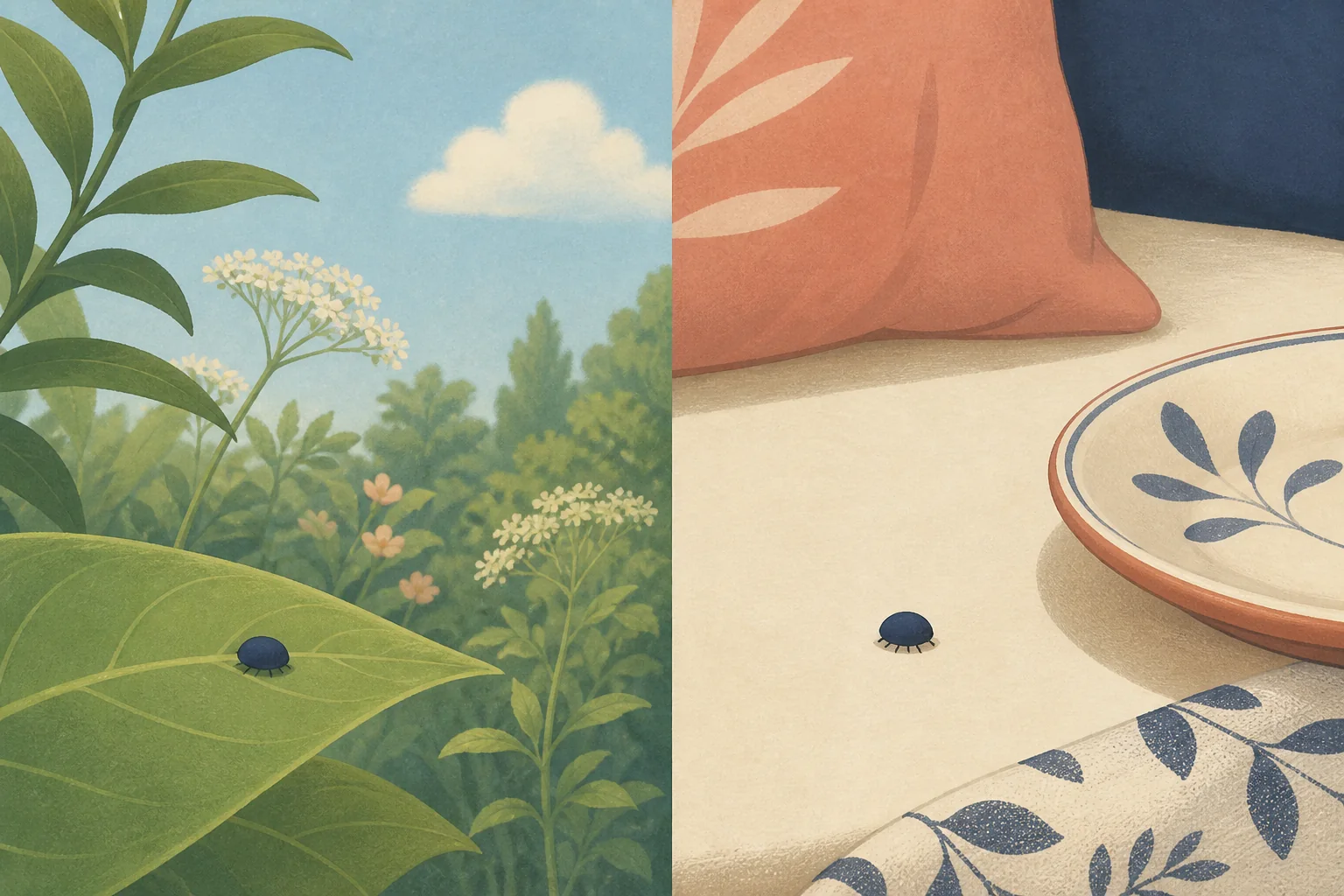
The same shape can feel like part of nature on a leaf and an intrusion beside dishes or bedding. Context changes the appraisal.
Knowledgeable respondents could strongly dislike cockroaches without reacting equally to ladybirds. With less identification knowledge, safe and risky species are harder to distinguish, and “some unknown bug” becomes a large category that merits caution.
The same insect was generally more aversive indoors than outdoors. Rhinoceros beetles were a notable exception, plausibly because keeping them is culturally familiar in Japan. A creature on a leaf belongs to nature; beside a plate, on bedding, or near a kitchen, it crosses into personal territory.
Children may see insects as things to catch, discoveries to show friends, or opportunities for praise. Achievement and social reward can outweigh caution. Later, study, work, clubs, and phones displace outdoor contact. Skills for catching, judging distance, and recovering from mistakes go unused; self-efficacy falls.
Adults also construct elaborate bad futures: it will get inside my clothes, fly at my face, disappear before bedtime, or have laid eggs somewhere. Greater predictive capacity can produce a detailed “story of failure” before anything has happened.
This structure extends beyond insects. Teenagers may debate values with a closest friend until dawn, sometimes ending in a fierce argument. Decades without such dialogue can make the same collision hard to manage at sixty. People who keep doing it retain skills for reading the other person, repairing an overstatement, and finding a stopping point.
Age does not uniformly weaken people. Unused skills become uncertain; practiced skills continue to update. In dialogue, understanding the other person’s words reduces uncertainty. With insects, recognizing the species and its movement does something similar: it replaces an undifferentiated threat with a more specific problem.
6. Children can learn fear from adults—and can learn calm behavior too
Direct injury is not required for fear learning. Children watch what adults approach and what they flee.
Studies with children aged seven to ten found that seeing adults show fear or disgust toward unfamiliar animals increased fear beliefs and avoidance. A 2015 experiment further suggested that positive modeling and prior familiarization before observational fear learning can inhibit some of the acquired fear.[5][6]
If a parent screams at every insect and pulls the child away, the behavioral message is “extreme danger.” If an adult keeps a safe distance and calmly says, “That is a ladybird; we can observe without touching,” the object is modeled as manageable.
A 2022 questionnaire of 109 visitors to a Japanese natural-history museum found associations between experiences such as collecting or rearing insects and more positive attitudes. But 66.7% of these museum visitors already said they liked or somewhat liked insects. The sample cannot represent Japan as a whole. Good statistical reading asks not only how many people answered, but who they were.[7]
7. Do not reduce gender differences to a story about hunting instinct
In the commercial survey of 314 adults living alone, 81.5% of men and 51.0% of women said they could deal with a cockroach. In the cross-national WHO study, lifetime prevalence for specific phobia overall was 9.8% among women and 4.9% among men.
That is not enough to conclude that ancestral male hunting makes modern men inherently good at insect control. At least four explanations must remain in view:
- possible average differences in anxiety or disgust sensitivity;
- differences in childhood exposure, including boys being invited to collect insects and girls being permitted to avoid them;
- differences in willingness to report fear;
- role assignment at home, which concentrates repeated successful practice in one person.
A person repeatedly assigned the task learns movement patterns and tool use and may develop the belief, “I hate this, but I can handle it.” A person who always leaves the room accumulates no comparable evidence, so the next encounter remains unknown.
Averages do not determine individual competence. There are women who are entomologists and pest-control experts, and men with intense fear of spiders or cicadas. Treating sex as destiny obscures biological, social-learning, role, and reporting effects—and produces bad solutions.
8. Replace “Africans are good with insects” with questions about knowledge and culture
The UN Food and Agriculture Organization says insects supplement the traditional diets of approximately two billion people and that more than 1,900 edible species have been recorded. Entomophagy exists not only in Africa but also across Asia and Latin America.[8]
A 2018 Zimbabwean study surveyed 200 urban and 175 rural adults. Insect consumption was reported by 80.0% of urban respondents and 89.7% of rural respondents. More than three servings per week were reported by 14.5% in urban areas and 63.9% in rural areas, a major difference linked to availability and living conditions.[9]
Eating selected insects does not imply loving every insect. Communities distinguish edible species from venomous species, crop pests, and disease vectors. Mosquitoes that carry malaria are rationally feared.
Africa comprises 54 countries with different cities and villages, climates, religions, cuisines, incomes, and education systems. National character is a poor explanation. The more precise questions are whether knowledge for distinguishing species and safe handling is shared in everyday life.
9. Higher floors reduce risk, but “none will ever appear” is not a credible guarantee
A 2013 commercial survey of 563 adults aged 20 to 69 in the greater Tokyo region asked about encounters over the preceding year. Average cockroach encounters were 4.89 in detached houses and 3.08 in apartment buildings. Within apartments, averages were 3.39 on floors 1–2, 3.61 on floors 3–5, 1.28 on floors 6–10, and 0.07 on floor 11 or above. This was an old self-reported survey and cannot be generalized to every current property, but the decline with height was pronounced.[10]
| Housing category | Mean annual encounters | Limitation |
|---|---|---|
| Detached house | 4.89 | Average across varying building conditions |
| Apartment, floors 1–2 | 3.39 | Close to ground, vegetation, and shared areas |
| Apartment, floors 6–10 | 1.28 | External entry falls but does not reach zero |
| Apartment, floor 11+ | 0.07 | Self-report from 2013; does not prevent transported insects or internal breeding |
Food boxes, deliveries, drains, common areas, and moving luggage can transport insects. Species suited to breeding inside a building are not stopped by elevation alone.
Instead of promising zero insects, a housing service could publish a pest-entry risk score based on building age, nearby restaurants, waste storage, plumbing, gaps, common-area cleaning, incident history, and inspections. The credible guarantee is prevention plus fast, transparent response—not metaphysical certainty that no insect can appear.
10. An emergency callout for one cockroach may be a market—but fear must not be the product
A high rate of dislike does not automatically create paying customers. People worry about unknown prices, letting a stranger into the home, spending tens of thousands of yen for one insect, or waiting for arrival.
Fear also makes abusive sales easier. Japan’s National Consumer Affairs Center said consultations about pest and animal control services rose to roughly 1.5 times the previous year’s level in fiscal 2023. In a case publicized in 2025, a customer who saw an online claim of “from about ¥1,000” was billed roughly ¥500,000 after the work.[11]
The first ethical rule for an insect-anxiety business is not to exploit panic. One possible model would charge ¥500 per month and ¥1,000 per callout, promise a visit within 60 minutes in a defined area, and include capture, outdoor removal, and a simple entry-point check. Any extra work would require photographic evidence, a fixed price list, and explicit approval.
With 10,000 members, subscription revenue would be ¥5 million per month and ¥60 million per year. If annual callout frequency were 5% and variable cost ¥8,000 per call, 500 visits would cost ¥4 million. These figures are a thought experiment, not proof of demand or profit. They exclude marketing, standby staff, night work, geographic density, repeat visits, insurance, software, and adverse selection by high-risk properties.
Potential customers include people living alone, families with children, older adults, remote workers, and anyone alone at night. Hotels, dormitories, and property managers could buy institutional plans. Prevention-certified housing, periodic tool delivery, emergency callouts, and online lessons could form an “anxiety-reducing home service,” rather than merely extermination.
11. Tools do not erase fear; they increase controllable conditions
At Pocholab, a telescoping insect net extending to roughly 1.5 meters is used for cicadas near the entrance. Close contact may still be frightening, but distance plus a downward net can make action possible. Long-handled catchers may work for small insects, though smooth-bodied species can slip free.
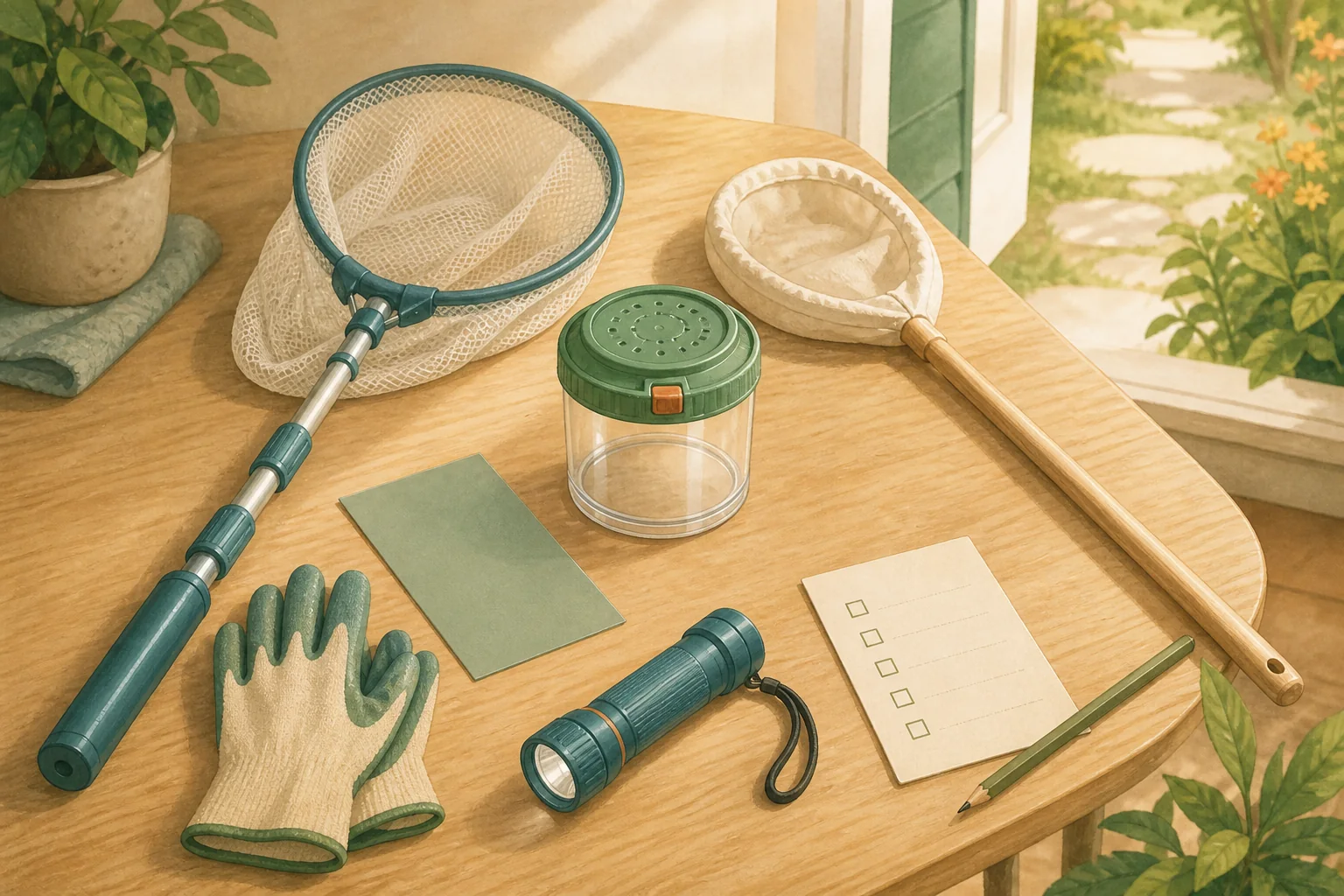
Competence does not mean touching an insect. It means creating distance, limiting movement, preparing an exit, and removing it safely.
A practical sequence is:
- If the species is unknown or may sting or contain venom, do not approach; contact a local authority or professional.
- Establish a retreat location and the outdoor exit first.
- Choose a long net, clear container and stiff card, or another tool that creates distance.
- Restrict the insect’s movement before attempting transport.
- If the attempt fails, do not chase impulsively; step away and switch methods.
Strong aversion does not necessarily predict heavy pesticide use. A 2022 study interviewed 70 participants and used a computerized aversion measure, but did not find the hypothesized clear relationship between insect aversion and household pesticide use. Someone intensely afraid may be unable to approach even to retrieve a spray; someone relatively calm may use pesticides for sanitation or agriculture. Purchasing depends on alternatives: available family help, living alone, chemical preferences, waiting time, and price.[12]
12. An “insect aversion center” should teach action, not affection
Cognitive behavioral therapy and graded exposure are used for specific phobias. Exposure is not surprising or forcing someone toward an insect. With consent, it creates tolerable steps in which a person learns that the predicted catastrophe is not inevitable and that they can cope.
The NHS public guide suggests ranking feared tasks from 0 to 100 and beginning with lower-intensity items. Avoidance brings short-term relief but can maintain fear in the long term.[13]
A 2022 meta-analysis compared 55 single-session and 30 multi-session exposure studies involving 1,758 clinical participants. It found no significant difference in pooled effects at post-treatment or follow-up, while single-session treatment required less total treatment time.[14]
A large UK trial of children aged seven to sixteen likewise found one-session treatment non-inferior to multi-session CBT on its primary outcome at six months, with somewhat lower cost. This does not mean a single session suits everyone.[15]

The learner chooses the steps, is never surprised, and may stop. Bare-handed contact does not have to be the goal.
A non-clinical life-skills course might proceed as follows:
- Use friendly drawings to teach genuinely hazardous versus harmless species and actions to avoid.
- Watch a calm short animation while identifying distance and exit routes.
- Practice with models, a clear container and card, and a telescoping net.
- Rehearse retreat, preparation, containment, and removal when a model appears in a room.
- Only participants who choose to do so observe a low-risk living specimen through a clear case under expert supervision.
At ¥4,000 for 90 minutes, eight students, three sessions per day, and 20 days per month, full attendance would produce ¥1.92 million in monthly sales before instructors, premises, insurance, and marketing. Partnerships among pest-control firms, insect museums, mental-health professionals, and property managers are more plausible than a standalone center.
Clinical treatment and a general life-skills class must remain separate. The class must not claim to provide medicine, and people with panic, trauma, or severe impairment need a route to qualified care.
13. Fish, debate, and driving: different objects can share the same structure of difficulty
Some people who tolerate insects cannot hold a living fish. Fish have no multitude of legs, but they are slippery, jump without warning, can cut with fins or hooks, and move their eyes and mouths. Disgust, unpredictability, touch, predicted injury, and lack of control recombine.
Fear of snakes, frogs, mice, birds, or dogs can be decomposed in the same way: What is genuinely dangerous? What is disgusting? Which movement cannot be predicted? What distance is tolerable? Which tool increases control?
Public speaking, a values conflict with a close friend, or returning to driving after years away are not identical, but their learning structure rhymes. Long avoidance prevents the prediction model from updating while imagined failures grow. A small restart, better reading of the situation, available help, and procedural updates based on both success and failure can expand the range of “I do not enjoy this, but I can manage it.”
This is not a recommendation for unsupervised exposure to everything. Real danger, severe panic, trauma, and disabling fear warrant professional support.
14. Final lesson: do not force fear to zero; keep it from stopping life
Insect aversion does not mean an immature brain. Systems built to anticipate danger, avoid pathogens, and defend living space can become broad and sensitive in urban environments, especially when contact and identification knowledge fade.
There is no need to pick up a cockroach bare-handed or find a hornet adorable.
If a person whose fear is 100 can reduce it to 40 with tools and a procedure—and perform the necessary action—that can change housing choices, confidence in living alone, summer mobility, and household roles.
Buy a long net. Keep a clear container and card. Research reputable service prices before an emergency. Learn which species you must not handle. Decide in advance when to ask for help.
Fighting bare-handed is not the only form of courage.
Design a safe distance. Create a procedure that survives failure. Call for assistance when appropriate. You can continue to dislike insects and still regain control of your life.
That is a more useful modern way to live with them.
References
- [1]2021 commercial survey of 314 Japanese adults living alone ↩
- [2]The cross-national epidemiology of specific phobia in the World Mental Health Surveys ↩
- [3]Itsy Bitsy Spider…: Infants React with Increased Arousal to Spiders and Snakes ↩
- [4]University of Tokyo: Why do so many modern people hate insects? The urbanization–disgust hypothesis ↩
- [5]The Effect of Disgust and Fear Modeling on Children’s Disgust and Fear for Animals ↩
- [6]Inhibition of Vicariously Learned Fear in Children Using Positive Modeling and Prior Exposure ↩
- [7]Likes and dislikes for insects of museum visitors ↩
- [8]FAO: Insects for food and feed — Overview ↩
- [9]Consumption patterns of edible insects in rural and urban areas of Zimbabwe ↩
- [10]2013 survey of insect encounters in Japanese housing ↩
- [11]National Consumer Affairs Center of Japan: beware low advertised pest-control prices ↩
- [12]Does Insect Aversion Lead to Increased Household Pesticide Use? ↩
- [13]NHS: Facing your fears ↩
- [14]The relative efficacy and efficiency of single- and multi-session exposure therapies for specific phobia ↩
- [15]One session treatment is equivalent to multi-session CBT in children with specific phobias ↩

NEW NOVEL 2026/08/01
Clouded Glass
Polishing is not about force.
Volume two of The World Became Slightly Farther Away.Five stories that can also be read as a starting point.
View on Amazon
Jijoden.com
Your life is worth writing.
There is a truer self you can tell only to AI.Gather fragments of memory into a single story.
Take a LookRelated Articles
The Psychology of Boasting and Lies in Japanese Izakaya
Explore the psychological background of boasting commonly heard at drinking parties. Learn why people tell lies and exaggerations, their impact on listeners, and the differences from genuine successful people, backed by research data.
Using Friends Cheaply May Lead to Being Used Cheaply Yourself
Exploring the hidden costs of asking friends for free work, based on psychological and sociological research. Understanding the importance of boundaries between friendship and business.
Decision Delay vs. Decisiveness: A Psychological, Cultural, and Practical Analysis
Analyzing the differences between decision delayers and decisive individuals through psychology, behavioral economics, and Japanese cultural context, with practical improvement strategies.
For Everyone Restless at Year’s End: A Science-and-Philosophy Guide to a Calmer New Year Mindset
Uses research on fresh-start effects, memory, and philosophical perspectives to unwind year-end anxiety and offer five gentle steps for shaping a sustainable New Year mindset and habits.
Why Do Sports Excite Us? An Evolutionary, Psychological, and Social Lens
From hunter–gatherer roots to group identity and dopamine reward systems, this article unpacks why sports thrill us, with pointers to recent research.