
Table of Contents
1. Conclusion: You Do Not Need to Buy Your Lifetime Maximum House
Own or rent? There is probably no universal winner.
Renting offers powerful flexibility to people who move frequently, face volatile income, or do not expect to remain in one region. For people with a settled community and a desire to stay, ownership can provide control over the home and the psychological security of having a place to live later in life.
The problem is the attempt to decide today how many rooms the family will need at its thirty-year maximum.
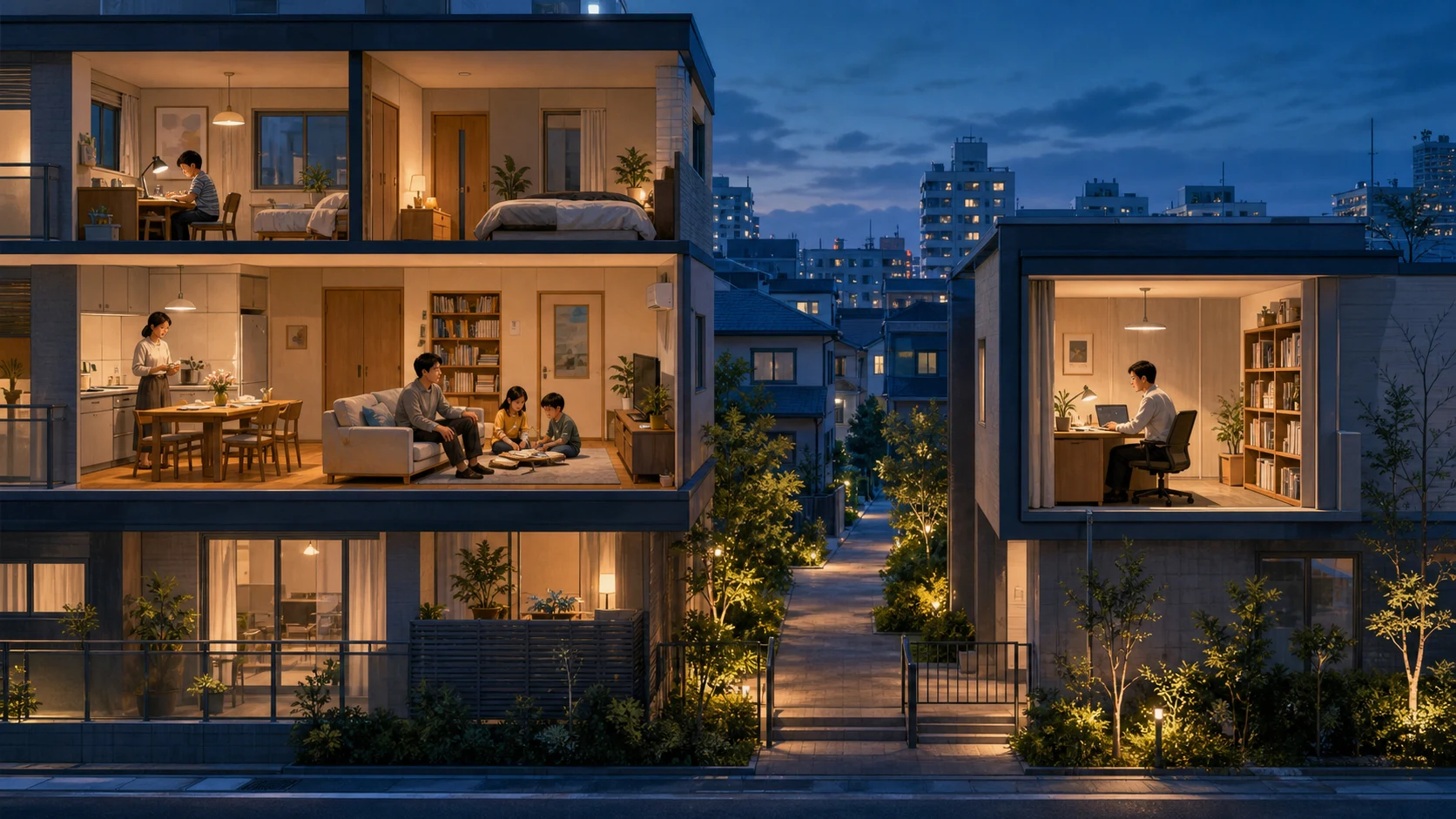
Consider two parents and two children in a three-bedroom Japanese condominium. Once each child uses a room, the third becomes the parents' bedroom, leaving only the living-dining-kitchen area. Full-time remote work then has nowhere quiet to go. Buying a four-bedroom home appears to solve the problem, yet the added room may lose its primary purpose after the children leave.
There is a third option: keep the three-bedroom owned home, then rent a small studio two to five minutes away only during the years when room demand peaks. Use it for work, study, or a little family distance, and return it when it is no longer needed. This is “homeownership plus renting”—an urban version of a detached annex.
It is not the optimum for everyone. But when the shortage is a five-to-ten-year problem, it deserves comparison before a household restructures an asset worth tens of millions of yen.
2. The Debate Never Ends Because Each Side Buys a Different Kind of Value
This is not a new argument. Japanese housing sites still publish “rent versus buy” features, and in 2024 KADOKAWA released a family comic essay whose title translates directly as Rent or Own? Housing-cost books and guides continued appearing in 2025 and 2026.[1][2][3]
How many such books are in bookstores? The responsible research answer is that there is no stable, authoritative count. National Diet Library and retail searches mix print and electronic formats, revised editions, magazines, general housing books without “own” or “rent” in the title, and books that devote only one chapter to the subject. The total changes with the date and search rules. A raw hit count would be less accurate than saying what the evidence does support: this is a recurring publishing category, not a one-season trend.[4]
The argument persists not because one side cannot do arithmetic, but because the two sides value different things.
| Dimension | Where ownership is strong | Where renting is strong |
|---|---|---|
| Stability | Makes it easier to keep a long-term home | Avoids direct exposure to the sale value of a home |
| Flexibility | Gives more control over alterations and use | Makes location, size, and monthly cost easier to change |
| Money | May leave a housing asset after repayment | Avoids a large down payment and property sale |
| Risk | Interest, repairs, tax, disaster, resale price | Rent increases, renewals, screening, later-life access |
Japan's 2023 homeownership rate was 60.9%, but it was 44.7% in Tokyo, 54.5% in Osaka, 65.1% in Saitama, 64.7% in Chiba, and 58.7% in Kanagawa. Housing prices, rental stock, commuting, and attachment to place differ too much for one national answer.[5]
“Own plus rent” can either double the disadvantages or combine the strengths. The dividing line is whether the rented room has a defined purpose and a defined exit.
3. The Three-Bedroom Home Is Not Necessarily Too Small; Demand Temporarily Peaks
Japan's 2024 Comprehensive Survey of Living Conditions counted 9.074 million households with children and 1.68 children per such household. Their mean annual income was ¥8.205 million and the median was ¥7.12 million. A model covering household income from roughly ¥4 million to ¥10 million and one or two children is therefore not detached from the reality of Japanese families.[6]
A baby does not normally require a private room with an independent work desk. The age at which a child strongly needs a room varies. Primary school through high school is about twelve years; living at home through university can add four. Sibling age gaps, temperament, entrance exams, university, and moving out determine how much those years overlap.
Nor is a three-bedroom home automatically wasteful after the children leave. The couple may each want a room plus the shared living area. Another room can store belongings, support a hobby, or receive returning children. Possessions can increase with age. It is too simplistic to claim that every older couple needs only a one-bedroom home.
Still, for some families, the fourth bedroom is indispensable only while children's private-room needs overlap with working from home.
Japan's Ministry of Land, Infrastructure, Transport and Tourism found in fiscal 2025 that 25.2% of employed workers had experienced telework and 16.8% had used it during the previous year. Remote work did not disappear after the pandemic, but it is not an everyday arrangement for everyone. A return-to-office policy can quickly reduce the need for a dedicated home office.[7]
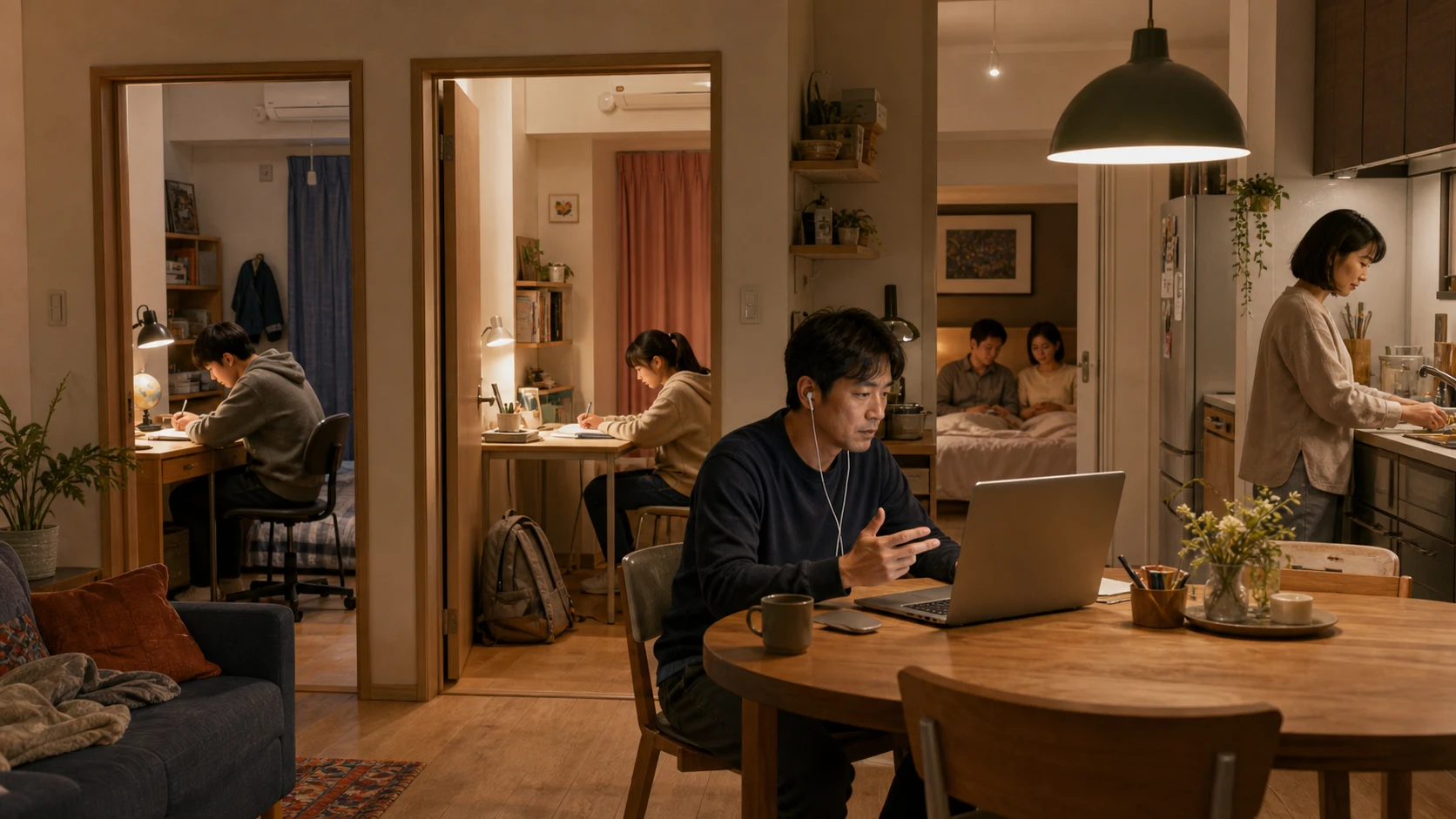
The three-bedroom purchase was not necessarily a mistake. The shortage appears when two children's rooms, the parents' bedroom, and confidential remote meetings all overlap.
Buying a four-bedroom home converts peak demand into permanent infrastructure. Renting one nearby adds capacity only for the peak. In computing terms, it resembles the choice between owning enough server capacity for the busiest few weeks forever and adding resources only while the load exists.
4. A Nearby Studio Can Be Worth More Than One Internal Bedroom
Moving from three to four bedrooms adds one room. Renting a studio nearby can add a separate entrance, toilet, and sometimes a bath and kitchenette. Functionally, that is a much larger change.
For work, it separates meeting audio, confidential information, and early or late hours from domestic space. For the family, it can become a study room, somewhere to calm down, or a place for a parent and child to talk one-on-one. During adolescence, having a few minutes of distance can protect a relationship better than keeping everyone inside one box all day.
Traditional stories often use a detached annex as a place that belongs to the home without sharing all of its air. Urban families may not have a garden in which to build one, but a nearby rental can provide a similar function.
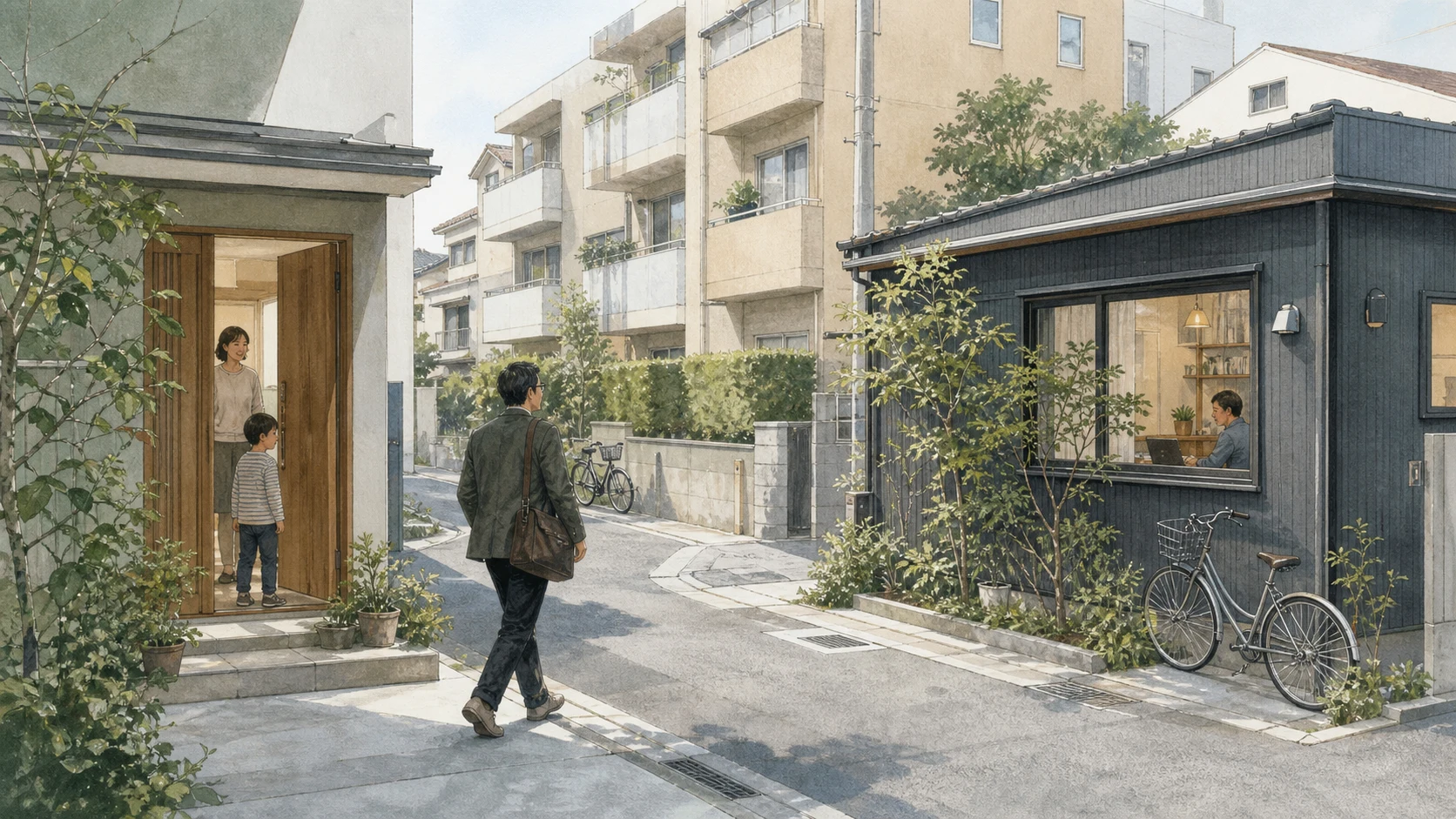
This is not distant dual-location living. Meals and ordinary nights stay with the family; a two-minute walk changes the environment when quiet separation is needed.
The value falls as distance increases. At twenty minutes by train or car, every meal and minor household task creates travel overhead. Five minutes on foot is a useful ceiling; two or three is ideal. Use map-bounded property search, identify a few suitable buildings, and wait for a vacancy. Because the main home is not being replaced, the family can afford to wait six months for the right unit.
5. A ¥70,000 Room Can Cost About ¥10 Million Over Ten Years—If the Assumptions Are Visible
“¥70,000 a month is ¥840,000 a year and ¥8.4 million over ten years” is correct, but incomplete. Brokerage, key money, guarantee charges, fire insurance, lock changes, renewal fees, electricity, and connectivity may also apply.
For residential leases, MLIT says the total brokerage fee received from landlord and tenant is normally capped at 1.1 months of rent. Renewal fees, guarantee charges, deposits, and key money are not nationally uniform, so the contract matters.[8][9]
The following is a comparison model, not a claim about the market average. It assumes key money of one month, brokerage of 1.1 months, an initial guarantee charge of half a month, ¥20,000 each for a lock change and initial fire insurance, a one-month renewal fee four times at two-year intervals, a ¥10,000 annual guarantee renewal, and ¥20,000 fire insurance every two years. A one-month deposit is treated as tied-up cash and excluded from total cost; moving, furniture, restoration, and any unreturned deposit are also excluded.
| Monthly rent and management | Ten-year rent | Initial and renewal costs | Contract cost | With ¥12,000 monthly utilities/connectivity |
|---|---|---|---|---|
| ¥50,000 | ¥6.00m | about ¥0.55m | about ¥6.55m | about ¥7.99m |
| ¥70,000 | ¥8.40m | about ¥0.67m | about ¥9.07m | about ¥10.51m |
| ¥90,000 | ¥10.80m | about ¥0.79m | about ¥11.59m | about ¥13.03m |
At ¥70,000 for ten years, approximately ¥10.5 million including the additional infrastructure is plausible. The flexibility is the important part: if the need ends after five years, much of the long-run cost disappears. A return to the office, a child moving out, or a family change can trigger an exit.
Replacing the owned home has costs beyond the price difference. For transactions above ¥4 million, MLIT presents the brokerage ceiling as sale price × 3% + ¥60,000, plus consumption tax. Selling a ¥50 million home and buying a ¥60 million home through agents produces maximum brokerage of about ¥1.716 million and ¥2.046 million respectively—about ¥3.762 million in brokerage alone. Registration, financing, stamp duties, property acquisition tax, moving, and possibly capital-gains tax come in addition.[10][11]
That does not prove renting is always cheaper. The larger home may preserve additional resale value, and a high local rent can reverse the comparison. The correct formulas are:
Nearby-annex total = rent + move-in and renewal charges + added infrastructure + furniture and exit costs
Incremental replacement cost = new-home price difference + sale and purchase costs + added interest and running costs − future resale-value difference
Compare those over the same usage period, not as two advertised monthly payments.
6. Where Can It Work? ¥70,000 Is Not a National Constant
At Home's March 2026 data covered Tokyo's 23 wards, outer Tokyo, Kanagawa, Saitama, Chiba, Sapporo, Sendai, Nagoya, Kyoto, Osaka, Kobe, Hiroshima, and Fukuoka. Apartment and rental-flat asking rents in every size band across all thirteen areas were higher than a year earlier. Single-oriented condominium rents reached post-2015 highs for twenty-two consecutive months in Tokyo's 23 wards and twenty months in Osaka.[12]
It is therefore unsafe to say that ¥70,000 buys a good bath-and-toilet-separated unit everywhere. That budget may struggle near stations in central Tokyo while producing more candidates in outer Tokyo, suburban Saitama, Chiba, or Kanagawa, outside central Osaka, or in residential districts around regional ordinance-designated cities. Even within one city, station, age, floor area, and equipment create large differences.
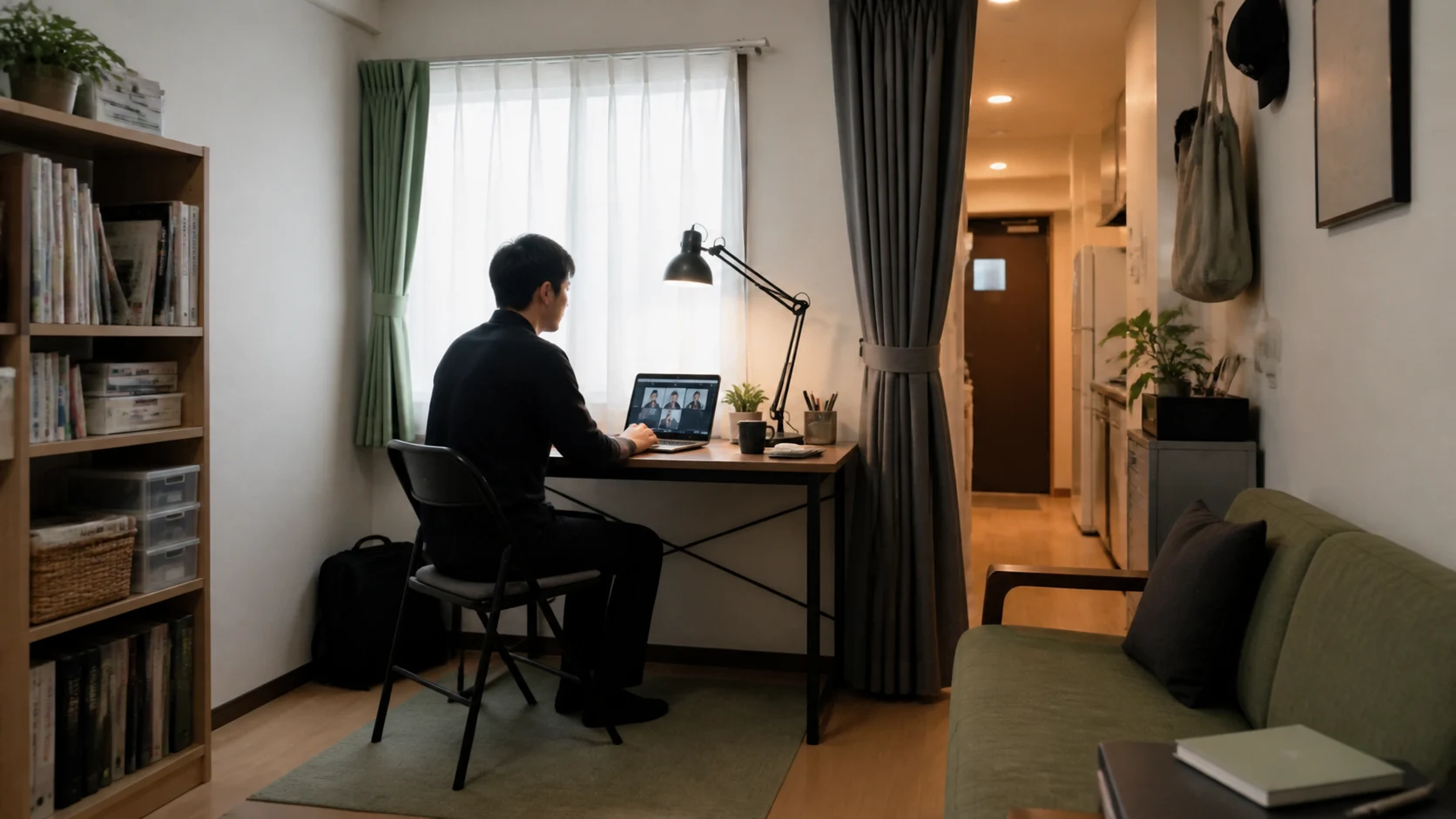
The target is not a luxurious second home. It is a small room with a meeting-capable desk, reliable connectivity, temperature control, a toilet, and perhaps somewhere to rest.
Screen candidate units in this order:
- Walk from the home entrance and confirm the route remains under five minutes in rain.
- List management, renewal, guarantee, insurance, and early-termination charges, not rent alone.
- Check whether calls at the expected hours will create noise problems.
- Confirm whether a fixed connection can be installed or mobile service is sufficient.
- Decide whether the room will shift to study or family use when remote work ends, or be returned immediately.
Do not lock in a ten-year story at signing. Calculate three, five, and ten years, then ask annually whether the room still creates more useful time and better relationships than its total cost.
7. Vague Contract and Family Rules Leave Only a Second Monthly Bill
Do not hide the use from the agent or landlord. Some residential leases allow working from home, while many prohibit customer visits, signs, corporate registration, or exclusive office use. Quiet solo work differs from operating premises that employees or clients visit. Describe the actual use—such as a secondary dwelling where an employee works online, or a location proposed for sole-proprietor registration—and obtain written confirmation.
Check the fire insurance, employer telework policy, and information-security requirements. If the family can enter, define key and device control and a rule for confidential meetings. Conversely, if one parent controls the room and uses it only to escape family life, it is no longer a family solution.
Agree on four things before signing:
- Purpose: work, examinations, rest, conversation, or a defined combination
- Priority: who can use it and during which hours
- Budget ceiling: an annual all-in number, not just monthly rent
- Exit trigger: three office days a week, a child moving out, or fewer than twenty hours of monthly use
MLIT's restoration guidance does not define restoration as returning an apartment to its original brand-new state. Its general approach places ordinary wear with the landlord and damage caused by tenant negligence or use beyond the ordinary with the tenant, though special contract clauses still matter. Fixed acoustic panels and furniture damage should not be treated casually.[13]
Finally, ¥70,000 a month can be a heavy burden for a ¥4 million-income household. The survey's mean disposable income for households with children was ¥6.215 million, but an average does not describe an individual budget. Education, the existing mortgage, condominium management and repair reserves, and emergency savings come first.[6]
8. Conclusion: Own the Right-Sized Core and Rent the Temporary Peak
If ownership buys stability and renting buys variability, using both is not contradictory.
The family does not rent nearby because buying three bedrooms was a mistake. It responds in small units to changing demand—baby years, school, examinations, remote work, office returns, and children leaving—without selling the entire home.
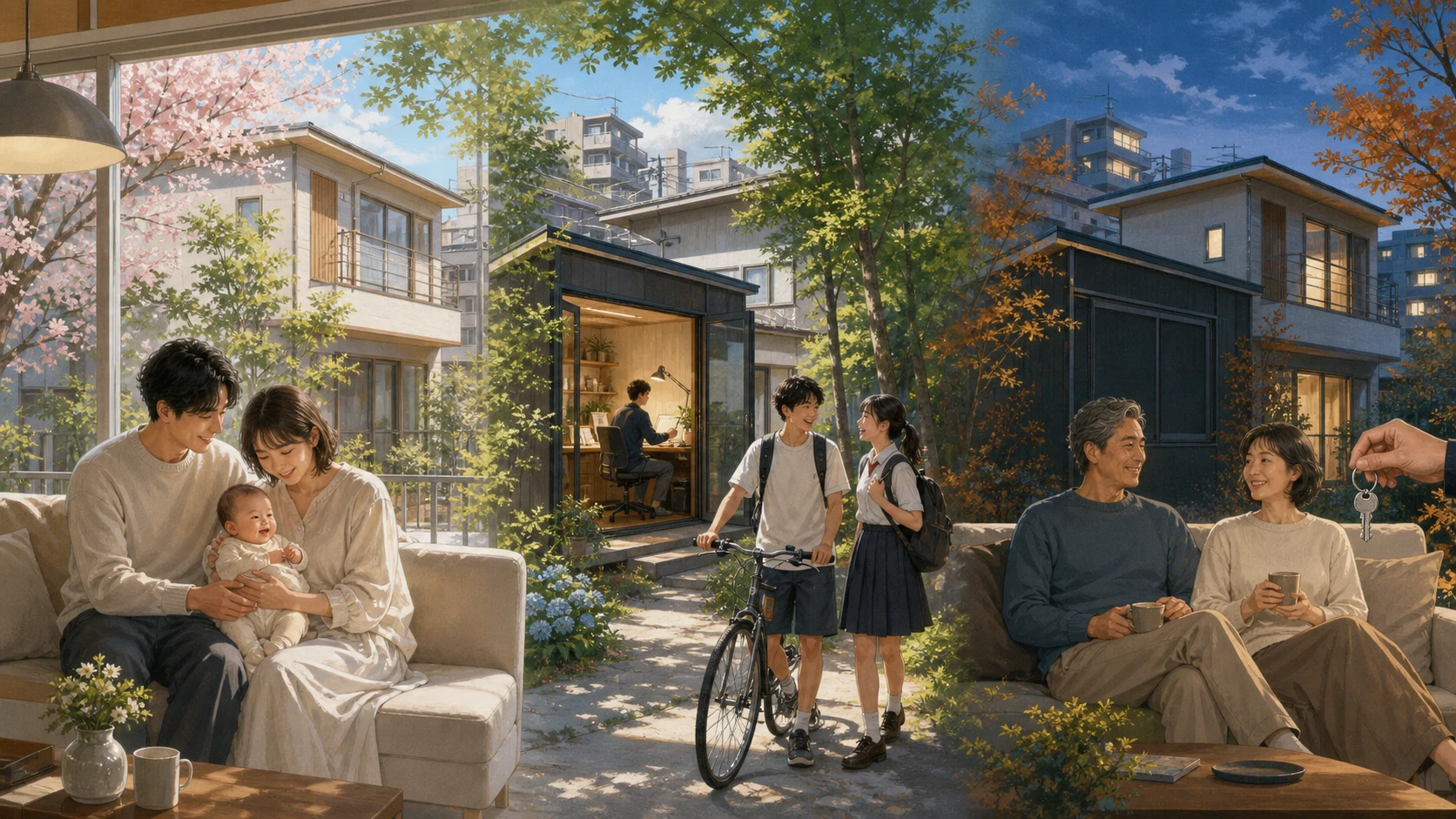
A family's space requirement does not rise forever in a straight line. Temporary capacity can be returned when its work is done, so the permanent home need not be sized for one maximum moment.
This strategy best fits a family likely to remain in the same community, broadly satisfied with its current owned home, able to identify why and for how long it lacks space, and surrounded by affordable small rentals. It fits poorly where transfers are frequent, cash flow is tight, nearby rents are too high, or the family wants to change the home or neighborhood anyway.
Before arranging viewings for a larger purchase, draw a 200-to-500-meter boundary around the current home and search for studios. Calculate three, five, and ten years. Then place those totals next to the larger home's price difference and the two property transactions.
The useful question is no longer “own or rent?” It is: which part of our housing should remain stable, and which part should remain changeable? Once framed that way, the missing fourth bedroom may not require a major move. It may already exist in a small room around the corner.
Disclaimer: This article provides general information and illustrative models for considering housing choices. It does not recommend a particular purchase, sale, or lease. Taxes, loans, contracts, insurance, use restrictions, and rents differ by area, property, time, and household. Consult the relevant agent, lender, tax professional, or other adviser before acting.
References
- [1]KADOKAWA, Chintai ka Mochiie ka?, published February 2024. ↩
- [2]SUUMO, “Rent Versus Buy”, discussing fifty-year cost assumptions, flexibility, and financing. ↩
- [3]NLI Research Institute, “Considering Housing from a Legal Perspective: Own or Rent”, discussing flexibility, security, disaster, and other values beyond arithmetic. ↩
- [4]National Diet Library Search, search-method guide. Results vary by collection, material type, and scope, so this article does not present an arbitrary title count. ↩
- [5]Statistics Bureau of Japan, 2023 Housing and Land Survey, final basic tabulation, as of October 1, 2023. ↩
- [6]Ministry of Health, Labour and Welfare, 2024 Comprehensive Survey of Living Conditions, statistical tables. Income refers to calendar 2023. ↩
- [7]MLIT, Fiscal 2025 Telework Population Survey, web survey of 40,000 workers in October 2025. ↩
- [8]MLIT, consumer notice on real-estate transactions, for sale and lease brokerage ceilings. ↩
- [9]MLIT, Private Rental Housing, advising review of move-in, renewal, termination, and restoration terms. ↩
- [10]MLIT Sumai Literacy, “What Does Housing Cost?”, outlining brokerage, financing, tax, management, and repair-reserve costs. ↩
- [11]National Tax Agency, “When Land or Buildings Are Sold”, covering capital gains, acquisition costs, disposal costs, and principal-home rules. ↩
- [12]At Home, Asking-Rent Trends in Major Japanese Cities, March 2026. Asking rent includes management and common-service charges. ↩
- [13]MLIT, Guidelines on Rental Restoration Disputes, distinguishing ordinary wear from tenant-caused damage. ↩

NEW NOVEL 2026/08/01
Clouded Glass
Polishing is not about force.
Volume two of The World Became Slightly Farther Away.Five stories that can also be read as a starting point.
View on Amazon
Jijoden.com
Your life is worth writing.
There is a truer self you can tell only to AI.Gather fragments of memory into a single story.
Take a LookRelated Articles
Moving Out of a Rental in Japan: A Practical Guide to a Fair Settlement
Separate renovation estimates from tenant liability. Check lease clauses, wallpaper depreciation, inspection signatures, AI-assisted review, certified mail, direct debits and Japan's updated small-claims procedure.
How Much of the World Did That Career Dream See? A Parent–Teen Guide to Work, Money, and Open Possibilities
Do not dismiss a child's dream—but do not mistake a familiar job title for the whole world. Using career data, psychology, philosophy, wage evidence, and practical family experiments, this guide shows parents and teens how to keep ambition grounded and options open.
Children, Smartphones, and Academic Performance: The Science Behind "How We Use Them"
Is "smartphones = bad" really true? Latest large-scale research reveals the real factors affecting children's academic performance. A clear explanation of scientific evidence on sleep, usage patterns, and timing.
Why Ignoring Audio and Connectivity in Remote Meetings Puts You at a Disadvantage
Explains how audio quality and connection stability shape evaluations in remote meetings, summarizing research findings, practical fixes, and organizational design implications.
Why Some People Never Forget a Face—and Others Need Five Meetings: What Face Recognition Reveals About Human Difference
Some people recognize an actor through any costume; others need several meetings to remember a face. Research on face tests, prosopagnosia, super-recognizers, AI, and diagnostic thresholds reveals why a person cannot be reduced to one score.