
Table of Contents
Is Fable 5, the Model That Landed "Above Opus," Actually Worth Using? (As of July 8, 2026)
Between June and July 2026, the biggest talking point in the AI industry was Claude Fable 5. This is not simply a story of "a new high-performance model shipped." Fable 5 is the most capable model Anthropic has ever offered to the general public, and at the same time it followed an unusual path in which access for all users was temporarily halted by a US government export-control directive. Anthropic announced Claude Fable 5 and Claude Mythos 5 on June 9, 2026, positioning Fable 5 as "a Mythos-class model made safe for general use." (Anthropic)
To lay out the timeline: Fable 5 and Mythos 5 were released on June 9, 2026. But on June 12, the US government issued an export-control directive restricting access by foreign-national users, and because Anthropic cannot verify nationality in real time, it suspended both models for all users. Export controls were lifted on June 30, and from July 1 Fable 5 was made available again on Claude.ai, the Claude Platform, Claude Code, Claude Cowork, and more. (Anthropic — suspension statement, Anthropic — redeployment)
In addition, promotional access for paid plans was initially set to end on July 7, but in an announcement dated July 7, 2026 local time, it was extended for all paid plans until July 12, 23:59:59 (US Pacific Time) — that is, until July 13, 15:59:59 Japan time. On Pro, Max, Team, and some Enterprise premium seats, you can use Fable 5 at no extra cost for up to 50% of your weekly usage limit. Once you exhaust that 50%, or after the period ends, you either continue with Usage Credits or switch to another model. (Impress Watch (Mado no Mori))
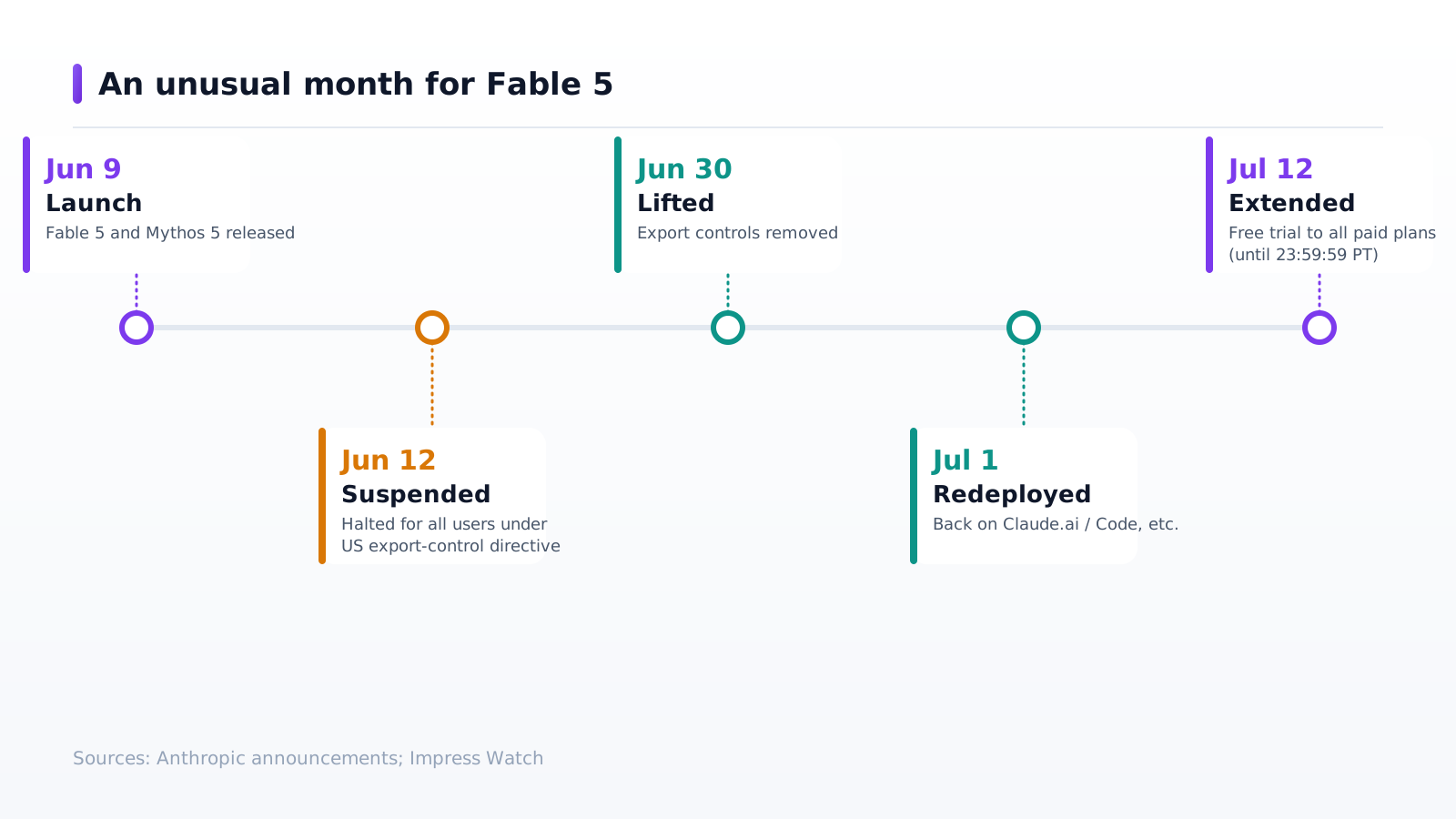
Figure 1: From launch to suspension, the lifting of export controls, redeployment, and the extended free trial — the unusual month Fable 5 went through.
Why Did Fable 5 Cause Such a Stir?
The biggest reason Fable 5 drew so much attention is that it is not merely an extension of the earlier Claude Opus line, but a model that brings Mythos-class capability down to general users. Claude Mythos 5 has the same capability as Fable 5, but it is a limited-availability model without safety classifiers, restricted to approved defensive-cybersecurity uses such as Project Glasswing. Fable 5, by contrast, is offered to the public — but in exchange, safety classifiers operate in high-risk domains such as cybersecurity, bio/chemical, and distillation, and it falls back to Claude Opus 4.8 when necessary. (Claude Platform, Anthropic)
This design — "strong, but cautiously stops where things get dangerous" — is exactly what Fable 5 symbolizes. Behind the US government's decision to suspend it was a report that an Amazon researcher had found a way to bypass Fable 5's safeguards, leading to the identification of software vulnerabilities and the generation of example exploit code. Anthropic subsequently introduced a new classifier and says it can block that technique in over 99% of cases — while acknowledging that a side effect may be more false positives even in ordinary coding and debugging. (Anthropic — redeployment)
In other words, Fable 5 is not just a high-performance chat AI. It is treated as "a frontier model right at the edge of what can be released to the public," and not only its performance but its very mode of availability carries significant meaning in the context of AI regulation, national security, and enterprise use. Both the AP and The Guardian reported this reinstatement as a concrete example of US government regulation of advanced AI models. (AP News, The Guardian)
The Basic Comparison: Fable 5 vs. Opus 4.8
Claude's official documentation frames it this way: when in doubt, use "Opus 4.8 for complex agentic coding and enterprise use," and "Fable 5" for workloads that demand the highest capability. Both models have a 1-million-token context window and up to 128k output, but Fable 5 costs twice as much as Opus 4.8 and has higher latency. (Claude Platform Docs — Models overview)
| Item | Claude Fable 5 | Claude Opus 4.8 |
|---|---|---|
| Positioning | Publicly available top-tier Mythos-class model | High-performance Opus model for enterprise and developers |
| Strengths | Long-horizon, complex, autonomous agentic work | Complex coding, practical work, knowledge work |
| API ID | claude-fable-5 | claude-opus-4-8 |
| Input price | $10 / 1M tokens | $5 / 1M tokens |
| Output price | $50 / 1M tokens | $25 / 1M tokens |
| Context | 1M tokens | 1M tokens |
| Max output | 128k tokens | 128k tokens |
| Adaptive thinking | Always on | Supported |
| Latency | Slower | Moderate |
| Safety-classifier fallback | Yes | Generally none |
| ZDR use | Requires 30-day retention; ZDR not available | ZDR available |
Especially important for business use: Fable 5 requires 30 days of data retention and cannot be used under a Zero Data Retention (ZDR) agreement. For organizations that require ZDR, Opus 4.8 is the more realistic choice. (Claude Platform Docs — Migration guide)
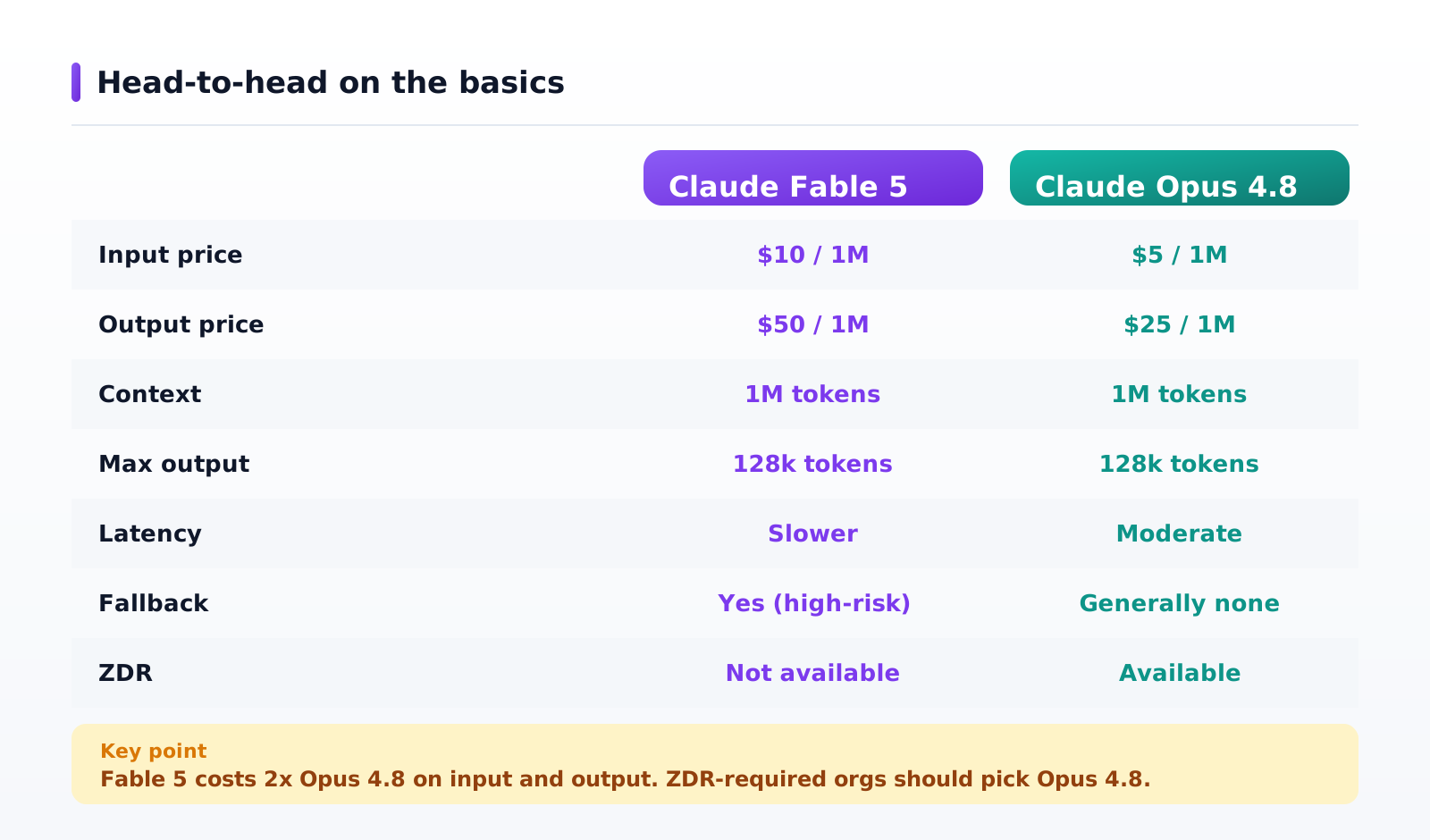
Figure 2: Head-to-head on the basics. Two points decide practical use: Fable 5 costs 2x Opus 4.8, and ZDR is not available.
On Benchmarks, Fable 5 Is Clearly Ahead
On performance, Fable 5 beats Opus 4.8 quite clearly. In Anthropic's public benchmarks, on SWE-Bench Pro, Fable/Mythos 5 scores 80.3% versus Opus 4.8's 69.2%. On the harder FrontierCode Diamond, Fable/Mythos 5 scores 29.3% versus Opus 4.8's 13.4% — a gap of more than 2x.
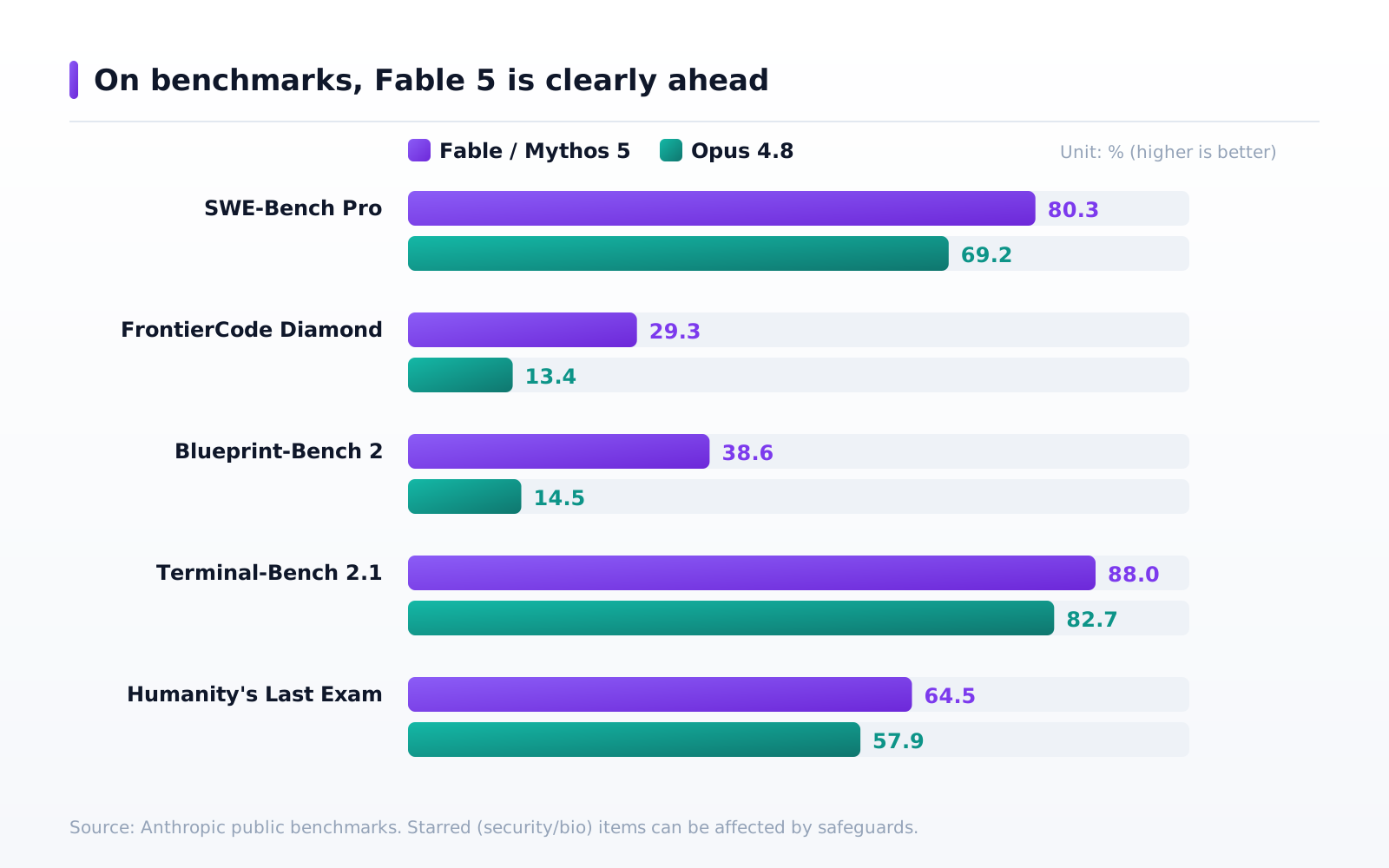
Figure 3: Fable/Mythos 5 vs Opus 4.8 on key benchmarks. The gap is largest on hard coding and spatial reasoning.
| Benchmark | Fable/Mythos 5 | Opus 4.8 | Reading |
|---|---|---|---|
| SWE-Bench Pro | 80.3% | 69.2% | Large lead in real code-fixing |
| FrontierCode Diamond | 29.3% | 13.4% | Over 2x on hard coding |
| GDPval-AA | 1932 | 1890 | Ahead on knowledge work too |
| GDP.pdf | 29.8% | 22.5% | Ahead on PDF/document understanding |
| Blueprint-Bench 2 | 38.6% | 14.5% | Big gap in spatial reasoning |
| OSWorld-Verified | 85.0% | 83.4% | Nearly even on PC operation |
| Legal Agent Benchmark | 13.3% | 10.4% | Ahead on legal agents too |
| Humanity's Last Exam with tools | 64.5% | 57.9% | Ahead on hard reasoning too |
| Terminal-Bench 2.1 | 88.0% | 82.7% | Ahead on terminal work too |
That said, Fable 5's benchmark table comes with a caveat. Anthropic explains that the score gap between Fable 5 and Mythos 5 is usually only about 1–3 points, but on the starred cybersecurity- and bio-related benchmarks, the influence of safety classifiers can make Fable 5 behave closer to Opus 4.8. In other words, the "underlying capability" is very high, yet in real use there are moments when the safeguards apply the brakes.
Is Opus 4.8 No Longer Needed?
The short answer: Opus 4.8 is still very important. Opus 4.8 was announced on May 28, 2026, improving on Opus 4.7 in coding, agentic work, reasoning, and practical knowledge work. Dynamic Workflows in Claude Code, Effort Control to tune the amount of effort, and a cheaper Fast Mode were introduced at the same time. (Anthropic — Opus 4.8)
Opus 4.8's strength is its balance of performance, price, and stability. Fable 5 is indeed strong, but its API price is twice Opus 4.8's on both input and output. For everyday code review, spec organization, documentation, adding tests, and general refactoring, Opus 4.8 is more than high enough in quality. For high-volume processing, Opus 4.8 is actually more cost-efficient. (Claude Platform Docs — Pricing)
Also, Fable 5 is designed to fall back to Opus 4.8 in high-risk domains. For tasks involving security, bio, chemistry, or model distillation, even if you choose Fable 5, the final response may end up equivalent to Opus 4.8. According to Anthropic, early data shows fallback did not occur in over 95% of Fable sessions — but any work touching those domains needs to account for this constraint.
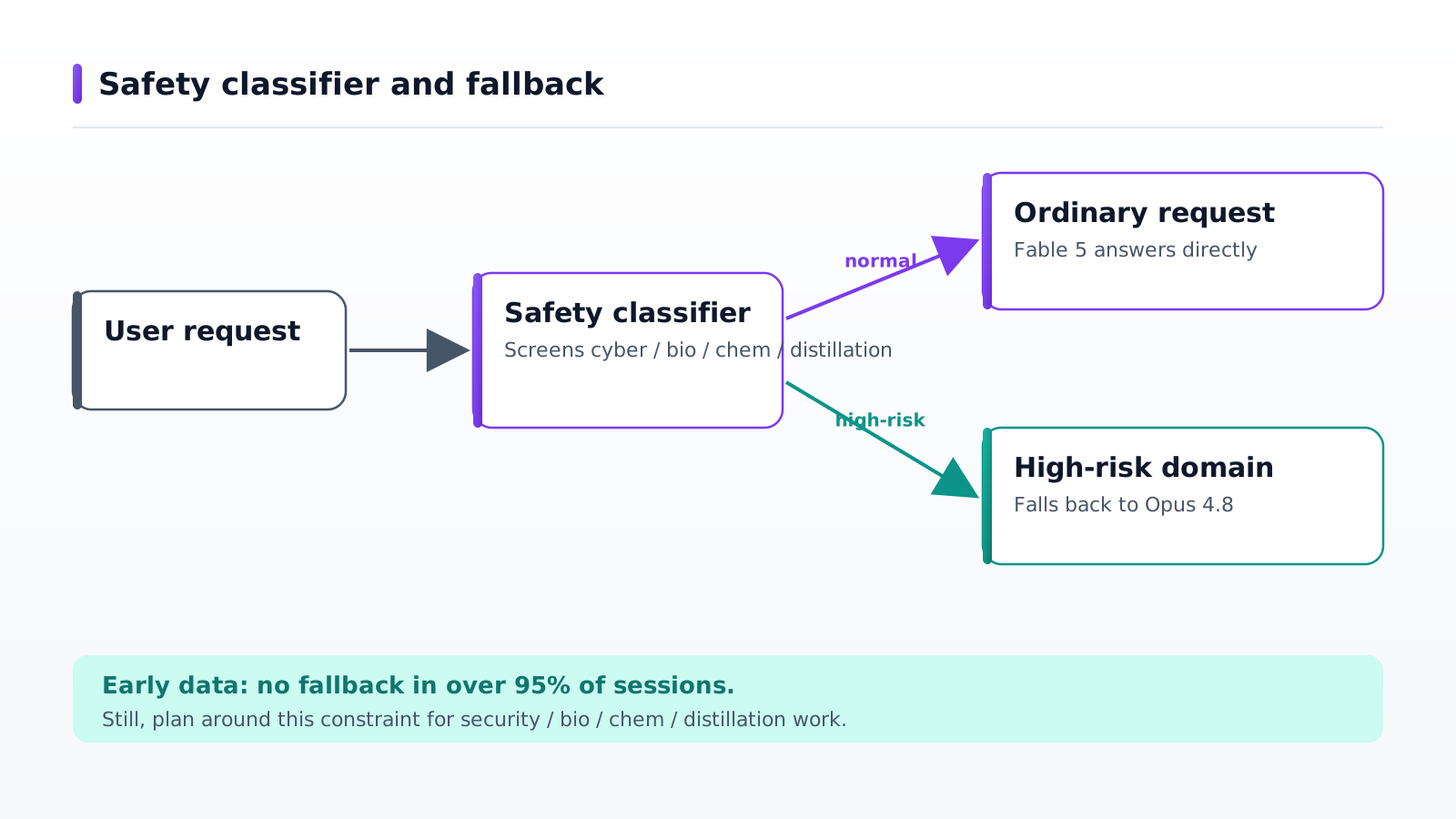
Figure 4: In high-risk domains the safety classifier engages and Fable 5 falls back to Opus 4.8 — though early data shows it does not trigger in over 95% of sessions.
Fable 5 Compared with GPT, Gemini, and Codex
In Anthropic's benchmark table, Fable/Mythos 5 is also compared with GPT-5.5 and Gemini 3.1 Pro. On SWE-Bench Pro, Fable/Mythos 5 scores 80.3%, GPT-5.5 58.6%, and Gemini 3.1 Pro 54.2%. On Humanity's Last Exam with tools, Fable/Mythos 5 scores 64.5%, GPT-5.5 52.2%, and Gemini 3.1 Pro 51.4%. On Terminal-Bench 2.1, Fable/Mythos 5 scores 88.0%, GPT-5.5 83.4% under the Codex CLI condition, and Gemini 3.1 Pro 70.7% under the Gemini CLI condition.
Looking at these numbers alone, Fable 5 is not merely "the strongest within Claude" — on public comparisons it sits quite strongly even against the top models from GPT and Gemini. The gap is largest not in one-shot Q&A, but in long procedures, tool use, whole-codebase understanding, and complex practical tasks. This symbolizes the shift from the old "AI that answers a prompt" to "AI you hand a whole job to."
On the other hand, for Grok and DeepSeek-family models, at least Anthropic's official comparison table does not list results under identical conditions. So in this article it is safest to keep Fable 5 and Opus 4.8 as the leads and limit the cross-comparison to GPT-5.5 and Gemini 3.1 Pro. Forcing every model into a single ranking invites misunderstanding due to differences in benchmark conditions and harnesses.
Which Should You Use?
You should use Fable 5 for long, complex tasks where the cost of failure and rework is large. Examples include migrating a large codebase, design changes spanning multiple services, deriving an implementation approach from ambiguous requirements, analysis that cuts across long documents, advanced legal/financial/research-leaning investigation, and composite judgments that include screenshots and PDFs. For such tasks, Fable 5's "ability to reach the finish line with fewer corrections" may deliver value that exceeds its 2x unit price.
You should use Opus 4.8 for the majority of everyday work. Code review, writing tests, reading existing code, drafting specifications, summarizing meeting notes, design consultation, and ordinary investigation and analysis are all high enough in quality with Opus 4.8. With half the price, manageable latency, and ZDR support, it can still be the mainstay model for enterprise use.
In practice, the most rational setup is to make Opus 4.8 your standard model for normal operation, and use Fable 5 as a premium model for breaking through the hard parts. Fable 5 is less an everyday model than one you deploy when "this one has to land on the first try" or "I want to hand off work that would take a human half a day to several days.
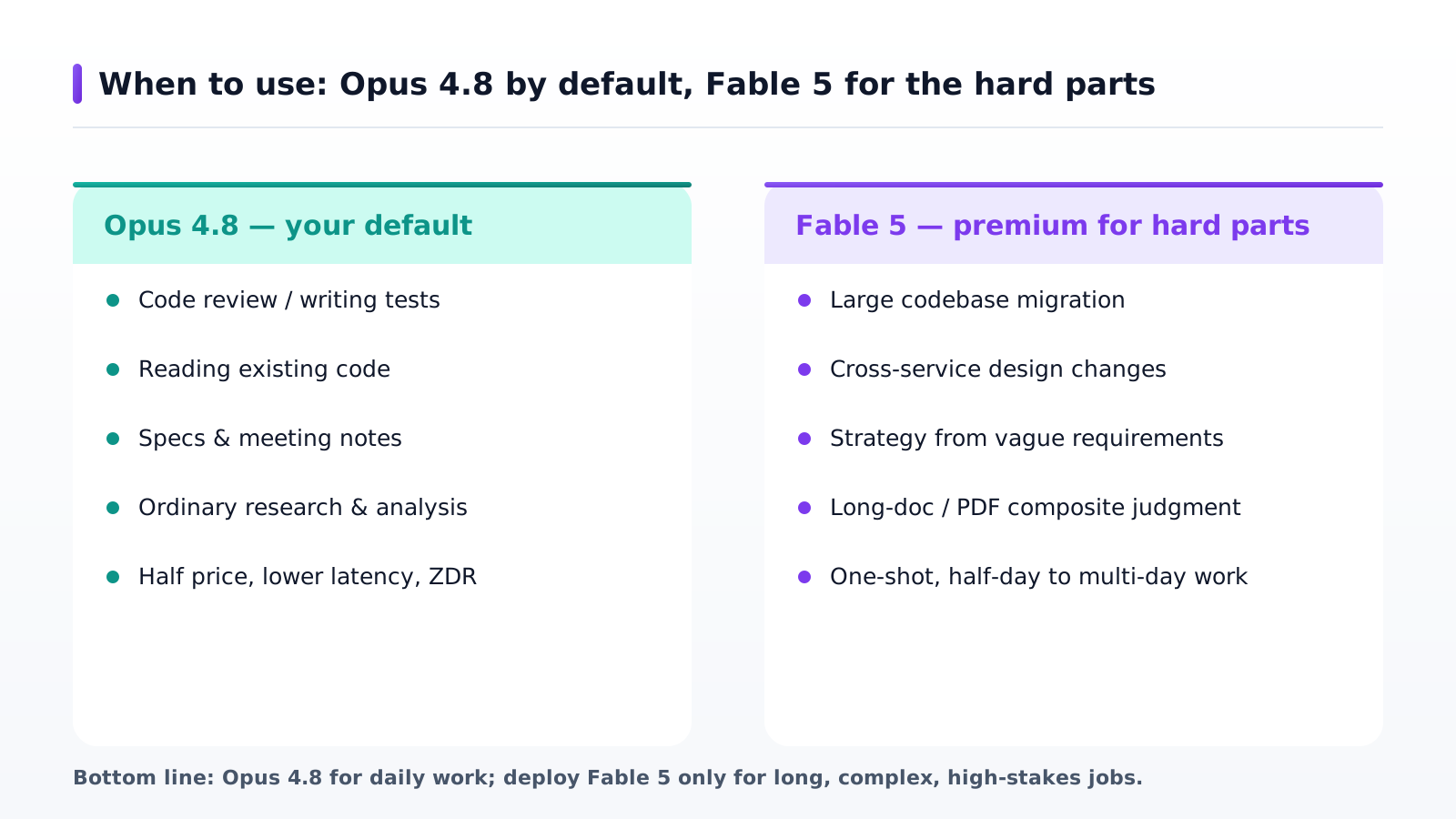
Figure 5: Make Opus 4.8 your default, and deploy Fable 5 only for the hard, high-stakes parts where rework is costly.
Conclusion
Claude Fable 5 is not simply the successor to Claude Opus 4.8. It brings the Mythos-class capability that sits above Opus to the general public, wrapped in safety classifiers. On benchmarks it clearly surpasses Opus 4.8, with the gap widening especially on long-horizon, high-difficulty, agentic work.
That said, Fable 5 is expensive, slow, requires 30-day data retention, and may hit fallbacks or refusals in high-risk domains. It is not a universal replacement. For everyday practical work, Opus 4.8 remains strong and more cost-efficient.
As of July 8, 2026, the conclusion is clear. Fable 5 is "the model you hand your hardest jobs to," and Opus 4.8 is "the top-class practical model you can use every day." Fable 5's arrival matters so much because it concretely demonstrates that AI is evolving from "a tool that answers" into "an agent entrusted with long-running work."
References (Mapped to Arguments)
- Claude Fable 5 and Claude Mythos 5 — Anthropic
- Statement on the US government directive to suspend access to Fable 5 and Mythos 5 — Anthropic
- Redeploying Claude Fable 5 — Anthropic
- Trial period for "Claude Fable 5" extended to July 12, 23:59:59, for all paid plans — Impress Watch
- Introducing Claude Fable 5 and Claude Mythos 5 — Claude Platform Docs
- Trump administration lifts restrictions on Anthropic AI models — AP News
- Anthropic says US has lifted export controls on Fable and Mythos AI models after security fears — The Guardian
- Models overview — Claude Platform Docs
- Migration guide — Claude Platform Docs
- Introducing Claude Opus 4.8 — Anthropic
- Pricing — Claude Platform Docs

NEW NOVEL 2026/08/01
Clouded Glass
Polishing is not about force.
Volume two of The World Became Slightly Farther Away.Five stories that can also be read as a starting point.
View on Amazon
Jijoden.com
Your life is worth writing.
There is a truer self you can tell only to AI.Gather fragments of memory into a single story.
Take a LookRelated Articles
Claude Opus 5 In-Depth Review: What Really Changed vs Opus 4.8, Fable 5, and GPT-5.6 Sol
A deep review of Claude Opus 5, released July 24, 2026, covering official system-card benchmarks, comparisons with Opus 4.8, Fable 5 and GPT-5.6 Sol, pricing, early user reports, practical usability, and safety.
GPT-5.6 Sol Explained: The Sol/Terra/Luna Tiers and When to Use Pro, Max and Ultra (as of July 2026)
A figure-rich breakdown of GPT-5.6, generally available since July 9 2026: the Sol/Terra/Luna tiers, the new reasoning controls, how Pro/Max/Ultra differ, a comparison with Claude Fable 5 and Opus 4.8, and where the new ChatGPT desktop app is still not unified. The point is how you allocate compute to the work, not always picking the top tier.
The Day AI Got Borders: Will Intelligence Be Export-Controlled?
A long-form essay on the suspension of Claude Fable 5 and Claude Mythos 5, model weights, export controls, cyber defense, technological sovereignty, and who should govern dangerous knowledge.
The OpenAI Trial and the Moment a Well-Intentioned Organization Becomes a Giant Company
A governance-focused analysis of the Musk-OpenAI lawsuit, nonprofit ideals, frontier AI capital demands, Anthropic, DeepSeek, Gemini, Copilot, and the institutional contradictions of AI companies.
Figma × Anthropic “Code to Canvas”: A New Roundtrip from Running UI to Editable Design
A primary-source-based analysis of Figma and Anthropic’s Code to Canvas: runtime UI capture mechanics, MCP strategy, continuity with HTML-to-Figma approaches, workflow impact, security governance, and what to watch next.