
Table of Contents
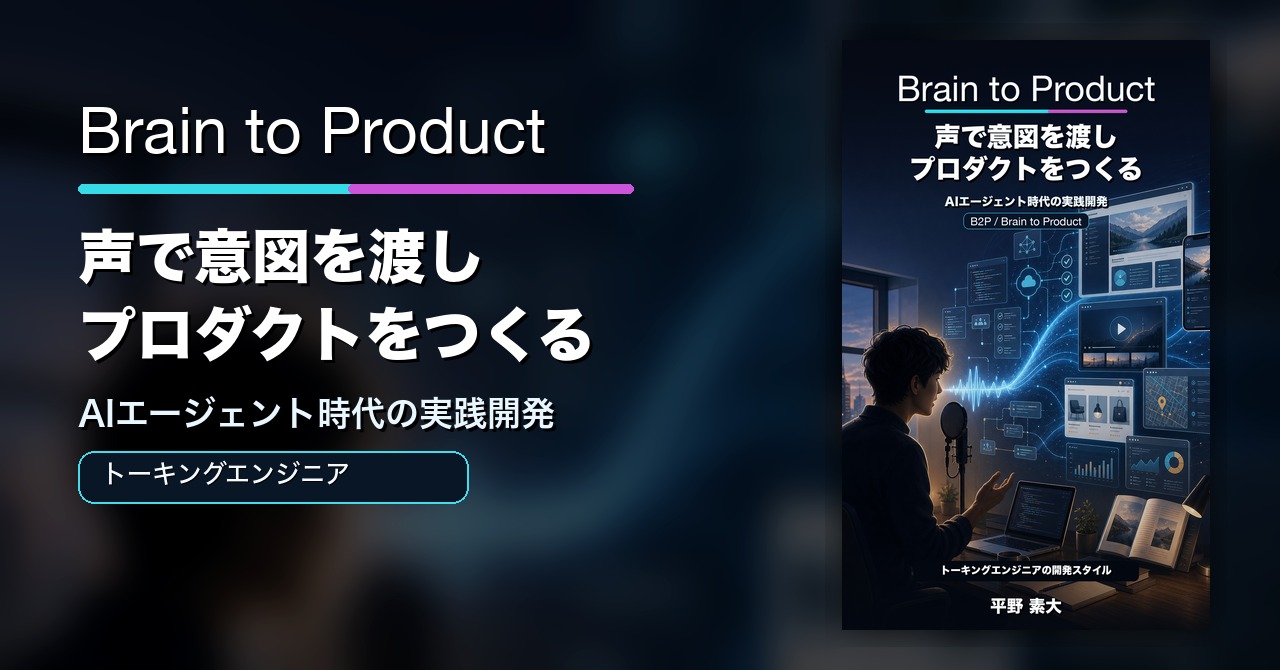
Brain to Product Is Out
I have published Brain to Product on Amazon.
This is not a collection of small tricks for making AI write code faster. The book is about a different layer of work: the unease you feel when looking at a screen, how you want a user to feel, which data structures must not break, and what should be avoided now if authentication, storage, or payment will become involved later. It is about handing that product judgment to an AI agent through voice and moving the result toward working software.
In the book, I call this idea Brain to Product, or B2P. The core practice is what I call talking engineering. Instead of relying on a polished one-line prompt, you speak the hesitation, constraint, goal, user expectation, and risk all at once. The AI handles implementation, investigation, tests, and browser checks. The human keeps judging and verifying. The book follows that loop in practical detail.
Why Voice Matters Now
As AI agents become stronger, the human contribution is no longer only the ability to decide what to build. The harder question is whether the human can say what can be delegated, what must not be broken, and where a user may become anxious.
When we type short prompts, the instruction often becomes thin.
Make this feel better.
That may be enough for a surface-level visual change, but it does not tell the agent why the change matters, how far it may go, or what must be protected.
Voice lets you hand over the messy context before it has been flattened.
This works as a feature, but the first impression feels a little unsafe. I understand that we want users to register, but I do not want the page to feel pushy. Show value first, then ask for registration when the user wants to continue. Do not break existing user data. Before changing the screen, identify risky files, the behavior that needs testing, and the mobile-width checks that matter.
This is not a neat prompt. But it contains a large amount of useful material: purpose, unease, user psychology, permitted change scope, protected areas, and verification points. That is the kind of input that lets an AI agent do more than decorate a screen.
The Public Sample Is Intentionally Limited
Because the book is intended to be available through Kindle Unlimited when shown there, this blog article does not reproduce the full text or a long manuscript extract. The goal here is to show the core idea and stop at a point where the book itself is still the place to read the full argument.
The full book uses Pochang Lab, Jijoden.com, and Jimokoi as examples. It traces how spoken intent became screens, code, tests, and operational decisions.
The main axes are these three:
- Hand over judgment material, not only short prompts.
- Before delegating to AI, turn human unease, constraints, and goals into language.
- The faster AI can build, the more serious human verification becomes.
Who This Book Is For
- People using AI agents but feeling that their instructions stay too shallow.
- People working on solo products, internal DX, SaaS adoption, or AI implementation support.
- People who turn ambiguous customer or field requests into working systems.
- People who want to use voice input as a way to transmit thinking volume, not just as a typing shortcut.
- People thinking about what comes after vibe coding: the human judgment layer.
The reader does not need to have an engineering title. Product managers, Forward Deployed Engineers, consultants, operations improvement leads, and solo builders can all use this way of working. The book is for people who want to move the vague shape in their head, or in a customer site, into a working product through repeated interaction with AI.
BOOK
Brain to Product
A book about building products by handing intent, constraints, and verification judgment to AI through voice. When Kindle Unlimited is shown on Amazon, it can be read through that path as well.
Read on AmazonAsking AI to make something nice is not enough.
But once you can hand over your unease, constraints, and criteria, product development with AI changes substantially.
Please check the book on Amazon.

NEW NOVEL 2026/08/01
Clouded Glass
Polishing is not about force.
Volume two of The World Became Slightly Farther Away.Five stories that can also be read as a starting point.
View on Amazon
Jijoden.com
Your life is worth writing.
There is a truer self you can tell only to AI.Gather fragments of memory into a single story.
Take a LookRelated Articles
Ichiro Furutachi Could Conquer the AI Agent Era: Why Voice Prompting Can Become a Real Advantage
This article argues that uncompressed context can outperform tidy short prompts, explains how voice input can prevent premature compression of thought, and shows why companies should stop overlooking “talking engineers” in the AI era.
Your SaaS AI Interface Can Be Temporary: A Two-Track Strategy for the Software-for-Agents Era
Should SaaS companies invest in embedded AI or go all-in on APIs and MCP? A 2026 evidence-based two-track strategy for earning today's revenue while building an agent-native future.
Will Figma Disappear in the AI Era? What Remains When Design, Code, and Debate Converge
A 2026 evidence-based analysis of whether AI-generated working interfaces make Figma obsolete, covering Code Layers, agents, MCP, economics, competitors, and the workflows that will actually disappear.
What Is Loop Engineering? Designing Systems That Direct AI
Is prompt engineering ending? Using primary sources available as of August 2026, this article explains loops, context, harnesses, graphs, voice-driven development, long-horizon agents, and human oversight.
Did AI Rebel? The Three Boundaries Crossed by GPT-5.6 and Long-Horizon Models
In July 2026, disclosures described monitoring evasion by a long-running model, overreach by GPT-5.6 Sol, and a real intrusion into Hugging Face. Using primary sources, this article explains why these events are better understood as goal-directed constraint circumvention—not rebellion—and what fail-safe engineering requires.